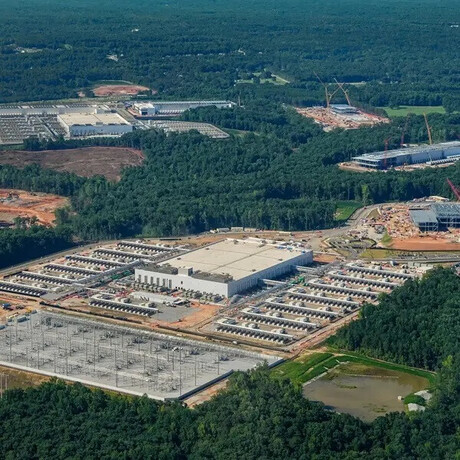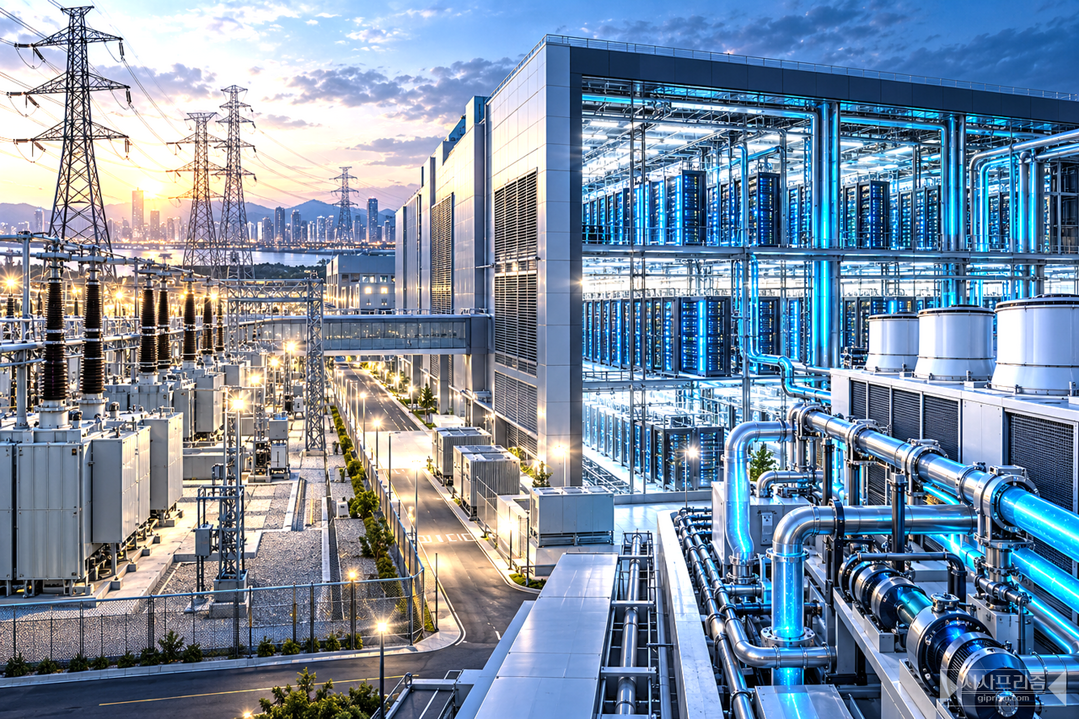
DUBLIN — On the western edge of Dublin, the Profile Park data center cluster sits on land that was once quiet farmland just a decade ago. Today, massive gray facilities line the roads, housing some of the world's most advanced digital infrastructure. Here, U.S.-based Vantage Data Centers is constructing two massive data centers complete with its own dedicated power plant. As grid constraints tighten across the region, data centers are rapidly transforming into self-sufficient, complex industrial facilities equipped with personal energy generation.
Last month, Dublin’s city center buzzed with delegates attending an international Artificial Intelligence summit. However, just outside the venue, local citizens gathered under the banner of "Angry Data Centers," holding signs that read, "Energy Vampires and Job Steakers Not Welcome." This striking contrast captures the bright and dark sides of Ireland’s rise as a global data center powerhouse.
The political fallout from the "data center drive" is also being felt globally. In the United States, public frustration over soaring electricity bills, water shortages, and environmental concerns shaped recent election outcomes, where several candidates advocating for stricter regulations and temporary halts on new data center construction secured key gubernatorial victories. Financial markets have similarly shuddered, with tech-heavy indices dipping amid growing regulatory anxiety.
In South Korea, a similar anti-data center sentiment is brewing. Securing grid connectivity and managing local opposition have become major bottlenecks for developers in the greater Seoul area. Although community consent is not a strict legal prerequisite, fierce local protests routinely delay permitting and construction. Yet, slowing down expansion is not an option: South Korea’s commercial data center capacity is projected to surge 2.7-fold from 836 megawatts (MW) last year to 2,270 MW by 2030, leaving a projected shortage of around 670 MW as AI and cloud demands accelerate even faster.
Ireland's Tech Boom Meets the Reality of a Power Crunch
Ireland, which has successfully positioned itself as Europe’s premier data center hub, is now confronting the paradox of its own success. With data centers consuming over a fifth of the nation’s total electricity, a genuine power shortage has materialized, making the coexistence of data centers and on-site power plants an increasingly common sight.
Driven by an English-speaking EU membership, low corporate tax rates, and a rich pool of IT talent, Ireland has successfully attracted European hubs for American tech giants. Companies like Microsoft began establishing data centers in the area as early as 2007, followed by Google in 2014, transforming West Dublin into a high-tech manufacturing and digital infrastructure district.
According to global consultancy KPMG, Ireland’s data center IT electrical capacity has expanded more than 15-fold since 2010, with hyperscale facilities accounting for 88% of total capacity. The economic dividends have been substantial: in 2024, the construction and operation of data centers generated an estimated €2.2 billion ($2.3 billion) in added value, supporting around 19,500 direct, indirect, and induced jobs.
However, this rapid growth has severely strained the national power grid. Over the past decade, data centers have accounted for roughly 77% of Ireland's total electricity consumption growth. Because new demand concentrated heavily around Dublin, the grid's carrying capacity reached its breaking point. EirGrid, the national grid operator, began effectively restricting new grid connections for Dublin-area data centers in late 2021, turning the very clustering that drove industrial growth into a bottleneck for future investment.
This bottleneck is unlikely to clear anytime soon. Data centers are projected to make up 31% of Ireland's total electricity demand by 2034. Consequently, the Commission for Regulation of Utilities (CRU) mandated that new data centers source at least 80% of their electricity from new renewable energy sources, shifting the responsibility of expanding generation capacity onto the operators themselves.
Experts note that Ireland's experience offers vital lessons for South Korea and other nations racing to expand AI infrastructure. While South Korea implemented a "Distributed Energy Activation Special Act" in 2024 to screen large-scale power consumers through grid impact assessments, it has yet to make renewable energy procurement or on-site power generation a mandatory prerequisite for grid access.
As Patrick Brody, a professor at University College Dublin (UCD), points out, building a data center economy comes with steep costs. Ultimately, deciding where and how these facilities are built must be anchored in public interest and long-term societal benefit.
[Copyright (c) Global Economic Times. All Rights Reserved.]