• 2026.11.01 (Sun)
  • All articles
  • LOGIN
  • JOIN
Global Economic Times
[등록] 2026-09-01 15:48:31
  • Synthesis
  • World
  • Business
  • Industry
  • ICT
  • Distribution Economy
  • Well+Being
    • Pet Life
    • Halal Horizon
  • Travel
  • Eco-News
  • Education
  • Korean Wave News
  • Opinion
  • Arts&Culture
  • Sports
  • People & Life
    • International Student Report
    • With Ambassador
  • Column
    • Cho Kijo Column
    • Cherry Garden Story
    • Ko Yong-chul Column
    • Kim Seul-Ong Column
    • Lee Yeon-sil Column
  • Photo News
  • New Book Guide
MENU
 
Home > World

US Army Conducts Rare Temporary Burial Drills to Prepare for Worst-Case Large-Scale War Scenarios

Ana Fernanda Reporter / Updated : 2026-11-01 10:53:00
  • -
  • +
  • Print


FORT BRAGG, N.C. — In a sobering acknowledgment of the realities of potential large-scale conflict, the U.S. Army recently conducted extensive temporary burial drills, practicing a grim procedure not widely exercised in decades: temporarily interring fallen soldiers when immediate evacuation is impossible.

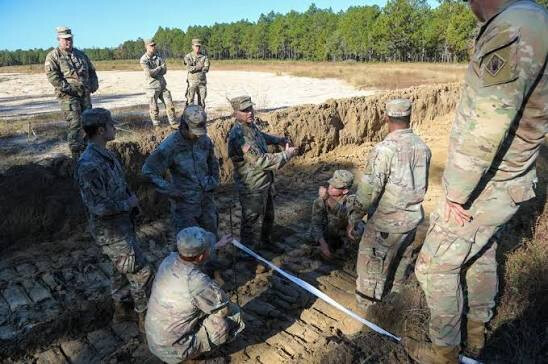
Code-named “Dragon Covenant,” the exercise took place at Fort Bragg, North Carolina, involving roughly 130 religious support personnel, including military chaplains, alongside engineering and mortuary affairs units. During the drill, participants used simulated remains—skeletal models and sealed water jugs—to test burial speeds, ground pressure resistance, and the structural preservation of remains.

Adapting Doctrine to Battlefield Realities

The exercise highlighted critical gaps in current military manuals. Initially, the doctrine mandated a 2.1-meter (7-foot) interval between burial trenches. However, engineers quickly realized that this space was too narrow for bulldozers to operate safely without risking driving over previously buried remains. Consequently, the spacing had to be widened to approximately 2.7 meters.

Speed is paramount in high-intensity combat. Military estimates suggest that an engineering company equipped with eight bulldozers and four excavators could temporarily bury up to 2,400 remains per day under continuous operation.

Balancing Logistics and Morale

The shift in training stems from a sobering realization: the rapid evacuation protocols that defined the past two decades of conflicts in Iraq and Afghanistan—backed by absolute U.S. air superiority—may not be feasible in a future large-scale war against a peer adversary.

While current joint directives prioritize immediate evacuation, temporary burial is authorized when safety hazards or a lack of transport assets prevent it. This creates a severe logistical dilemma: refrigerated trucks required to preserve remains must compete with the critical cooling needs of food and medicine for living troops.

Furthermore, with fewer than 400 active-duty mortuary affairs specialists across the U.S. Army, frontline combat units are being trained to form five-person recovery teams to handle and transport remains to collection points.

Honoring the Fallen Under Fire

Conducting mass temporary burials also transforms how the military honors the dead. With continuous round-the-clock burials and intensive combat operations, individual traditional funerals and formal identifications are often impossible. Chaplains during the drill focused on maintaining dignity, offering continuous prayers even as bulldozers filled the trenches. Army leadership also noted that psychological and physical support plans must be established to prevent burnout among religious support teams facing mass casualties.

The last time the U.S. Army executed large-scale temporary battlefield burials on this scale was during the Korean War, which later led to the massive repatriation effort known as "Operation Glory" in 1954.

The lessons learned from the Dragon Covenant exercise will be integrated into updated military field manuals, with follow-up integrated drills scheduled for next spring.

"Whether we can bring every soldier home with dignity depends entirely on how well we prepare before the worst-case scenario strikes," said Master Sgt. Delbert Luide, mortuary affairs supervisor for the 3rd Infantry Division Support Command.

[Copyright (c) Global Economic Times. All Rights Reserved.]

  • #Cherry Garden
  • #HalalFood
  • #Halal
  • #Petlife
  • #Halalhorizone
  • #Hormuz Impasse
  • #globaleconomictimes
  • #micorea
  • #mykor
Ana Fernanda Reporter

Popular articles

  • US Deploys Third Carrier and 10,000 Troops to Middle East Amid Rising Tensions with Iran

  • Henri Kagan and Kenso Soai Awarded the Nobel Prize in Chemistry

  • Stay in the U.S. Starting at $70K? "It Means Go Back to Your Country," Students Reeling from Shock

I like it
Share
  • Facebook
  • X
  • Kakaotalk
  • LINE
  • BAND
  • NAVER
  • https://globaleconomictimes.kr/article/1065577910020751 Copy URL copied.
Comments >

Comments 0

Weekly Hot Issue

  • Family of Chwimukheon Lee Young-sun Donates 456 Artworks to Inherit Calligraphy Culture
  • Hanchang EGM Celebrates 20th Anniversary with 45 Million Won Kimjang Donation for Vulnerable Communities
  • GBStyle Donates 3,000 Undergarments to Cheonan Welfare Foundation Company Growth Shared with the Local Community
  • Cheonan Samgeori Rice Cake Festival to Highlight Tradition and Local Flavor on Nov. 8
  • Cheonan Mayor Jang Gi-su Attends Smart City Expo in Spain to Explore AI Urban Solutions
  • Gangwon State Holds Paper Competition to Shape Future of Coal Industry Transition Regions

Most Viewed

1
Why Can't We Use 'Muse' in Korea?… Zuckerberg Says, "Due to a Lack of Data Centers"
2
US Big Tech Shakes Up Korean Semiconductor Industry as Giants Eye Chinese Memory Alternatives
3
Hyundai Motor and Kia Recruit for AI-Focused "Softeer Bootcamp"
4
Hyundai and Kia Accelerate European Push with Compact Cars to Outrun Chinese Rivalry
5
Hollys Suffers Personal Information Leak… "Please Change Your Membership Password Immediately"
체리가든 스토리
nutri huevos
로타리
동포저널

Hot Issue

South Korea on Track for Historic $1 Trillion Export Milestone, Ranking 4th Globally

Alphabet Shares Plummet by $500B on Mixed Earnings and AI Spending Surge; Analysts View the Dip as a Buying Opportunity

US Midterm Elections Complicate Trade Calculus... Persistent Uncertainty Over Tariffs and Investment

Fashion Runway Show 2026

Let’s recycle the old blankets in Jeju Island’s closet instead of incinerating them.

Global Economic Times
korocamia@naver.com
CEO : LEE YEON-SIL
Publisher : KO YONG-CHUL
Registration number : Seoul, A55681
Registration Date : 2024-10-24
Youth Protection Manager: KO YONG-CHUL
Singapore Headquarters
5A Woodlands Road #11-34 The Tennery. S'677728
Korean Branch
Phone : +82(0)10 4724 5264
#304, 6 Nonhyeon-ro 111-gil, Gangnam-gu, Seoul
Copyright © Global Economic Times All Rights Reserved
  • 향기네무료급식
  • APEC2025
  • 반달곰 프로젝트
Search
Category
  • All articles
  • Synthesis
  • World
  • Business
  • Industry
  • ICT
  • Distribution Economy
  • Well+Being 
    • 전체
    • Pet Life
    • Halal Horizon
  • Travel
  • Eco-News
  • Education
  • Korean Wave News
  • Opinion
  • Arts&Culture
  • Sports
  • People & Life 
    • 전체
    • International Student Report
    • With Ambassador
  • Column 
    • 전체
    • Cho Kijo Column
    • Cherry Garden Story
    • Ko Yong-chul Column
    • Kim Seul-Ong Column
    • Lee Yeon-sil Column
  • Photo News
  • New Book Guide
  • Overseas Koreans
  • Multicultural News