![[등록] 2026-09-01 15:48:31](/support/_updata/banner2/tl181982910_6749.png)


- LG Deploys Hundreds of 'CLOiD' Robots to Secure 100,000 Hours of Training Data Using Physical AI
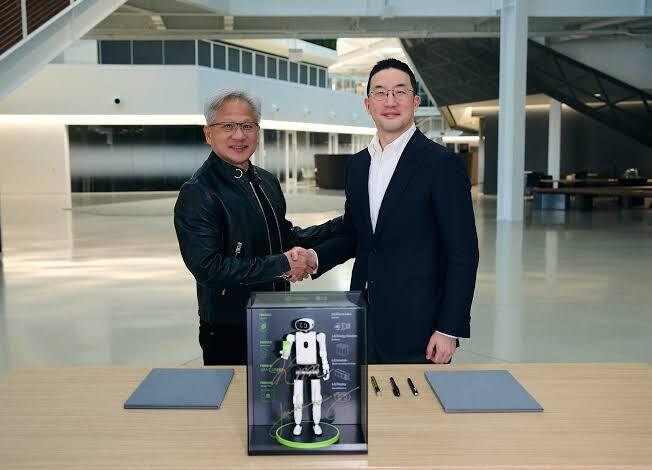
LG Electronics and NVIDIA are rapidly accelerating their joint robotics initiatives. Madison Huang, Senior Director of Omniverse and Robotics Product Marketing at NVIDIA and eldest daughter of NVIDIA CEO Jensen Huang, visited LG Electronics' Yangjae Data Factory in Seocho-gu, Seoul. This high-profile visit came just four days after the two tech giants signed a landmark Memorandum of Understanding (MOU) on robot business cooperation.
Under this partnership, the companies plan to deploy hundreds of LG's proprietary "CLOiD" robots into the Yangjae facility. By leveraging NVIDIA's cutting-edge physical AI technologies, they aim to accumulate a massive total of 100,000 hours of learning data—equivalent to 12 years of operational experience—by the end of the year.
Rapid Execution Following High-Level MOU
The high-level meeting brought together key leadership figures, including LG Electronics CEO William Cho, LG CNS CEO Hyun Shin-gyun, and LG Science Park President Jung Soo-heon, alongside Huang and other NVIDIA executives. Industry watchers have expressed intense interest in LG's Yangjae R&D campus, which is currently undergoing a massive transformation into a dedicated "Data Factory."
Spanning four floors from the basement to the third floor with a gross floor area of 10,000 square meters, the facility is designed to serve as a comprehensive hub where robots learn, validate, and refine diverse tasks. LG Electronics is ramping up operations with the goal of achieving full capacity within the year, deploying hundreds of CLOiD robots to handle data generation, collection, and machine learning tasks simultaneously.
Simulating Real-World Environments for Data Superiority
The Data Factory mirrors complex real-world settings to test robotic versatility. In spaces designed to resemble residential homes, robots practice cleaning operations. In simulated manufacturing environments modeled after LG’s Tennessee washing machine plant, robots execute heavy-duty tasks such as component transport, material loading, and precise assembly. Additional specialized zones have been set up for LG CNS logistics automation solutions and LG Innotek's robotic hand manipulation training.
The collected operational data is integrated seamlessly with NVIDIA’s advanced robotics software stack. The workflow utilizes NVIDIA's Omniverse libraries, Cosmos open-world models, and Isaac open robotics development platforms. Through this infrastructure, LG aims to establish a robust "data virtuous cycle" where high-quality data is repeatedly processed to continuously elevate robot performance.
By combining real-world data with augmented and synthetic virtual datasets, the cumulative training data is projected to reach 100,000 hours by year-end. LG Electronics plans to utilize these insights to advance its Robot Foundation Models (RFM), significantly sharpening its competitive edge in the humanoid robotics market.
Global Industry Impact and Future Outlook
During her tour of the facility, Huang left an encouraging autograph reading "AMAZING LG" on an LG CLOiD robot. Following the inspection, she described her encounter with LG's technological capabilities as "Incredible," giving it an enthusiastic thumbs-up.
LG Electronics has designated this year as the breakout year for its robotics business. The company recently established a dedicated Robotics Business Center directly under the CEO and bolstered its ecosystem by acquiring "Kinisi," a startup specializing in physical AI and real-time perception technology, during the first half of the year.
By expanding its product portfolio from industrial and commercial applications to domestic home robotics, and by combining core components like actuators with deep data analytics, LG Electronics is positioning itself as a comprehensive total robotics solutions provider. Through "One LG" synergy across group affiliates and strategic global alliances with pioneers like NVIDIA, the company is firmly securing its leadership in the era of physical AI.
[Copyright (c) Global Economic Times. All Rights Reserved.]