• 2026.08.01 (Sat)
  • All articles
  • LOGIN
  • JOIN
Global Economic Times
fashionrunwayshow2026
  • Synthesis
  • World
  • Business
  • Industry
  • ICT
  • Distribution Economy
  • Well+Being
  • Travel
  • Eco-News
  • Education
  • Korean Wave News
  • Opinion
  • Arts&Culture
  • Sports
  • People & Life
    • International Student Report
    • With Ambassador
  • Column
    • Cho Kijo Column
    • Cherry Garden Story
    • Ko Yong-chul Column
    • Kim Seul-Ong Column
    • Lee Yeon-sil Column
  • Photo News
  • New Book Guide
MENU
 
Home > Distribution Economy

Slight Relief: Domestic Fuel Prices Drop for 11th Consecutive Week as Gasoline and Diesel Hover in 1,800-Won Range

Kim Young Min Reporter / Updated : 2026-08-01 08:04:25
  • -
  • +
  • Print


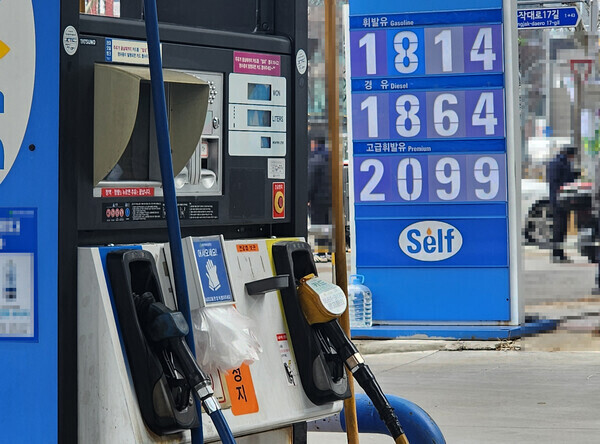
South Korean motorists and logistics providers are experiencing a modest measure of financial reprieve as retail gasoline and diesel prices across the nation registered their eleventh consecutive weekly decline. The downward trend, driven primarily by easing international crude prices and reduced geopolitical supply anxieties, offers welcome stabilization to domestic energy markets.

According to comprehensive market data released on Saturday, August 1, by Opinet, the oil price information portal operated by the state-run Korea National Oil Corporation (KNOC), average pump prices for gasoline during the fifth week of July (July 26 to 30) fell by 3.3 won from the previous week to land at 1,869.1 won per liter. Simultaneously, retail diesel prices recorded a similar downward movement, dropping by 4.1 won per liter to average 1,852.8 won.

Regional Disparities and Brand Variances

A granular examination of the regional data reveals subtle structural price differences across South Korea's urban centers and provinces. Seoul maintained its status as the most expensive market in the nation, with gasoline averaging 1,910.1 won per liter. Nevertheless, even the capital city participated in the nationwide cooling trend, posting a 1.2 won decline compared to the preceding week. Conversely, the industrial hub of Ulsan posted the lowest retail gasoline prices in the country, averaging 1,843.8 won per liter after a week-on-week reduction of 1.6 won.

Pricing dynamics also displayed noticeable variation among major retail service station brands. GS Caltex recorded the highest average retail price for gasoline at 1,873.3 won per liter. On the opposite end of the spectrum, budget-oriented "Altteul" (Thrifty) gas stations provided the most competitive pricing, offering gasoline at an average of 1,861.3 won per liter, highlighting the cost-saving opportunities available to price-sensitive consumers.

Global Crude Trends and Geopolitical Catalysts

The sustained decline in South Korea's domestic petroleum products is directly correlated with shifting sentiment in international crude oil markets, where supply anxiety has gradually receded. Market analysts attribute the global price correction to a temporary de-escalation of military tension between the United States and Iran, coupled with ongoing multinational security initiatives led by Saudi Arabia to safeguard maritime navigation routes in the Red Sea.

Reflecting these broader geopolitical dynamics, Dubai crude—the primary price benchmark for South Korea's oil imports—plunged by $7.2 from the previous week to settle at $80.7 per barrel. Similarly, international refined gasoline prices dropped by $2.9 to $115.9 per barrel, while automotive diesel fell by $2.0 to $158.0 per barrel.

Because changes in international crude and refined petroleum prices typically manifest at domestic gas stations with a lag of two to three weeks, industry experts project that South Korean fuel prices will likely maintain their stable to slightly downward trajectory over the coming weeks.

Government Price Caps and Policy Measures

To buffer end-consumers and vulnerable logistics operators from severe market volatility, the South Korean government continues to enforce its statutory maximum price ceiling system on essential petroleum products. On July 25, authorities rolled over the 8th Price Cap Order, keeping maximum allowable retail thresholds unchanged.

Under this regulatory framework, official price ceilings remain pegged at 1,784 won per liter for gasoline, 1,773 won per liter for diesel, and 1,380 won per liter for kerosene. As global supply chains stabilize, policy makers remain vigilant to ensure that international market relief is swiftly and fairly passed on to Korean households.

[Copyright (c) Global Economic Times. All Rights Reserved.]

  • #ormuz Impasse
  • #globaleconomictimes
  • #micorea
  • #mykorea
  • #nammidonganews
  • #singaporenewsk
  • #Samsung
  • #Daewoo
  • #Hyosu
Kim Young Min Reporter

Popular articles

  • 'The Jae-Chul Ryu Magic': LG Electronics Hits New Milestones in Q2 Performance

  • Hyundai Motor Group to Acquire 100% Stake in Boston Dynamics, Accelerating Humanoid and Physical AI Commercialization

  • Google Unveils ‘Full-Stack AI’ Strategy to Accelerate AI Transformation for South Korean Enterprises

I like it
Share
  • Facebook
  • X
  • Kakaotalk
  • LINE
  • BAND
  • NAVER
  • https://globaleconomictimes.kr/article/1065567802398796 Copy URL copied.
Comments >

Comments 0

Weekly Hot Issue

  • Wall Street Pauses Semiconductor Rally as Hyperscalers Surge: What It Means for Samsung Electronics and SK Hynix
  • The Hidden Kitchen Hazard: Why Washing Raw Chicken Could Cause a Food Poisoning Disaster
  • ‘From Brain to Intestines’: Deadly 40°C Heatwaves Threaten Vital Organs Across South Korea
  • “The World Cup Is Not For Sale”: UEFA Issues Ultimatum to FIFA Over Private Equity Stake Proposal
  • Samsung Electronics Posts Record Quarter on AI Memory Boom, Warns Shortages Will Persist in H2
  • U.S. Army Tests Maritime 'Hammer of the Gods' Electronic Warfare System

Most Viewed

1
South Korea to Tighten Rules on Single-Stock Leveraged Products; Minimum Deposit Raised to 30 Million Won
2
KCCI Jeju Forum Opens: Chairman Chey Tae-won Urges Businesses to Catch the AI Wave Before It Becomes an Insurmountable Wall
3
OpenAI Rebounds in Secondary Market as Valuation Surges 20% in Three Months
4
AI Drones Take to the Skies in Revolutionary Hunt for Mosquitoes
5
Hyundai Motor Group to Acquire 100% Stake in Boston Dynamics, Accelerating Humanoid and Physical AI Commercialization
광고문의
임시1
임시3
임시2

Hot Issue

President Lee Jae-myung Arrives in Argentina, Marking First South Korean Presidential Visit in 22 Years

Amazon's Zoox Wins Historic U.S. Approval for Driverless Robotaxis Without Steering Wheels or Pedals

South Korea and Chile Reaffirm Strategic Alliance with Modernized FTA and Critical Minerals Partnership

Chinese OTA Giant Trip.com Dethrones Local Leaders Yanolja and Yeogi Eottae to Take No. 1 Spot in South Korea

Fashion Runway Show 2026

Global Economic Times
korocamia@naver.com
CEO : LEE YEON-SIL
Publisher : KO YONG-CHUL
Registration number : Seoul, A55681
Registration Date : 2024-10-24
Youth Protection Manager: KO YONG-CHUL
Singapore Headquarters
5A Woodlands Road #11-34 The Tennery. S'677728
Korean Branch
Phone : +82(0)10 4724 5264
#304, 6 Nonhyeon-ro 111-gil, Gangnam-gu, Seoul
Copyright © Global Economic Times All Rights Reserved
  • 향기네무료급식
  • BCB부천방송
  • 반달곰 프로젝트
Search
Category
  • All articles
  • Synthesis
  • World
  • Business
  • Industry
  • ICT
  • Distribution Economy
  • Well+Being
  • Travel
  • Eco-News
  • Education
  • Korean Wave News
  • Opinion
  • Arts&Culture
  • Sports
  • People & Life 
    • 전체
    • International Student Report
    • With Ambassador
  • Column 
    • 전체
    • Cho Kijo Column
    • Cherry Garden Story
    • Ko Yong-chul Column
    • Kim Seul-Ong Column
    • Lee Yeon-sil Column
  • Photo News
  • New Book Guide
  • Multicultural News
  • Jobs & Workers