![[등록] 2026-09-01 15:48:31](/support/_updata/banner2/tl181982910_6749.png)


(C) NPR
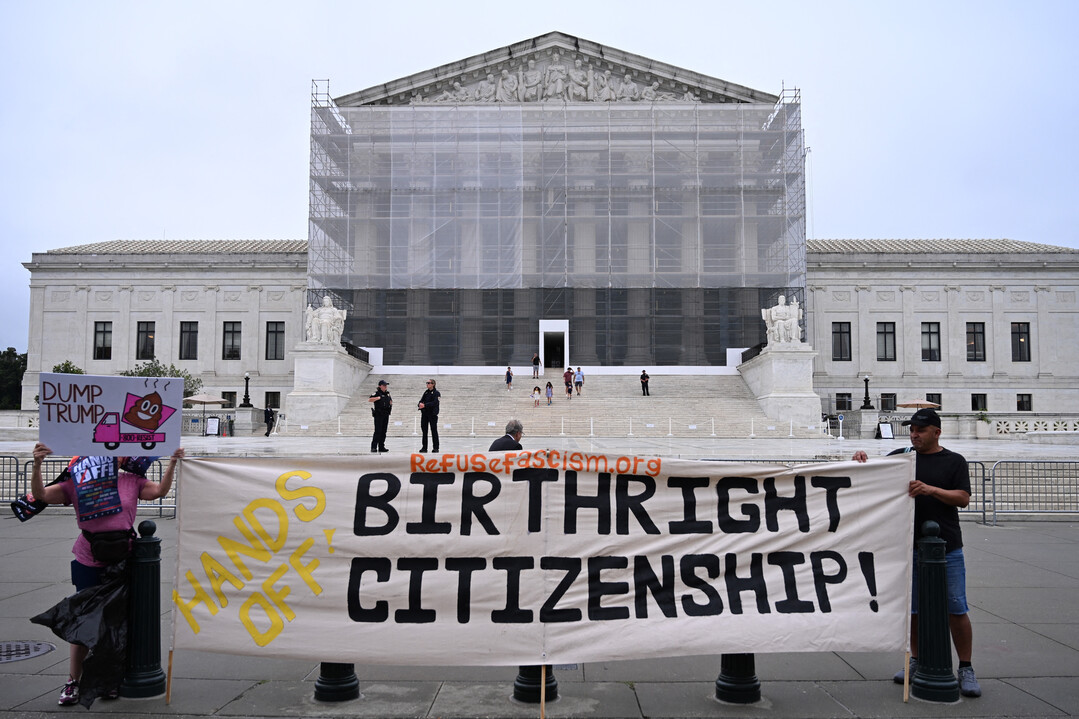
(WASHINGTON, D.C.) The United States Supreme Court has agreed to hear arguments regarding the constitutionality of the Donald Trump administration's policy aimed at restricting birthright citizenship.
On December 5th (local time), the Supreme Court announced it would review the legal validity of President Trump's executive order, which seeks to limit birthright citizenship for children born in the United States to parents who are either residing illegally or temporarily staying without permanent residency (green cards), as reported by the Associated Press and other media outlets.
President Trump signed the executive order immediately after his inauguration on January 20th. In response, 22 states led by Democratic governors, along with Washington D.C., filed a lawsuit arguing the executive order violates the 14th Amendment of the Constitution.
Lower courts in some states subsequently issued decisions to suspend the executive order's effect, which was applied nationwide, affecting both the plaintiffs and the entire nation.
However, in June, the Supreme Court sided with the administration, ruling that lower courts could not issue nationwide injunctions to halt federal government policies.
The situation reversed again in July when the New Hampshire Federal Court accepted a class action suit filed by the American Civil Liberties Union (ACLU) and issued a preliminary injunction that temporarily suspended the nationwide effect of the executive order.
The Federal Court of Appeals also ruled the birthright citizenship restriction policy unconstitutional that same month. Consequently, the Trump administration requested the Supreme Court to expedite the review of the case.
With the Supreme Court's decision to hear the case, arguments are expected to be held in the spring of next year, with a final ruling anticipated in the early summer, according to AP.
The 14th Amendment of the US Constitution explicitly states that "All persons born or naturalized in the United States and subject to the jurisdiction thereof, are citizens of the United States and of the State wherein they reside."
Under this principle, the US has historically granted automatic citizenship to nearly all children born on American soil, including those born to parents who are either illegally or temporarily residing in the country.
The Trump administration's policy to restrict birthright citizenship fundamentally challenges this long-standing principle, making the Supreme Court's upcoming decision highly anticipated. The current Federal Supreme Court maintains a conservative majority, with six of the nine justices considered to be conservative.
[Copyright (c) Global Economic Times. All Rights Reserved.]