![[등록] 2026-09-01 15:48:31](/support/_updata/banner2/tl181982910_6749.png)


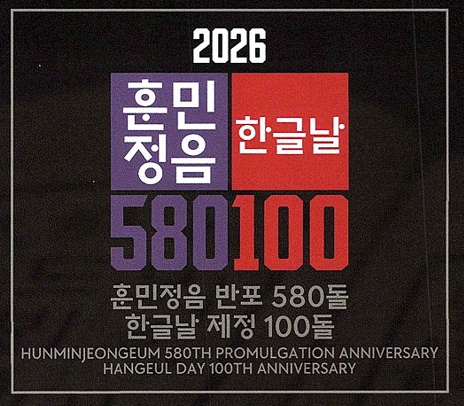
2026 feels inexplicably fluttering. In the 49 years I have walked alongside Hangeul since my high school days in 1977, I have never seen a time when so many layers of meaning overlapped in a single year. The 580th anniversary of the promulgation of Hunminjeongeum, the 100th anniversary of the establishment of Hangeul Day, the 150th anniversary of Ju Si-gyeong’s birth, the 100th anniversary of the creation of Hunmaengjeongeum (Hangeul Braille), and the 70th anniversary of the King Sejong Memorial Society—these five streams converge into one river in 2026. This is not merely a year of commemoration; it is a grand turning point in the history of Hangeul civilization.
The Light from 580 Years Ago: The Promulgation of Hunminjeongeum
King Sejong’s release of Hunminjeongeum to the world in early September (lunar calendar) of 1446 was an unprecedented event in the history of human writing. Despite having earned three doctoral degrees and reading the Hunminjeongeum Haeryebon (The Explanatory Edition) countless times, I find new enlightenment with every reading. Recently, through the use of Magnetic Resonance Imaging (MRI) technology to film vocal organs, it was confirmed that the position of the tongue and the shape of the lips described by Sejong align startlingly well with modern phonetic observations. It was a moment where the science of 580 years ago was proven by 21st-century cutting-edge technology. This 580th anniversary is the time to announce to the world once more that this script is not just an old heritage, but a scientific creation that transcends time.
The Resonance of 100 Years: The Establishment of Hangeul Day
In 1926, the Joseon Language Research Society (today’s Hangeul Society) designated the 29th day of the 9th lunar month as "Gagya Day." This was a fierce act of resistance to protect the spirit of the nation under the shadows of the Japanese colonial period. Hangeul Day is not a simple public holiday. It is a blood-boiling declaration by our predecessors that "our words and our script are the very life of our nation." As we reach the 100th anniversary in 2026, we must inherit this spirit but also take a step further. We must ensure that Hangeul Day does not remain a holiday for Korea alone, but becomes a global cultural heritage day that celebrates the scientific nature and the creative spirit of the script.
Ju Si-gyeong, Teacher of the Nation: 150th Anniversary of His Birth
Had it not been for Master Ju Si-gyeong (1876–1914), the Hangeul we know today would not exist. If Sejong created Hangeul, Ju Si-gyeong saved it. The very name "Hangeul" originated from his spirit, and the disciples he raised—Kim Du-bong, Choi Hyeon-bae, and Lee Geuk-ro—established the modern Korean language system by creating the Unified Orthography and compiling dictionaries. On the 150th birthday of a man who left such a massive legacy during his short thirty-eight years of life, we must show the proper respect due to the father of Korean linguistics.
Light in the Darkness: 100 Years of Hunmaengjeongeum
In 1926, Master Songam Park Du-seong introduced the Hangeul Braille system, Hunmaengjeongeum, to the world. If Hunminjeongeum was the script that brightened the dark mouths of the people, Hunmaengjeongeum is the script that brightened the dark eyes of the visually impaired. This Braille system, which inherits the name of Hunminjeongeum, is the most faithful fruition of Sejong’s creative philosophy: "to make it easy for everyone to learn and convenient for daily use." Across 480 years, Sejong’s will blossomed once again. The 100th anniversary of Hunmaengjeongeum reminds us that the essence of the Hangeul spirit is the universal right to communication.
Roots of 70 Years: The King Sejong Memorial Society
Founded in 1956, the King Sejong Memorial Society has spent 70 years researching and honoring the spirit of Sejong. As a solid foundation for academic research and cultural projects, the 70-year journey of this institution is the history of the Sejong promotion movement and the Hangeul cultural movement itself.
Five Streams, One Great River
The convergence of these five celebrations in one year is not a coincidence, but rather a providence of history. The promulgation by Sejong (1446) → The modern systematization by Ju Si-gyeong (1876~) → The national institutionalization of Hangeul Day (1926) → The creation of Hunmaengjeongeum (1926) → The cultural succession by the King Sejong Memorial Society (1956)—all these flows are connected by a single spirit. What is that spirit? It is the intent to open the path of communication for as many people as possible, in the most scientific way, and in the easiest manner.
I have pursued this spirit throughout my life, writing 126 books (72 co-authored) and 147 research papers related to Hangeul. In 2026, under the banner of "Hangeul 580100," we must weave all these meanings together and share them with the world. Hangeul is not a treasure for Koreans alone, but an intellectual heritage to be shared by all of humanity. It is time for the seeds sown by Sejong 580 years ago, the trees nurtured by Ju Si-gyeong and Park Du-seong 100 years ago, and the forest fenced by the Memorial Society 70 years ago to become a vast forest of Hangeul civilization reaching out to the entire world.
We must not let 2026, the year these five Hangeul celebrations meet, simply slip away. This is not just a celebration; it is a mission.

(Kim Seul-ong Director of the Sejong Korean Language Culture Institute, Adjunct Professor at Hankuk University of Foreign Studies Graduate School, Ph.D. in Hunminjeongeum Studies)
[Copyright (c) Global Economic Times. All Rights Reserved.]