![[등록] 2026-09-01 15:48:31](/support/_updata/banner2/tl181982910_6749.png)


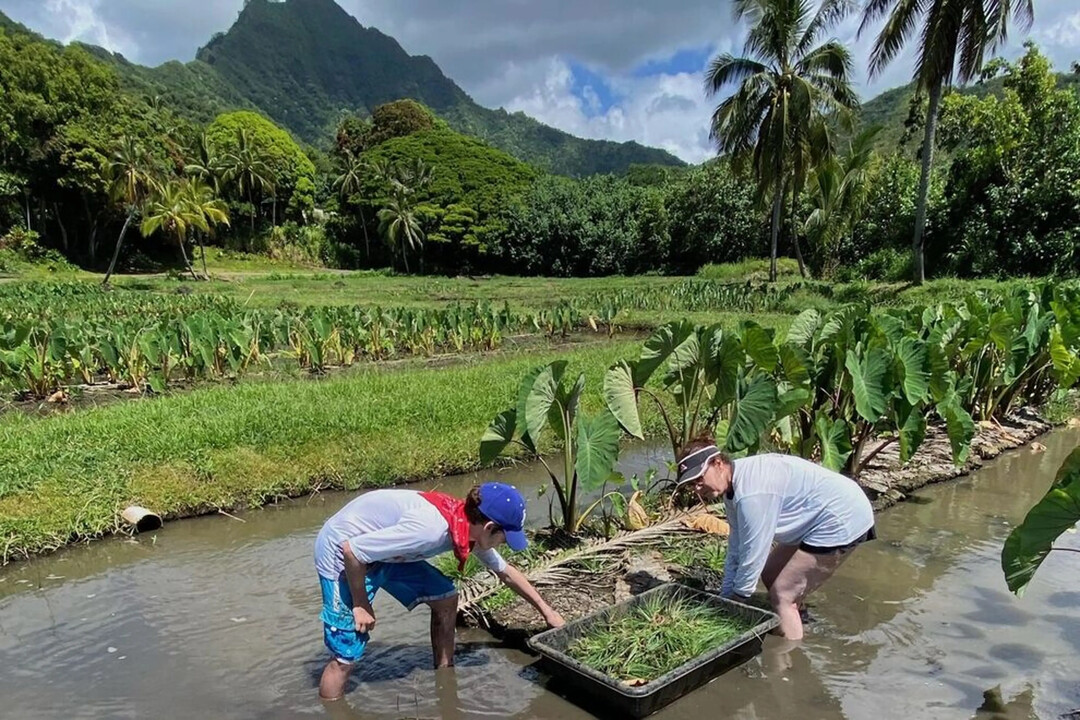
Kaina Makua, a Native Hawaiian farmer who planned to quadruple the production of kalo (taro), a traditional crop in Hawaii, expected to receive $470,000 in subsidies from the federal government this year. Kalo is an important crop used to make poi, a pounded, sticky purple staple food. However, in January, he learned that he would not receive these funds.
Hawaii relies on imports for 90% of its food, making federal government support essential for local farmers like Makua to strengthen the islands' food security. According to state researchers, to be self-sufficient in the event of a disaster, the self-sufficiency rate of major crops such as kalo, 'ulu (breadfruit), and 'uala (sweet potato) must be increased to at least 50%.
Local farmers play a crucial role not only in alleviating food insecurity, which affects one-third of all households in Hawaii, but also in supplying these major crops and other agricultural products to food banks and schools.
However, following the Trump administration, funding under the Inflation Reduction Act has been suspended, and budgets for other U.S. Department of Agriculture (USDA) programs have been cut. According to the Oahu Resource Conservation & Development Council, approximately $90 million in funds for Hawaii and Pacific region farms and food system-related organizations have been frozen or cut.
Kaina Makua, holding kalo at his farm in Makaweli Valley, Kauai, said he has now entered "survival mode." He is reducing production and is uncertain how to make up for the lost funds.
Over the past 15 years, Makua has developed his family farm on Kauai into Aloha Aina Poi Company, a cultural center that mentors young farmers and provides after-school programs teaching children about Hawaiian farming practices and traditions.
"This effort to grow these native crop systems and try to bring everyone back to native foods has been an uphill battle," Makua lamented. "There has been a lot of progress and positive change, but once again, we are disappointed."
Brian Miyamoto, executive director of the Hawaii Farm Bureau Federation, said there is significant confusion among local farmers about what has been frozen and what has not. For example, the Environmental Quality Incentives Program, which provides technical and financial assistance to agricultural producers, is currently secure. However, without clear answers on whether the federal funding freeze is permanent or if there will be additional budget cuts, farmers are struggling to figure out their next steps. The USDA did not respond to a request for comment.
"Organizations whose funding has been frozen or where continued support is uncertain will have to make business decisions such as reducing staff or scaling back services," Miyamoto worried.
Over the past decade, Native Hawaiian farming practices and food systems have gained momentum as the state government set a goal to increase local food production to 20-30% of consumption by 2030. However, this progress is now at risk.
"We may not achieve the agricultural goals we have been working towards for years," Miyamoto emphasized. "In the case of cultural crops, instead of an increasing trend in production, we may see a decrease due to the uncertainty of federal funding. There is so much uncertainty."
Uncertain Future for Native Food Production
Before the arrival of Western civilization, Native Hawaiians relied on fishing and staple crops such as kalo, 'ulu, and 'uala for sustenance. In the mid-1800s, European and American businessmen gained enough influence on the islands to purchase land and convert it into sugar and pineapple plantations. As these industries declined in the 1950s, much of Hawaii's farmland was paved over for tourism development. By the 1960s, only half of Hawaii's agricultural products were grown locally.
According to the USDA's 2022 Census of Agriculture, there are approximately 6,500 farmers in Hawaii, and an increasing number of them are Native Hawaiian agricultural practitioners like Makua who are revitalizing traditional food systems and cultivating the land.
One way local farmers have expanded their influence and built power over the past decade is by uniting through food hubs and cooperatives. By consolidating their harvests, farmers have been able to secure state government contracts to supply food to schools and food banks. However, due to federal budget cuts, it is uncertain whether they will be able to fulfill these contracts.
At the Hawaii 'Ulu Cooperative, more than 150 farmers bring their 'ulu harvests to be frozen or processed into various products such as flour and pancake mix, which are then sold to local schools, hospitals, and retailers. The cooperative had hoped to increase 'ulu production to one million pounds by 2030, but the USDA has frozen grants that provide direct payments and technical assistance to farmers. A $6 million grant for farmers over three years is also currently tied up due to the funding freeze.
"Most of the funding for farmers was about expansion," said Dana Shapiro, co-founder and CEO of the cooperative. "Most farmers have put their expansion plans on hold, which is a huge setback for those who have been preparing their fields. Everything grows so quickly in Hawaii that if you don't plant immediately, all that effort goes to waste."
The cooperative was also a supplier for the USDA's Local Food for Schools program, which recently had its budget cut. "The federal budget cuts to these programs will have a significant impact not only on the cooperative and our farmers but also on the children and underserved families in the community who have been receiving fresh, healthy, local produce," Shapiro worried.
Miyamoto and other local agricultural leaders held meetings with their congressional delegation, the USDA, and other agencies in Washington D.C. last week. While they received clear answers about the continuation of some programs, such as the Environmental Quality Incentives Program, they did not for others. He is continuing to ask the state legislature for funding to make up for the federal losses but knows it will be an uphill battle given the many areas needing funds.
Meanwhile, Makua is considering his next steps. "If this is the road to success, it's going to be a resilient one, and the people who grow through our program will be at least that much more resilient," he said. "But we might pivot. We don't know yet. We'll know in the summer."
[Copyright (c) Global Economic Times. All Rights Reserved.]