


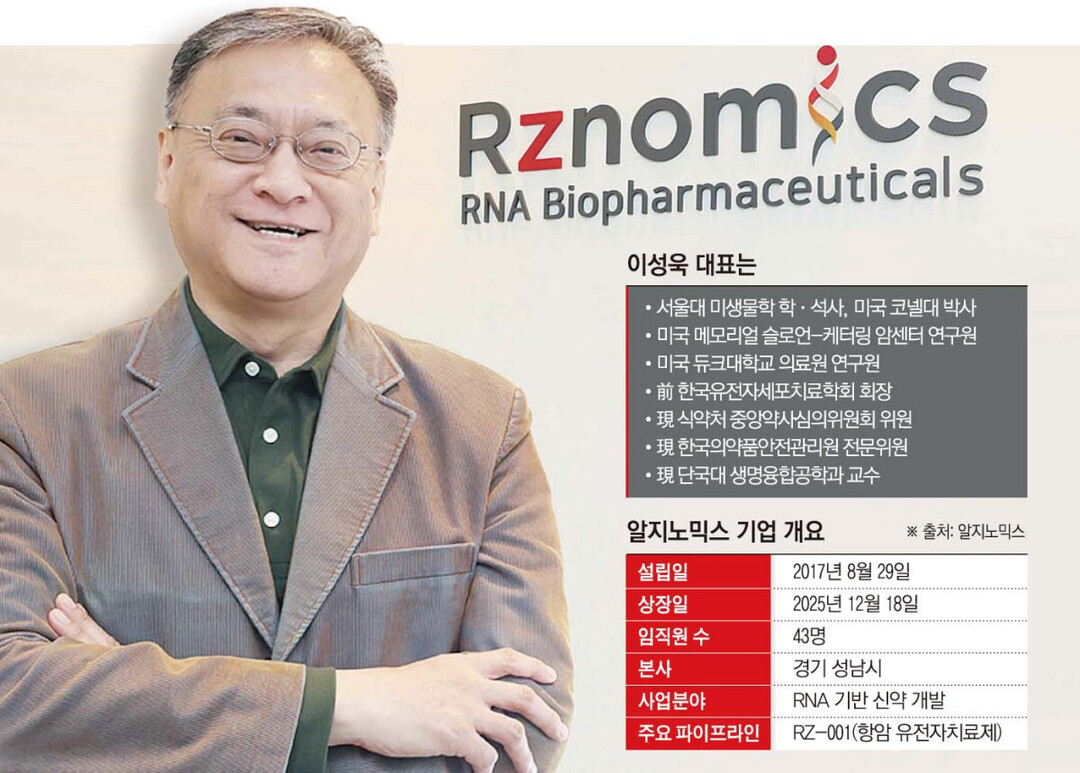
SEOUL — South Korean biotech firm Rznomics is approaching a pivotal moment in its partnership with pharmaceutical giant Eli Lilly, as it prepares to finalize its first drug candidate under a deal valued at up to $1.334 billion (1.9 trillion KRW). While the company anticipates converting this milestone into a formal license agreement by year-end, recent terminations of other Eli Lilly collaborations have cast a shadow of caution over the market.
Signed in May of last year, the multi-target agreement tasks Rznomics with utilizing its proprietary RNA trans-splicing ribozyme platform to identify drug candidates for targets specified by Eli Lilly. Under the arrangement, Lilly retains the option to take over preclinical, clinical, and commercial development. The deal structure allows Rznomics to receive upfront fees and milestones per target, with room to expand the partnership's scope as new targets are added.
Currently, the two companies are focusing on a therapy for hereditary hearing loss. According to Rznomics, the program has reached the final candidate selection phase, bolstered by regular consultations with Lilly’s research team. Financially, the collaboration has already outpaced early expectations; Rznomics collected four research payments from Lilly this year, bringing its cumulative third-quarter revenue to 1.6 billion KRW—surpassing its pre-IPO annual projection of 950 million KRW.
To deepen ties with its U.S. partner, Rznomics plans to open a research facility at Lilly Gateway Labs in San Diego by early next year, following a lease agreement signed in August. The company, which held 38.6 billion KRW in cash reserves at the end of Q3, is also considering additional fundraising to support ongoing R&D recruitment.
Despite steady operational progress, investors remain wary, reflected in Rznomics' stock price. After peaking at 122,625 KRW in March following its December IPO, shares have tumbled over 80%, trading at 21,250 KRW on the 19th even after a brief boost from its inclusion in the KOSDAQ 150 index.
Market skepticism stems largely from Eli Lilly’s recent string of scrapped partnerships:
Peptron: Earlier last month, Lilly concluded a two-year evaluation of South Korean firm Peptron’s long-acting drug delivery technology without moving forward to a commercial contract, triggering a sharp sell-off in Peptron shares.
Foghorn Therapeutics: In the same month, Lilly and U.S.-based Foghorn Therapeutics terminated their broader oncology collaboration after disappointing Phase 1 clinical data for their lung cancer candidate, FHD-909, forcing Foghorn to cut roughly 40% of its staff.
Rznomics maintains confidence in its platform's viability, pointing to clean safety profiles in ongoing Phase 1/2a trials for its lead internal asset, RZ-001, which targets glioblastoma and liver cancer. Beyond the Lilly deal, the company is actively pursuing global partnering opportunities and Material Transfer Agreements (MTAs) for its broader pipeline—including Alzheimer's candidate RZ-003 and retinitis pigmentosa therapy RZ-004—though it has yet to finalize any standalone intellectual property (IP) licensing deals from its portfolio of 36 registered patents.
[Copyright (c) Global Economic Times. All Rights Reserved.]