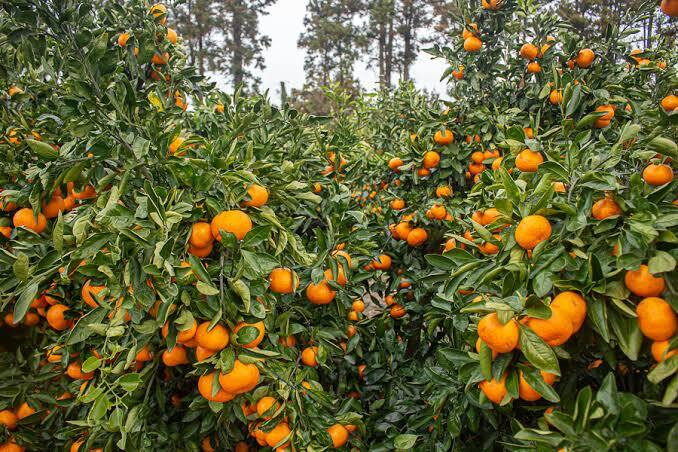
JEJU, South Korea — Long celebrated as South Korea’s premier citrus paradise, Jeju Island is undergoing a dramatic agricultural transformation. Driven by steadily climbing temperatures and extreme weather patterns, local farmers and researchers are increasingly trading traditional tangerine orchards for exotic subtropical produce—ranging from Mexican jicama to hand-peeled snack pineapples and massive jackfruits.
Data released on November 23 by provincial authorities and the Rural Development Administration underscores this rapid shift. Jeju’s subtropical fruit cultivation has more than doubled over the last decade and a half, expanding from 41 hectares in 2010 to 87 hectares across 232 farms this year. The island now accounts for nearly 40 percent of South Korea’s entire subtropical fruit acreage.
While mangoes currently monopolize roughly three-quarters (64.8 hectares) of Jeju's subtropical farmland, the Jeju Agricultural Research and Extension Services (JARES) is working aggressively to diversify the island's crop portfolio and reduce reliance on a single fruit.
Among the most promising newcomers is jicama, a crunchy, root vegetable native to Latin America often dubbed the "Mexican potato." Following open-field trials conducted between May and October on the island's eastern coast, researchers found that strategic spacing and manual flower removal boosted average root weights by over 54 percent to more than a kilogram, achieving a high commercial-grade yield of nearly 69 percent.
Fruit growers are also eyeing snack pineapples—a novel variety engineered to be pulled apart segment-by-segment with bare hands. Trial harvests of the "Daenong No. 4" cultivar yielded sweet, 14.6-Brix fruits projected to generate 15.14 million won ($11,000) per 1,000 square meters—outperforming standard domestic pineapples by 23 percent. Commercial rollout is slated for 2028. Simultaneously, agricultural scientists are evaluating the viability of jackfruit, an Indian native capable of growing up to 30 kilograms, alongside Mediterranean staples like olives.
To help farmers transition without massive infrastructure investments, JARES is also breeding dwarf banana trees. Unlike conventional varieties that tower up to five meters high and demand costly heating, these compact plants stay under 2.3 meters, allowing growers to repurpose existing tangerine greenhouses. Nine elite strains have already been isolated ahead of a planned 2028 commercial launch.
This agricultural pivot is less a choice than a necessity dictated by climate data. According to regional meteorologists, Jeju’s five warmest years on record have all occurred within the last half-decade, peaking at an unprecedented annual average of 17.8°C in 2024. While warmer weather opens doors for tropical species, it threatens Jeju’s signature tangerines by disrupting skin coloration and causing fruit splitting.
To cushion farmers against these climate shocks, local lawmakers are stepping in. A newly proposed provincial ordinance championed by Councilor Kang Bong-jik aims to formally designate climate-adaptive and subtropical crops as strategic income sources, unlocking systematic funding and technical support for Jeju’s evolving farms.
[Copyright (c) Global Economic Times. All Rights Reserved.]