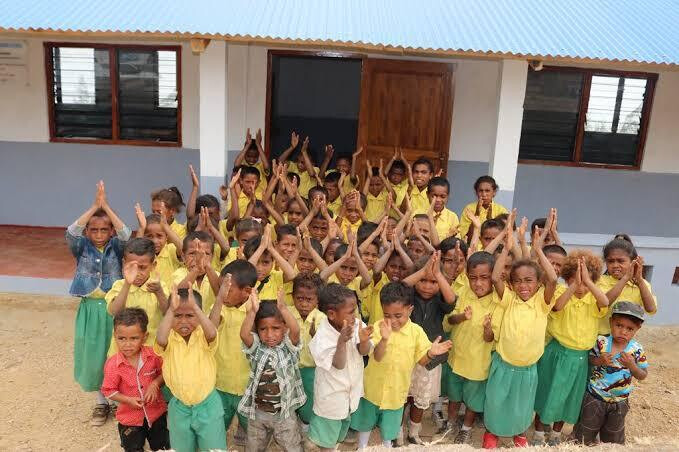
On October 15, the government of Timor-Leste decided to suspend in-person classes at schools nationwide. The decision came as smoke from wildfires in a neighboring country drifted across the border, blanketing the sky. Not only elementary, middle, and high schools, but also early childhood education institutions such as kindergartens closed their doors. The climate crisis has not only threatened children's health but also disrupted their learning. Particularly for young children, this went beyond a mere interruption of education, halting opportunities for safe care, play, and everyday social interaction.
In fact, the climate crisis is having a widespread impact on children worldwide. According to UNICEF’s 2026 Children’s Climate Risk Report, approximately 1.1 billion children globally are simultaneously exposed to three or more overlapping climate hazards. However, the severity of these risks and the capacity to cope with them vary depending on region, household income, and disability status. Young children, who are in a period of rapid physical and brain development, are especially vulnerable to environmental hazards such as heatwaves and air pollution. If access to proper care and learning opportunities is cut off by climate disasters during this critical stage, it can have long-term adverse effects on their development.
What, then, should early childhood education look like in the era of the climate crisis? First, environments must be created where children can learn and grow safely. Additionally, children should be supported in understanding a changing environment, confronting disaster situations, and recovering their daily routines. Isn't it the role of education to simultaneously protect young children from the climate crisis and build their own capacity to respond?
Similar perspectives were recently discussed at the Asia-Pacific Regional Network for Early Childhood (ARNEC) learning forum held in Jakarta. Voices emerged calling for moving beyond viewing young children merely as vulnerable victims of the climate crisis, and instead empowering them to adapt to change and contribute to community resilience. While young children cannot be burdened with the responsibility of solving the climate crisis, they must be given a foundation to grow healthily through early experiences of connecting with nature and learning how to cope with risks.
For example, in early childhood education settings in New Zealand, children learn to understand their surrounding environment and coexist with it through exploring local streams, engaging in nature-caring play, social-emotional learning, and psychosocial support. In Queensland, Australia—a region prone to disasters such as cyclones—the "Birdie’s Tree" program uses storybooks, play, and teacher training to help young children understand climate disasters, express resulting emotions, and learn self-soothing techniques through breathing and physical movement. Both examples show that early childhood education can foster relationships with nature while building emotional resilience to respond to disasters.
Educational facilities and care systems must also be strengthened to counter climate risks. Building educational facilities in flood-prone areas or placing teachers and children in classrooms without guidelines for heatwaves and air pollution risks leaving children unprotected despite ongoing education. Ultimately, alongside educational programs, efforts must be made to closely assess regional climate risks and child vulnerabilities, reflecting them in school infrastructure and disaster response systems. ChildFund Korea’s initiative in the ger districts of Ulaanbaatar, Mongolia—establishing four kindergartens equipped with air purifiers and eco-friendly heating systems, while supporting child development, emotional well-being, and teacher capacity for air quality management—is part of this approach. It represents an effort to create safe learning spaces beyond simply expanding facilities.
Furthermore, for this approach to be sustainable, changes at the national policy level must follow. Facing the threat of rising sea levels, the Marshall Islands in the Pacific explicitly stated the importance of early childhood development in its 2025 Nationally Determined Contributions (NDCs) submitted to the United Nations, pledging to integrate it across government policies and projects. Early childhood education must also be treated as a vital component of climate crisis response policies. Structures need to be established to identify high-risk areas and vulnerable children, prioritizing the allocation of resources for safe educational facilities, care systems, and disaster-response education.
It is our responsibility to protect children from the climate crisis and support them to adapt and grow in a changed environment. Depending on the environments and the opportunities for care and learning young children receive, the resilience of our future society will differ. We must now recognize children not merely as passive recipients of protection, but as active agents capable of learning, participating, and driving positive change. It is hoped that our society places young children not at the periphery, but at the very core of climate action, making their development and participation a key priority in both education and policy.
[Copyright (c) Global Economic Times. All Rights Reserved.]