![[등록] 2026-09-01 15:48:31](/support/_updata/banner2/tl181982910_6749.png)


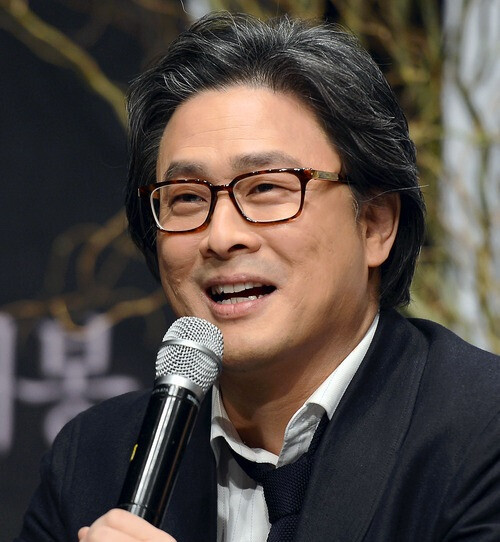
Renowned South Korean filmmaker Park Chan-wook recently captivated audiences at the Seoul International Book Fair, articulating his profound admiration for Han Kang's novel, "Human Acts," and expressing a keen interest in bringing it to the silver screen. "That work immediately struck me as eminently suitable for a film adaptation," Park remarked, "Upon reading just the first chapter, I was convinced of its exceptional quality. It truly is a masterpiece."
The director's declaration came during a "Meeting with the Author" event at COEX in Gangnam, Seoul, where he appeared alongside esteemed literary critic Shin Hyeong-cheol. The event drew an overwhelming crowd, eager to hear Park discuss his meticulous adaptation process and approaches to character development, themes central to the lecture titled 'Director Park Chan-wook's Reliable Corner.' "Human Acts" (translated into English by Deborah Smith) delves into the harrowing events of the 1980 Gwangju Uprising, depicting the brutal suppression of a mass demonstration and its lasting impact on the lives of those affected, particularly through the poignant narrative of a middle-school student searching for a friend amidst the chaos.
Beyond "Human Acts," Park Chan-wook unveiled a list of other cherished Korean literary works he harbors a desire to adapt, albeit acknowledging the significant challenges involved. "While the likelihood of these projects materializing is low, they represent a cherished hope," he stated. Among these are Park Gyeong-ri's monumental saga "Toji" (The Land), Lee Mun-gu's "Kwanchon Supil," and Shin Kyung-sook's "The Isolated Room." He also conveyed a particular aspiration to interpret Kim Hoon's "The Sword Sings" and "Namhansanseong" through his distinctive cinematic lens. Park articulated a wish to mirror Kim Hoon's precise, austere, and unsentimental prose in his visual storytelling, a stylistic endeavor he conceded might face considerable investment hurdles.
Park Chan-wook consistently champions the intrinsic power of original literary works, emphasizing their role as fertile ground for cinematic inspiration. He posits that compelling characters and narratives within books often ignite his directorial vision. Reflecting on his career, he noted that despite crafting numerous films since "Joint Security Area (JSA)" (2000), none have achieved its commercial triumph. He attributed JSA's success to the potent material provided by Park Sang-yeon's novel "DMZ," which served as its source. Park explained that by adhering faithfully to the original's core framework, he was able to meticulously portray the complex friendship between North and South Korean soldiers within the unique confines of the Joint Security Area, a heavily fortified strip of land that divides the Korean Peninsula and the only place where soldiers from both sides stand face-to-face. The film, widely considered Park's breakthrough, earned critical acclaim and multiple awards, cementing his reputation.
His recent acclaimed film, "Decision to Leave" (2022), though not a direct adaptation, illustrates his flexible approach to literary inspiration. The film originated from his fascination with the character of Martin Beck from the Swedish "Beck" detective novel series. Park revealed that his initial concept—a detective falling in love with a suspect—evolved significantly during the writing process, ultimately diverging from its initial literary prompt and saving the need for copyright acquisition.
Earlier in his career, Park famously adapted Garon Tsuchiya and Nobuaki Minegishi's Japanese manga "Old Boy" (2003). The film garnered international recognition, including the Grand Prix at the 57th Cannes Film Festival, for its visceral tale of a man inexplicably imprisoned for a decade seeking vengeance upon his release. For "Thirst" (2009), Park radically reinterpreted Émile Zola's 19th-century novel "Thérèse Raquin," transforming the classic French naturalistic tale of illicit love and murder into a modern vampire horror film. This audacious adaptation showcased his ability to fuse disparate genres and narratives. His 2016 masterpiece, "The Handmaiden," another celebrated adaptation, transposed Sarah Waters' Victorian-era novel "Fingersmith" to 1930s colonial Korea. Co-written with Jeong Seo-kyeong, the film masterfully wove themes of colonialism, class, gender, and female liberation into Waters' original intricate plot of deception and romance, demonstrating Park's skill in recontextualizing foreign narratives for a Korean setting. He revealed that the film's direction was clear to him after reading two-thirds of the novel, with the specifics hammered out in collaboration with Jeong.
Park Chan-wook's deep engagement with literature dates back to his childhood. He recounted being profoundly moved by John le Carré's "The Spy Who Came in from the Cold" and feeling a strong connection to Émile Zola's prose, musing that if he were a novelist, he would aspire to such a style. More recently, he expressed admiration for W.G. Sebald's "Austerlitz," describing it as an "enchanting" and "fascinating read." He further illustrated his creative process by noting that underlined sentences in his books—such as a seemingly innocuous line from "Thérèse Raquin" about the Pont Neuf corridor—often serve as unexpected wellsprings of cinematic ideas.
The director concluded by drawing an evocative analogy between adapting an original work into a film and embarking on a meticulously planned journey. Just as even a pre-arranged trip can veer into unforeseen detours, he suggested, the filmmaking process, even when guided by a source text, frequently leads to unexpected destinations, yielding results vastly different from initial expectations. This perspective underscores Park Chan-wook's unique blend of meticulous planning and open-ended artistic exploration in his celebrated cinematic endeavors.
[Copyright (c) Global Economic Times. All Rights Reserved.]