![[등록] 2026-09-01 15:48:31](/support/_updata/banner2/tl181982910_6749.png)


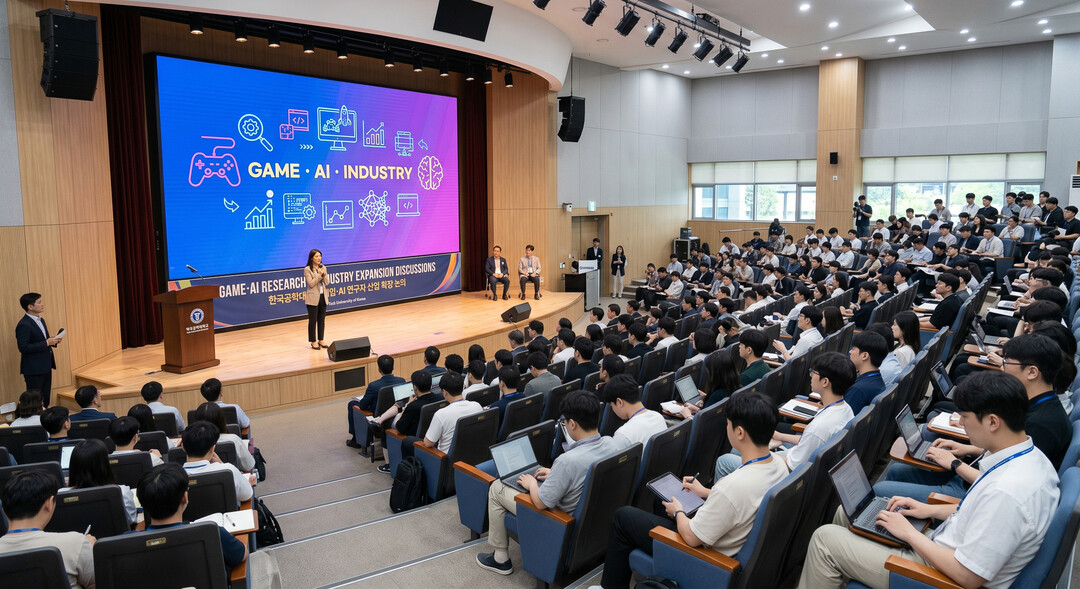
SEOUL — The Tech University of Korea (TU Korea), in collaboration with the Korea Game Society, successfully hosted the '2026 Korea Game Society Spring Academic Conference' from May 29 to 30. The two-day event, held at the AI Convergence College Engineering Building on the TU Korea campus, brought together over 200 prominent researchers, students, and industry experts to discuss the rapidly evolving landscape of artificial intelligence and its integration into the gaming sector.
Under the overarching theme of "The Industrial Expansion of Artificial Intelligence (AI) and Gaming," the conference served as a premier platform for exploring how cutting-edge AI technologies are driving transformation across the gaming industry. Participants engaged in deep discussions regarding convergence research trends and practical applications of AI in real-world commercial environments.
The academic gathering featured a robust turnout from the nation’s leading academic and public institutions. Professors and research teams from 22 universities nationwide participated, including TU Korea, KAIST (Korea Advanced Institute of Science and Technology), Dongguk University, Sejong University, Soongsil University, Incheon University, Chonnam National University, Chonbuk National University, and Hongik University. Additionally, key public and defense research institutions—such as the ROK Army Future Innovation Research Center, the ROK Army Training & Doctrine Command, and the Game Rating and Administration Committee—joined the discourse, highlighting the cross-disciplinary relevance of modern gaming and simulation technologies.
Industry Insights and Technical Innovations
The conference also featured significant contributions from industrial leaders, bridging the gap between academic theory and commercial practice. Keynote and industry sessions included presentations by Lee Bo-ra, Ambassador at Lovable, who discussed the "Potential of Vibe Coding in Game Development." Hwang Ji-man, Director at Appintos, outlined strategic insights into "Platform Expansion Strategies Centered on HTML5 Games," while Kim Yong-young, Chief Marketing Officer (CMO) at M-Block, presented an innovative paper on "The Convergent Interpretation of Prediction Markets and Game Theory."
During the core academic sessions, researchers presented groundbreaking papers across diverse domains, including Game AI, Gaming Industry Dynamics, Gaming Culture, Programming, Game Content, and Digital Assets. TU Korea’s specialized sessions drew significant attention, showcasing advanced technical research that integrates AI with computer engineering. Featured topics included real-time path tracing, Gaussian rendering, autonomous driving scenario generation, and financial system simulations.
TU Korea Research Teams Clinch Top Honors
Demonstrating its academic excellence, TU Korea’s research teams secured two prestigious Best Paper Awards during the conference.
The first award-winning paper, titled "A Study on Exergames for Sarcopenia Prevention Using Inertial Measurement Units (IMU)," was co-authored by Professors Jung Sung-taek and Shim Mi-sun, alongside students Lee Jong-jin and Shin Yo-han from the Department of Artificial Intelligence. The research was highly praised for utilizing wearable sensor data to develop interactive games aimed at preventing muscle loss in aging populations.
The second accolade was awarded to Professor Lee Dae-hyun and student Kim Hyung-il from the Department of Game Engineering for their paper, "GPU-based Animation Character Morphing Mesh Technique Utilizing UV and Bone Index Volume Textures." This study introduces a highly efficient method for rendering complex character animations on graphics hardware, promising to significantly reduce processing overhead in high-fidelity game engines.
Fostering Future Talent and Digital Art
Beyond academic presentations, the conference hosted a variety of co-located events designed to foster the next generation of creators. A nationwide university Capstone Design presentation session allowed undergraduate students to showcase their practical engineering solutions.
Furthermore, the venue celebrated creative convergence through the 'Korea Game Society × Naver OGQ Market International Digital Art Invitation Exhibition' and the 'Korea Game Society × Nexon Games National University Student Digital Art Competition.' These exhibitions spotlighted the artistic capabilities of students blending technological prowess with visual storytelling.
Bae Yoo-seok, Dean of the AI Convergence College at TU Korea, expressed strong commitment to the field, stating, "Leveraging our institution's core strengths in game engineering and artificial intelligence, we will continue to dedicate our resources to nurturing global talent capable of leading the future gaming industry."
[Copyright (c) Global Economic Times. All Rights Reserved.]