![[등록] 2026-09-01 15:48:31](/support/_updata/banner2/tl181982910_6749.png)


MIAMI / WASHINGTON D.C. — President Donald Trump has sparked a fresh wave of controversy with the unveiling of a lavish, 47-story presidential memorial in Miami and a simultaneous legal defeat regarding his ambitious plans to renovate the White House.
The developments underscore a presidency defined by grand architectural ambitions, even as federal courts move to reinforce the constitutional boundaries of executive power.
A Skyline Defined by Gold: The 47-Story Memorial
Late Monday night, President Trump released a 100-second teaser video showcasing the architectural vision for his official presidential memorial. Proposed to rise in the heart of downtown Miami, the structure is a towering 47-story skyscraper—a deliberate nod to his status as the 47th President of the United States.
The digital rendering features a sleek high-rise topped with a soaring spire and the "TRUMP" name emblazoned in massive lettering across the upper facade. The video highlights several extravagant features:
Golden Escalators: A signature aesthetic choice, positioned alongside what appears to be a replica of Air Force One.
The Oval Office Experience: A meticulously reconstructed replica of the White House inner sanctum for public tours.
Colossal Statuary: Most notably, the video depicts at least two massive, gold-toned statues of the President. One towers over the main entrance, while another stands in a grand auditorium, depicted with his right arm raised toward the audience.
While presidential libraries are a tradition for outgoing U.S. leaders—typically funded by private donations to house historical records—the scale of this project has drawn criticism. The memorial is slated to be built adjacent to Miami’s historic Freedom Tower. Local historians and the immigrant community have expressed concerns that the 47-story monolith will overshadow the 88-meter Freedom Tower, which served as a processing center for Cuban refugees in the 1960s and remains a symbol of liberty for the city’s diaspora.
"Steward, Not Owner": The White House Legal Blow
While the Miami project moves forward in the design phase, the President’s plans for his current residence have hit a significant legal wall.
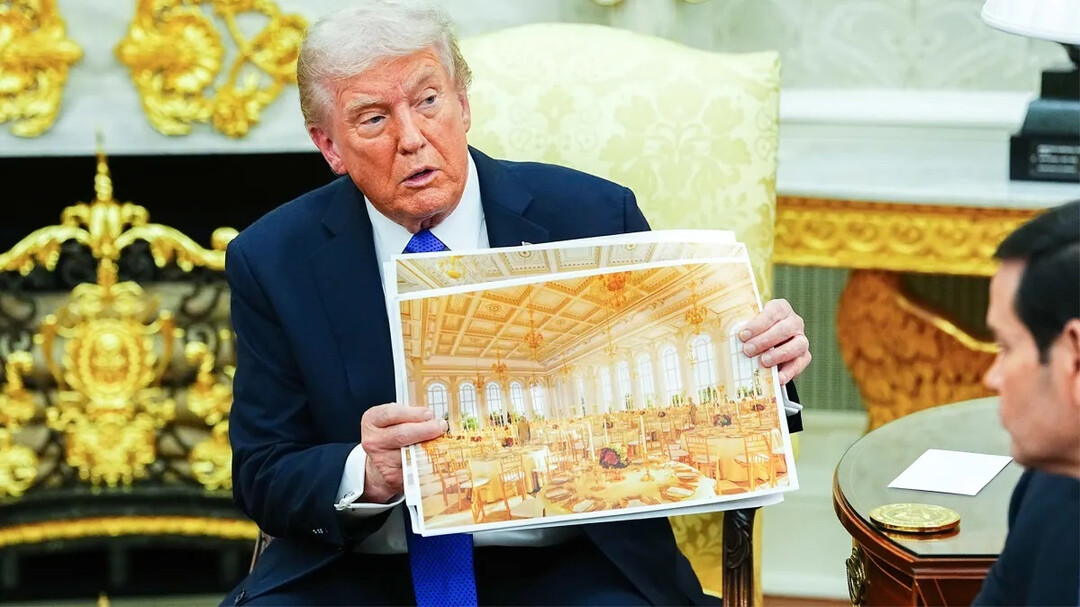
On Tuesday, U.S. District Judge Richard Leon issued a 35-page ruling blocking the administration's plan to construct a massive, $400 million ballroom at the White House. The administration had argued that because the project was funded by private donations from corporations and individuals, it did not require Congressional approval or taxpayer appropriations.
The National Trust for Historic Preservation (NTHP) filed a lawsuit to stop the construction, arguing the changes would permanently alter the historical integrity of the executive mansion. Judge Leon sided firmly with the preservationists.
"The President of the United States is a steward of the White House for future presidential families; he is not its owner!" Judge Leon wrote in his scathing opinion. "There is no statute that grants the President the unilateral authority he claims."
A Defiant Response
The President was quick to fire back at the ruling. Following the court’s decision, he took to social media to label the NTHP a "group of left-wing fanatics."
In his defense, Trump attempted to draw comparisons to other federal projects, questioning why the NTHP was blocking his ballroom and the Kennedy Center’s remodeling while allegedly ignoring renovations at the Federal Reserve building overseen by Chair Jerome Powell.
Context and Controversy
The dual developments highlight the ongoing tension between Trump’s "builder" persona and the institutional norms of the federal government. For supporters, the Miami memorial represents a bold celebration of a transformative presidency. For critics, the gold statues and the attempt to remodel the White House reflect a disregard for the humble traditions of the American executive branch.
As the legal battle over the White House ballroom heads toward a likely appeal, the debate over the Miami skyline is just beginning. Whether the "Trump Memorial" will ultimately stand as a monument to a legacy or a symbol of overreach remains a polarizing question in a deeply divided nation.
[Copyright (c) Global Economic Times. All Rights Reserved.]