![[등록] 2026-09-01 15:48:31](/support/_updata/banner2/tl181982910_6749.png)


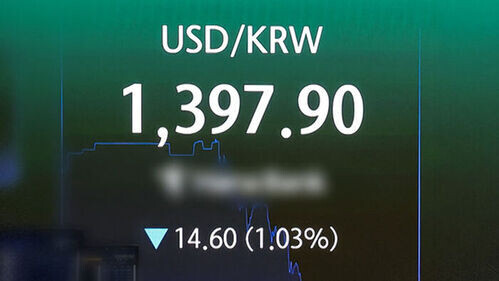
The South Korean won has strengthened significantly against the US dollar, breaking below the psychological threshold of 1,400 won for the first time in roughly 11 months and returning to the 1,300-won range. This shift in the foreign exchange market is primarily driven by weakening expectations of US Federal Reserve rate hikes, coupled with heavy corporate dollar-selling and a steady influx of foreign capital into the domestic stock market.
Weakening US Rate Hike Expectations and Corporate Dollar Liquidation
During Seoul's daytime trading session, the won-dollar exchange rate closed at 1,397.7 won, down 14.1 won from the previous trading session. This marks the first time a daytime closing price (recorded at 3:30 PM) has dipped below 1,400 won since late September of last year.
The downward trajectory began shortly after the market opened higher at 1,413.3 won. Around midday, the rate dropped to 1,399.0 won, breaching the 1,300-won territory for the first time since October 2 of last year, and maintained its downward momentum through the afternoon.
The primary catalyst behind the dollar's retreat was a series of softer-than-expected US economic indicators. The US retail sales for July fell by 0.6% from the previous month, significantly missing market projections. Furthermore, the Consumer Price Index (CPI) growth slowed, and the Producer Price Index (PPI) undershot expectations. These cooling inflation and consumption metrics reinforced market beliefs that the Federal Reserve will freeze interest rates at its upcoming policy meeting. Consequently, the dollar index—which measures the greenback against six major currencies—slumped to 99.46 during afternoon trading.
Domestic supply and demand dynamics also accelerated the won's appreciation. Amid the mid-August corporate tax payment period, major export companies like Samsung Electronics and SK Hynix liquidated significant portions of their overseas dollar earnings into won. Traditionally concentrated at month-end, these corporate "negotian" (dollar-selling) flows have increasingly surfaced on a routine basis, amplifying downward pressure on the exchange rate.
Additionally, capital inflows stemming from SK Hynix's American Depositary Receipt (ADR) issuance served as another stabilizing factor for the local currency. Foreign investors have also tapered off their previous selling streaks, recording five consecutive sessions of net purchases on the Kospi and Kosdaq markets starting August 11, acquiring roughly 8 trillion won worth of domestic equities.
FOMC Minutes and Yen Movements Stand as Key Variables
Whether the exchange rate can firmly anchor in the 1,300-won range moving forward largely depends on upcoming US monetary policy developments, foreign capital persistence, and the trajectory of Asian currencies like the Japanese yen. Analysts note that if robust domestic fundamentals—such as current account surpluses and steady economic growth—converge with continuous foreign stock buying and a stronger yen, the exchange rate could extend its decline.
The Japanese yen trading near the 159-yen mark against the dollar has heightened vigilance over potential market intervention by Tokyo authorities, providing a favorable tailwind for the won. If the Bank of Japan accelerates policy normalization while the Fed stays put, yen strength could ripple across broader Asian foreign exchange markets.
However, experts advise caution. Instability in US long-term Treasury yields and persistent overseas investment demand from domestic retail and institutional investors remain hurdles. The release of the July Federal Open Market Committee (FOMC) meeting minutes poses a critical test; if policymakers express persistent inflation concerns or voice stronger-than-expected advocacy for further tightening, US yields and the dollar could rebound sharply. While macroeconomic fundamentals lean toward a stronger won, short-term consolidation is widely expected until definitive catalysts for further declines materialize.
[Copyright (c) Global Economic Times. All Rights Reserved.]