• 2026.08.20 (Thu)
  • All articles
  • LOGIN
  • JOIN
Global Economic Times
fashionrunwayshow2026
  • Synthesis
  • World
  • Business
  • Industry
  • ICT
  • Distribution Economy
  • Well+Being
  • Travel
  • Eco-News
  • Education
  • Korean Wave News
  • Opinion
  • Arts&Culture
  • Sports
  • People & Life
    • International Student Report
    • With Ambassador
  • Column
    • Cho Kijo Column
    • Cherry Garden Story
    • Ko Yong-chul Column
    • Kim Seul-Ong Column
    • Lee Yeon-sil Column
  • Photo News
  • New Book Guide
MENU
 
Home > Synthesis

Unlocking the Mystery of 'Beat Signals' in Quantum Materials: Korean Researchers Reveal the Hidden Cause

Desk / Updated : 2026-08-20 00:16:42
  • -
  • +
  • Print


South Korean researchers have successfully identified the origin of "beat signals," a long-standing obstacle in interpreting quantum signals within quantum materials. This breakthrough is expected to contribute significantly to the precise control and design of advanced quantum devices.

The Korea Research Institute of Standards and Science (KRISS) announced on August 19 that it collaborated with the Gwangju Institute of Science and Technology (GIST), Chungnam National University, and Kongju National University to pinpoint the exact cause of beat signals in topological insulator nanowires, which had previously hindered accurate quantum signal analysis.

Topological insulators are unique quantum materials that act as electrical insulators on the inside while allowing electrons to move freely along their surfaces. When these materials are fabricated into nanoscale thin wires, electrons travel in loops around the surface. Applying a magnetic field causes the electron waves traveling along different paths to interfere with one another, resulting in an electrical conductivity that changes rhythmically—a phenomenon known as the Aharonov-Bohm (AB) oscillation.

Previously, researchers knew that doping and other material effects could form a thin layer just beneath the surface where electrons could also move, potentially acting as an alternate conduction path. However, the exact extent to which this subsurface layer influenced the topological surface state and AB oscillations remained unclear.

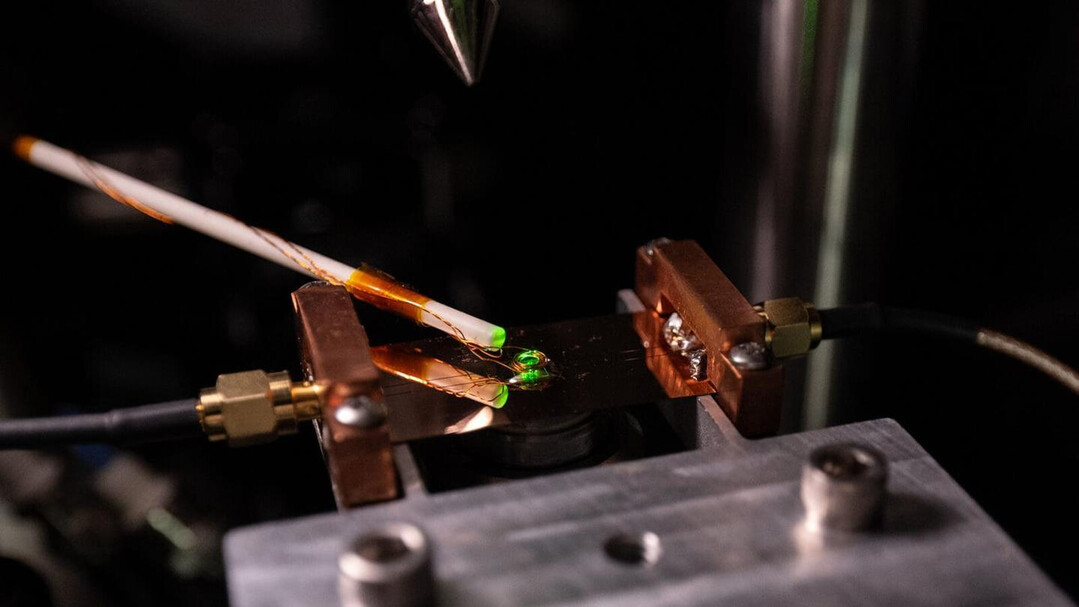
The joint research team discovered the beat phenomenon while investigating whether AB oscillations appear in thermoelectric phenomena within antimony (Sb)-doped bismuth selenide ($mathrm{Bi_2Se_3}$) nanowires. A beat signal occurs when oscillations of slightly different frequencies overlap, creating a pulsing fluctuation in signal intensity, much like the wobbling tone produced by two slightly misaligned tuning forks. By capturing this unexpected overlapping vibration component, the team re-analyzed existing electrical conductivity data and confirmed the presence of the exact same beat phenomenon.

The investigation revealed that the beat signals arise from the superposition of oscillation components originating from two distinct regions: the topological surface state and the two-dimensional electron gas, a conventional subsurface electronic layer. Specifically, because the two electron travel paths enclose slightly different cross-sectional areas around the nanowire, they generate oscillations with slightly different frequencies. When these frequencies overlap, they produce the characteristic beat pattern.

Furthermore, Professor Tae-geun Song's team at Kongju National University utilized machine learning techniques to successfully separate the previously entangled oscillation components. They proved that the individual frequencies remain unique even when the beat pattern shifts in response to gate voltage changes.

Dr. Myung-Ho Bae, a principal researcher at KRISS, noted that this study demonstrates how quantum interference can occur as electrons transition between topological states and conventional electronic states. Meanwhile, Professor Sang-Jun Choi of GIST emphasized that understanding and controlling the interference between different electronic states will serve as a foundational principle for designing future topological quantum devices.

The findings of this collaborative research were published in the international academic journal Nano Letters on June 8.

[Copyright (c) Global Economic Times. All Rights Reserved.]

  • #globaleconomictimes
  • #micorea
  • #mykorea
  • #Lifeplaza
  • #nammidonganews
  • #singaporenewsk
  • #Taiwanpost
  • #Samsung
  • #Doosa
Desk
Desk

Popular articles

  • Memory Boom Drives Samsung Electronics to Record $65 Billion Q2 Profit, Offsetting Heavy Set Losses

  • South Korea Launches Comprehensive ‘Agentic AI Initiative’ to Secure Global Leadership in Execution-Centric AI Ecosystems

  • “Buy the Dip Despite the Panic Crash?”: Semiconductor Bottom Thesis Gains Traction Amid 'Samjon-Nix' Rout

I like it
Share
  • Facebook
  • X
  • Kakaotalk
  • LINE
  • BAND
  • NAVER
  • https://globaleconomictimes.kr/article/1065539735856255 Copy URL copied.
Comments >

Comments 0

Weekly Hot Issue

  • Won-Dollar Exchange Rate Falls Below 1,400 Won, Returning to 1,300 Range After 11 Months
  • Jensen Huang’s Strategic Alliance with South Korea: Redefining the Global Physical AI Landscape
  • SK Hynix Announces Record-Breaking 40 Trillion Won Share Buyback and Cancellation to Maximize Shareholder Value
  • AI is a Winner-Take-All Game… Fall Behind and Risk Becoming a "Subcontractor Nation"
  • Korea Tourism Organization Successfully Attracts Consecutive Incentive Tour Groups from India 
  • 'Gyeongbuk International AI & Metaverse Film Festival' to Open on September 3rd… 3,403 Entries from 97 Countries

Most Viewed

1
The 16th Ethiopia-gil World Festival & Meskel Festival
2
Goldman Sachs Maintains KOSPI Target at 12,000, Citing "Excessive Market Fear"
3
Nable Communications Secures 5G Private Network Upgrade Deal with LG Uplus
4
'Delisting Countdown' Becomes Reality as Mass Administrative Stock Designations Hit Listed Companies
5
TSMC Accelerates 3nm Capacity Expansion: Monthly Output Set to Exceed 180,000 Wafers by Year-End
광고문의
임시1
임시3
임시2

Hot Issue

Jensen Huang’s Strategic Alliance with South Korea: Redefining the Global Physical AI Landscape

Semiconductor Boom Lifts Growth Outlook, Yet Job Creation Falters

Unlocking the Mystery of 'Beat Signals' in Quantum Materials: Korean Researchers Reveal the Hidden Cause

KT Launches "KT NPU LLM Station": A Breakthrough Enterprise Sovereign AI Appliance Combining Domestic Chips and LLM

Fashion Runway Show 2026

Global Economic Times
korocamia@naver.com
CEO : LEE YEON-SIL
Publisher : KO YONG-CHUL
Registration number : Seoul, A55681
Registration Date : 2024-10-24
Youth Protection Manager: KO YONG-CHUL
Singapore Headquarters
5A Woodlands Road #11-34 The Tennery. S'677728
Korean Branch
Phone : +82(0)10 4724 5264
#304, 6 Nonhyeon-ro 111-gil, Gangnam-gu, Seoul
Copyright © Global Economic Times All Rights Reserved
  • 향기네무료급식
  • BCB부천방송
  • 반달곰 프로젝트
Search
Category
  • All articles
  • Synthesis
  • World
  • Business
  • Industry
  • ICT
  • Distribution Economy
  • Well+Being
  • Travel
  • Eco-News
  • Education
  • Korean Wave News
  • Opinion
  • Arts&Culture
  • Sports
  • People & Life 
    • 전체
    • International Student Report
    • With Ambassador
  • Column 
    • 전체
    • Cho Kijo Column
    • Cherry Garden Story
    • Ko Yong-chul Column
    • Kim Seul-Ong Column
    • Lee Yeon-sil Column
  • Photo News
  • New Book Guide
  • Multicultural News
  • Jobs & Workers