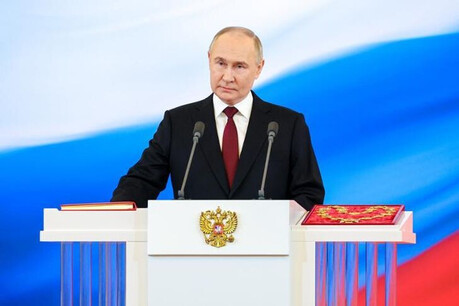
Russian President Vladimir Putin secured the most significant strategic gains from the first-ever trilateral summit between the United States, China, and Russia, according to an analysis by Alexander Gabuev, director of the Carnegie Russia Eurasia Center. In an op-ed published in the Financial Times (FT) on Saturday, Gabuev argued that Putin successfully prevented U.S. President Donald Trump from applying meaningful pressure on Moscow for the coming months, thereby buying crucial time to sustain the war in Ukraine.
Gabuev declared Putin the "real winner" of the trilateral meeting, assessing that the summit represented neither the emergence of a new illiberal axis nor a serious effort to establish guardrails for nuclear superpower competition. Instead, he characterized the event as another clear display of "the end of the Western alliance as we knew it."
Presidents Trump, Xi Jinping, and Putin held their inaugural trilateral meeting on Thursday on the sidelines of the Asia-Pacific Economic Cooperation (APEC) summit in Shenzhen, China. Following the talks, the three leaders issued a "trilateral peace declaration" covering United Nations reform, energy supply stability, and nuclear risk reduction. Notably, the war in Ukraine was omitted from the joint statement. While a Kremlin spokesperson confirmed that Ukraine was not a central agenda item during the three-way talks, it served as the primary focus of a bilateral meeting between Trump and Putin held earlier that day.
Gabuev noted that the summit, which was largely dominated by photo opportunities, yielded minimal substantive results. President Xi projected the image of a responsible global statesman while appeasing Trump to buy Beijing time to strengthen its negotiating leverage. Meanwhile, Trump appeared content simply to sit at the same table with his Chinese and Russian counterparts, raising personal talking points such as preventing nuclear war and criticizing alleged overreach by the International Criminal Court (ICC). Gabuev pointed out that Trump, who had once vowed to drive a wedge between Putin and Xi, has now opted to join hands with both leaders.
In contrast, Gabuev analyzed that Putin’s rewards went far beyond the symbolic. Through the bilateral and trilateral engagements, the Russian leader ensured that Washington would refrain from exerting substantial pressure on Moscow for several months—a timeline Gabuev described as the key to understanding the Kremlin’s "victory strategy."
Gabuev outlined two primary factors supporting this timeline:
Sustained War-Fighting Capacity: Despite facing external pressures, Russia retains the financial resources, weaponry, and manpower necessary to continue fighting through 2027. Russia also holds an advantage in long-range strike capabilities. Although Ukraine has targeted the Crimean Bridge and Russian oil refineries, ongoing Russian airstrikes are devastating Ukraine's economy and tax base, driving up the financial burden on European backers and triggering fresh waves of refugees toward Europe. Gabuev also noted that distorted intelligence briefings from inner-circle advisors have led Putin to firmly believe that Russian forces are advancing on the battlefield.
European Political Calendar: Gabuev projected that a potential victory by National Rally (RN) lawmaker Marine Le Pen in next spring’s French presidential election would severely complicate European support for Ukraine. Consequently, Putin has little incentive to engage in serious peace negotiations before next summer and is unlikely to accept a ceasefire as a precondition for talks. Gabuev added that the risk of President Trump suspending vital U.S. aid to Ukraine remains high.
On the same day as the Shenzhen talks, European leaders countered by convening a "Coalition of the Willing" summit in Berlin. Co-hosted by German Chancellor Friedrich Merz, French President Emmanuel Macron, and British Prime Minister Andy Burnham, the gathering brought together roughly 40 nations. Gabuev observed that Europe’s dilemma stems not only from the Kremlin's aggression, but also from a lack of seriousness on the part of Trump and his advisors. Because many of Russia's core security concerns cannot be resolved without U.S. involvement, he warned that negotiations could end without results unless a competent new negotiating team takes charge at the White House.
Concluding his piece, Gabuev urged Europe to invest resources into managing relations with Russia and shaping a regional security framework that secures Ukraine's survival while reducing the risk of escalation. He also advised European leaders to partner with officials from a future U.S. administration who possess experience negotiating complex security treaties with Moscow, warning that it would be "even more tragic if the West finds itself in 2029 still without a plan to end the war."
[Copyright (c) Global Economic Times. All Rights Reserved.]