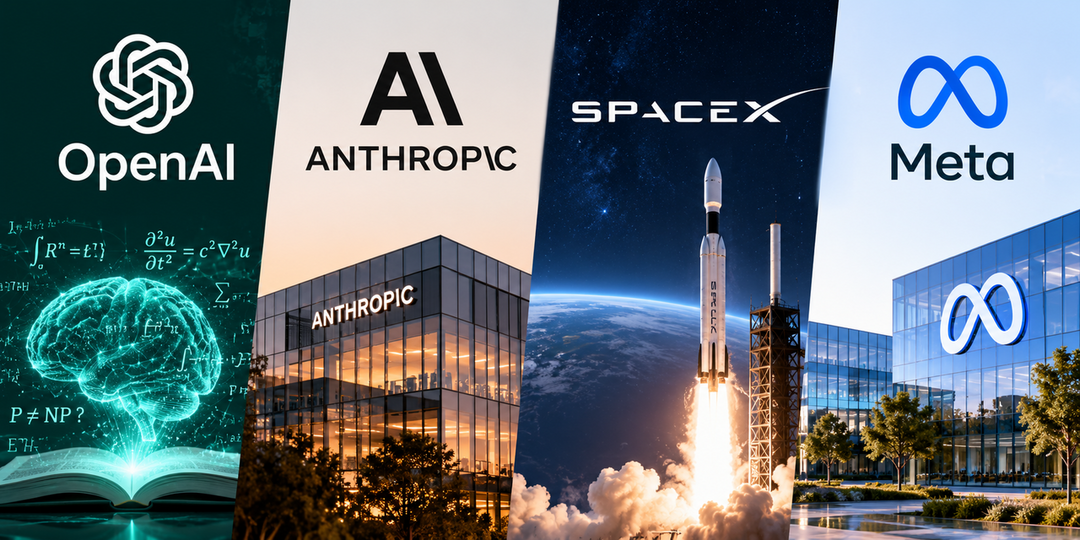
NEW YORK / SEOUL — Artificial intelligence developer Anthropic has shattered global capital market records with the largest initial public offering (IPO) in history. Yet, rather than silencing skeptics, the company’s rocky trading debut has reignited Wall Street’s debate over whether the AI boom is nearing its peak.
A Historic Capital Raise
On November 18 (local time), Anthropic priced its IPO at $83 per share, well above its initial target range of $70 to $78. Driven by institutional demand that reportedly exceeded the original 825 million share offering by roughly sixfold during its November 10 roadshow, the company expanded its share issuance by 18.8% to 980 million shares.
The pricing valued Anthropic at $1 trillion on an issued-share basis, and roughly $1.5 trillion (approx. 2,008 trillion KRW) on a fully diluted basis—a 55.4% jump from its $965 billion private valuation in May. Through the public offering alone, Anthropic secured $81.3 billion. Combined with $26 billion in private placements from seven strategic partners—including Google, Microsoft, Nvidia, AMD, Broadcom, Micron, and TSMC—the total capital raised reached a staggering $107.3 billion (approx. 143 trillion KRW), surpassing SpaceX’s $86.2 billion IPO record set in June.
Early Investors Reap Massive Paper Gains
The blockbuster listing delivered an immediate windfall for early backers. In South Korea, Yuanta Securities estimated on November 20 that SK Telecom’s stake in Anthropic is now worth roughly 5 trillion KRW based on the first-day closing price—an 18.4-fold return on its cumulative 270 billion KRW investment. While a mandatory lock-up period prevents SK Telecom from selling shares until mid-May next year, the valuation marks a major strategic victory.
Initially, market analysts hailed the strong IPO demand as proof of enduring investor appetite for AI. Dan Ives, a partner at Yorkville Ives & Co., noted in a November 18 report that the debut serves as a near-term catalyst that helps restore confidence in AI's growth trajectory.
The Profitability Paradox
However, euphoria quickly gave way to scrutiny over Anthropic’s deteriorating bottom line and massive capital commitments. According to Reuters, the company’s operating margin swung sharply from 8% in the second quarter to -3% in the third quarter, squeezed by soaring model operating expenses and intensifying price wars.
Furthermore, Anthropic faces roughly $900 billion in long-term commitments for semiconductors, cloud computing, and data centers, with $70 billion due within the next 12 months. As Reuters Breakingviews pointed out on November 19, raising cash is only half the battle; converting that capital into sustainable profits depends heavily on securing timely access to chips and data center capacity.
Market Jitters Spill Over to Seoul
These underlying anxieties played out immediately on the trading floor. Listing on the Nasdaq on November 19 under the ticker "ANT," Anthropic opened at $111.50—up 34.34% from its offer price—and briefly touched $115.10. However, profit-taking quickly erased early gains, dragging the stock down to close at $97.17 before sliding further to $90.60 in after-hours trading.
The lukewarm debut sent shockwaves across the Pacific on November 20, compounded by reports of potential new U.S. semiconductor export restrictions against China. South Korea’s benchmark KOSPI plunged 5.21% to close at 4,869.96, dipping below the 4,900 mark for the first time in ten months. Tech bellwethers bore the brunt of the sell-off, with Samsung Electronics tumbling 7.01% to 183,100 KRW and SK Hynix falling over 5% to 1,113,000 KRW.
While Anthropic’s historic fundraising proves that capital remains abundant for AI frontrunners, its post-IPO stumble underscores a shifting market sentiment: investors are no longer satisfied with technological promise alone and are now demanding clear proof of profitability.
[Copyright (c) Global Economic Times. All Rights Reserved.]