Across South Korea, mega-development projects are surging into the habitats of endangered wildlife. A recurring pattern has emerged: authorities lock in construction sites before thoroughly assessing wildlife habitats, tacking on conservation measures as an afterthought. Environmental groups are demanding an immediate halt to these projects, citing a lack of rigorous review and social consensus.
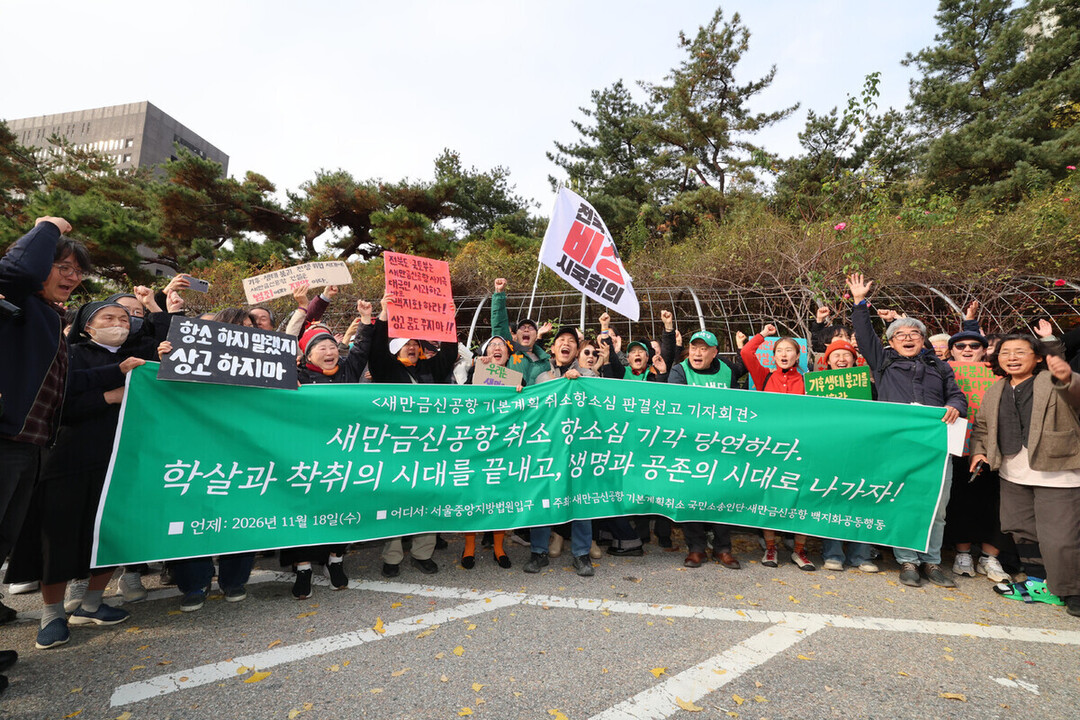
This week alone, ecological controversies erupted at four major development sites nationwide. On November 18, the Seoul High Court canceled the master plan for the Saemangeum International Airport, ruling that authorities failed to properly evaluate bird-strike risks and tidal flat destruction. On November 16, environmental activists gathered at the construction site of the Yongin Semiconductor National Industrial Complex to demand a halt, arguing that massive deforestation was proceeding without proper ecological assessments. On November 19, calls mounted to completely slash the budget for the Nodeul Island project in Seoul, which plans to build a boardwalk through the habitat of the endangered narrow-mouthed frog. Meanwhile, renewed demands to reconsider the Seoraksan Osaek Cable Car—slated for construction in the habitat of the endangered long-tailed goral—have gained traction as project costs balloon.
While the four projects differ in nature—spanning an airport, a cable car, a cultural complex, and semiconductor fabs—they share a common criticism: sites were chosen inside endangered species' habitats without meticulous ecological scrutiny.
Site Selection Before Ecological Review
The Saemangeum Airport exemplifies this approach. The court found that the Ministry of Land, Infrastructure and Transport (MOLIT) failed to weigh bird-strike hazards when selecting the site. Even MOLIT’s own internal assessments showed that Saemangeum carried a significantly higher risk of bird strikes than other airports, yet this data was excluded from site-selection criteria. The surrounding area is home to over 31 legally protected bird species, and the Seocheon tidal flats—a UNESCO World Natural Heritage site—lie just 7 kilometers away. The court rejected the ministry's argument that the risk could be managed simply by chasing birds away.
The Seoraksan Osaek Cable Car follows a similar trajectory. The Kkeutcheong area, where the upper station will be built, is a core habitat for the long-tailed goral, a Class I endangered species. The Ministry of Environment (now the Ministry of Climate, Energy and Environment) initially opposed the project in 2019. When the project was reviewed again in 2023, the state-run Korea Environment Institute warned that the facility would "act as a major disruptive factor to the goral’s habitat and breeding." Nevertheless, the project was approved that same year on the sole condition that goral populations be monitored via unmanned cameras and field surveys. Gangwon Province and Yangyang County have defended the project as a 40-year regional aspiration, promising eco-friendly construction methods without blasting.
The same pattern is unfolding in the heart of Seoul. The city is pushing ahead with its "Nodeul Global Art Island" project on the Han River, featuring a skywalk and gardens. The island's eastern forest—previously off-limits without prior reservation because it houses the Class II endangered narrow-mouthed frog—is slated to get a wooden deck trail. According to a small-scale environmental impact assessment, 326 of the island's 637 trees will be damaged, and the frogs will be relocated to a temporary shelter during construction. This marks the second time Seoul has relocated Nodeul Island’s frogs for development, following a similar move in 2010.
The Seoul Metropolitan Government maintains that most of the forest's large trees are invasive species and that the project will restore the area into an ecological forest, promising to monitor the frogs' resettlement for three years. On November 19, the Seoul Federation for Environmental Movement countered that "building artificial facilities and trails right next to a habitat you claim to preserve is contradictory."
Once Started, Nothing Stops
The issue extends beyond site selection; construction begins before environmental concerns are resolved.
The Yongin Semiconductor National Industrial Complex officially broke ground on October 28 on a site slated for six Samsung Electronics chip plants. However, the Korea Land and Housing Corporation (LH), which oversees the project, began clearing the forest a month earlier. The environmental impact assessment was wrapped up just 13 days after the project was filed. LH maintains this was legal preliminary work following proper construction notices. The Korea Federation for Environmental Movements (KFEM) criticized the move, stating that "large-scale logging destroys wildlife habitats, severs ecological connectivity, and eliminates forests that store and absorb carbon," adding that "the mere fact that construction has begun does not validate the site selection or supply plan."
The conflict is spilling beyond the complex's borders. Powering the chip plants requires building new power stations and ultra-high-voltage transmission lines that will cut through mountains and villages in other regions. "Protecting the mountains of Yongin is protecting the mountains and villages of the entire nation," said Lee Kyung-ho, secretary-general of the Daejeon Federation for Environmental Movement. A nationwide coalition of civic and resident groups has staged a sit-in tent protest at the site since groundbreaking day.
The Seoraksan Osaek Cable Car has also faced turbulence post-groundbreaking. Last year, the Korea Heritage Service issued a stop-work order after uncovering unauthorized construction, and colonies of rare plants were subsequently discovered at the planned site. Meanwhile, the target opening date has been pushed back from 2026 to 2031, and costs have surged to 179.3 billion won. Despite these setbacks, the project's permit has been extended through the end of 2027. Gangwon Governor Woo Sang-ho has stated that he "cannot cancel a project approved under a predecessor."
Construction on Nodeul Island began in October last year. However, the 40.6 billion won allocated for the trails and skywalk cutting through the narrow-mouthed frog's forest is included in next year's budget. This prompted the Seoul Federation for Environmental Movement to demand that the Seoul Metropolitan Council completely cut the 53.3 billion won budget slated for next year, urging the city to "halt construction immediately" and stressing that "this budget review is more critical than anything."
Government Moves to Cut Existing Red Tape
Of the four projects, only Saemangeum has been halted—and even then, it was stopped by the courts rather than administrative agencies or developers. Back-to-back rulings in the first and second trials canceling a national project's master plan prior to construction are exceptionally rare. The appellate court ruled that MOLIT failed to adequately consider the public interest of environmental conservation while disproportionately emphasizing development benefits.
Civic groups are now looking to leverage this ruling against other airport projects. The coalition leading the Saemangeum lawsuit has demanded that MOLIT drop its appeal and halt plans for the Gadeokdo New Airport and the Jeju Second Airport, both of which face similar bird-strike controversies.
Conversely, the government is moving to streamline environmental reviews. While reviewing major industrial projects in July, President Lee Jae-myung remarked that even when new environmental impact assessments are required, "there is a need to drastically shorten the review period." The presidential office subsequently announced plans to pass a special law to this effect within the year—a move KFEM warns is a clear signal that the government intends to effectively neutralize the environmental impact assessment system.
[Copyright (c) Global Economic Times. All Rights Reserved.]