• 2026.03.29 (Sun)
  • All articles
  • LOGIN
  • JOIN
Global Economic Times
fashionrunwayshow2026
  • Synthesis
  • World
  • Business
  • Industry
  • ICT
  • Distribution Economy
  • Well+Being
  • Travel
  • Eco-News
  • Education
  • Korean Wave News
  • Opinion
  • Arts&Culture
  • Sports
  • People & Life
    • International Student Report
    • With Ambassador
  • Column
    • Cho Kijo Column
    • Cherry Garden Story
    • Ko Yong-chul Column
    • Kim Seul-Ong Column
    • Lee Yeon-sil Column
  • Photo News
  • New Book Guide
MENU
 
Home > Column > Cherry Garden Story

Jokbal: A Deep Dive into Korea’s Beloved Pig’s Trotters

KO YONG-CHUL Reporter / Updated : 2024-12-22 16:48:42
  • -
  • +
  • Print


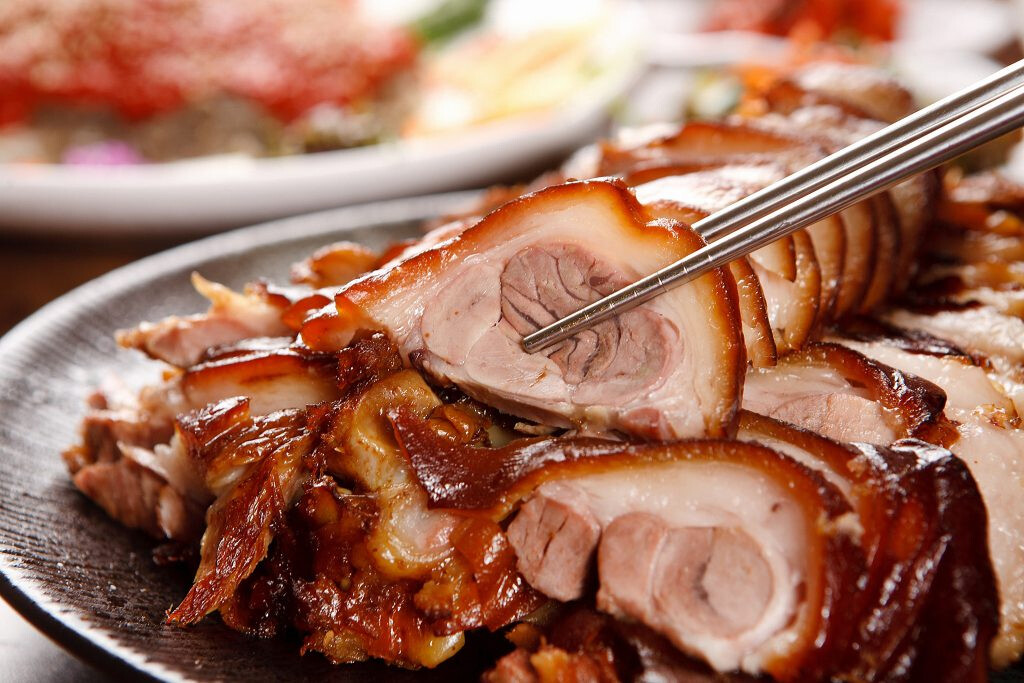
Seoul, South Korea – Jokbal, a Korean dish made from pig’s trotters, has been a beloved comfort food for centuries. This hearty and flavorful dish has a rich history and a unique preparation method.

A History of Jokbal The origins of jokbal can be traced back to Korea’s traditional dishes involving boiled pork. While boiled pork was a common dish, the specific practice of boiling pig’s trotters and preparing them as a standalone meal emerged later. It’s believed that the current form of jokbal, marinated and braised, was developed by refugees from North Korea who settled in Jangchungdong, Seoul, after the Korean War. To make a living, they adapted their traditional pork dishes, blending them with Chinese five-spice flavors, giving birth to the jokbal we know today.

The Making of Jokbal Creating the perfect jokbal is a meticulous process.

Boiling: Pig’s trotters are first boiled for several hours to make them tender.
Marination: The boiled trotters are then marinated in a mixture of soy sauce, garlic, ginger, and various spices.
Braising: The marinated trotters are braised until the meat is fall-off-the-bone tender and the sauce has reduced to a rich, sticky glaze.
Serving: Traditionally, jokbal is served sliced and accompanied by a variety of side dishes, such as kimchi, pickled radish, and sesame leaves.
Why Jokbal is Popular Jokbal’s popularity can be attributed to several factors:

Flavor: The combination of sweet, salty, and savory flavors is incredibly satisfying.
Texture: The tender, gelatinous skin and meat provide a unique mouthfeel.
Nutritional Value: Pig’s trotters are rich in collagen, which is beneficial for skin and joint health.
Cultural Significance: Jokbal has become a symbol of Korean cuisine and is often enjoyed during gatherings and special occasions.
Today, jokbal is a staple of Korean cuisine and can be found in restaurants throughout the country. Its unique flavor and rich history make it a must-try dish for anyone visiting Korea.

[Copyright (c) Global Economic Times. All Rights Reserved.]

  • #globaleconomictimes
  • #koyongchul
  • #cherrylee
  • #seoulkorea
  • #periodicoeconomico
  • #글로벌이코노믹타임즈
  • #GET
  • #GETtv
  • #liderdel
KO YONG-CHUL Reporter
Reporter Page

Popular articles

  • Ko Sang-goo, President of World Federation of Korean Associations, Elected as First Private Sector Chair of World Korean Community Leaders Convention

  • The "Invisible Violence" on Japanese Streets: The Rise of 'Butsukari'

  • Hunminjeongeum Liaodong Academic Expedition Issues Letters to Leaders of Korea and China at Shenyang Consulate

I like it
Share
  • Facebook
  • X
  • Kakaotalk
  • LINE
  • BAND
  • NAVER
  • https://globaleconomictimes.kr/article/1065599218018110 Copy URL copied.
Comments >

Comments 0

Weekly Hot Issue

  • 70% of Hacked Companies Fail to Report Breaches: Call for Enhanced Cybersecurity Response
  • Card Issuers Caught in the Crossfire of Samsung-Apple Pay Fee War
  • Google Gemini to Import Rival AI Chat Histories: Battle for User Retention Intensifies
  • Hyundai Motor Group Expands Mandatory Vehicle Rotation System to Bolster National Energy Conservation Efforts
  • France Invites South Korea to June G7 Summit; Seoul Evaluating Attendance
  • President Lee Asserts ‘Self-Reliant Defense’ as Crucial, Vows Swift Recovery of Operational Control

Most Viewed

1
The Zenith of ‘K-Strawberries’: A Sweet Innovation Unfolds in Nonsan… The 28th Nonsan Strawberry Festival Opens
2
Netanyahu Declares Decisive Blow to Iran’s Nuclear and Missile Programs, Signals Early End to War
3
K-Beauty SMEs Join Forces with Distributors: A New Paradigm for Global Expansion through Strategic Consortiums
4
Global Food Delivery Giants Hit Record Highs: Subscription and Quick-Commerce Emerge as Key Growth Engines
5
Won Breaches 1,500 Mark for First Time Since Financial Crisis; KOSPI Stabilizes at 5,500 Amid Chip Rally
광고문의
임시1
임시3
임시2

Hot Issue

Generative AI Enters the Classroom: GBSA Appoints 130 Specialized Instructors to Lead Gyeonggi’s Digital Future

Hyundai Motor Group Expands Mandatory Vehicle Rotation System to Bolster National Energy Conservation Efforts

Samsung and LG Clash in Milan Over European HVAC Supremacy at MCE 2026

President Lee Asserts ‘Self-Reliant Defense’ as Crucial, Vows Swift Recovery of Operational Control

Let’s recycle the old blankets in Jeju Island’s closet instead of incinerating them.

Global Economic Times
korocamia@naver.com
CEO : LEE YEON-SIL
Publisher : KO YONG-CHUL
Registration number : Seoul, A55681
Registration Date : 2024-10-24
Youth Protection Manager: KO YONG-CHUL
Singapore Headquarters
5A Woodlands Road #11-34 The Tennery. S'677728
Korean Branch
Phone : +82(0)10 4724 5264
#304, 6 Nonhyeon-ro 111-gil, Gangnam-gu, Seoul
Copyright © Global Economic Times All Rights Reserved
  • 에이펙2025
  • APEC2025가이드북TV
  • 독도는우리땅
Search
Category
  • All articles
  • Synthesis
  • World
  • Business
  • Industry
  • ICT
  • Distribution Economy
  • Well+Being
  • Travel
  • Eco-News
  • Education
  • Korean Wave News
  • Opinion
  • Arts&Culture
  • Sports
  • People & Life 
    • 전체
    • International Student Report
    • With Ambassador
  • Column 
    • 전체
    • Cho Kijo Column
    • Cherry Garden Story
    • Ko Yong-chul Column
    • Kim Seul-Ong Column
    • Lee Yeon-sil Column
  • Photo News
  • New Book Guide
  • Multicultural News
  • Jobs & Workers