![[등록] 2026-09-01 15:48:31](/support/_updata/banner2/tl181982910_6749.png)


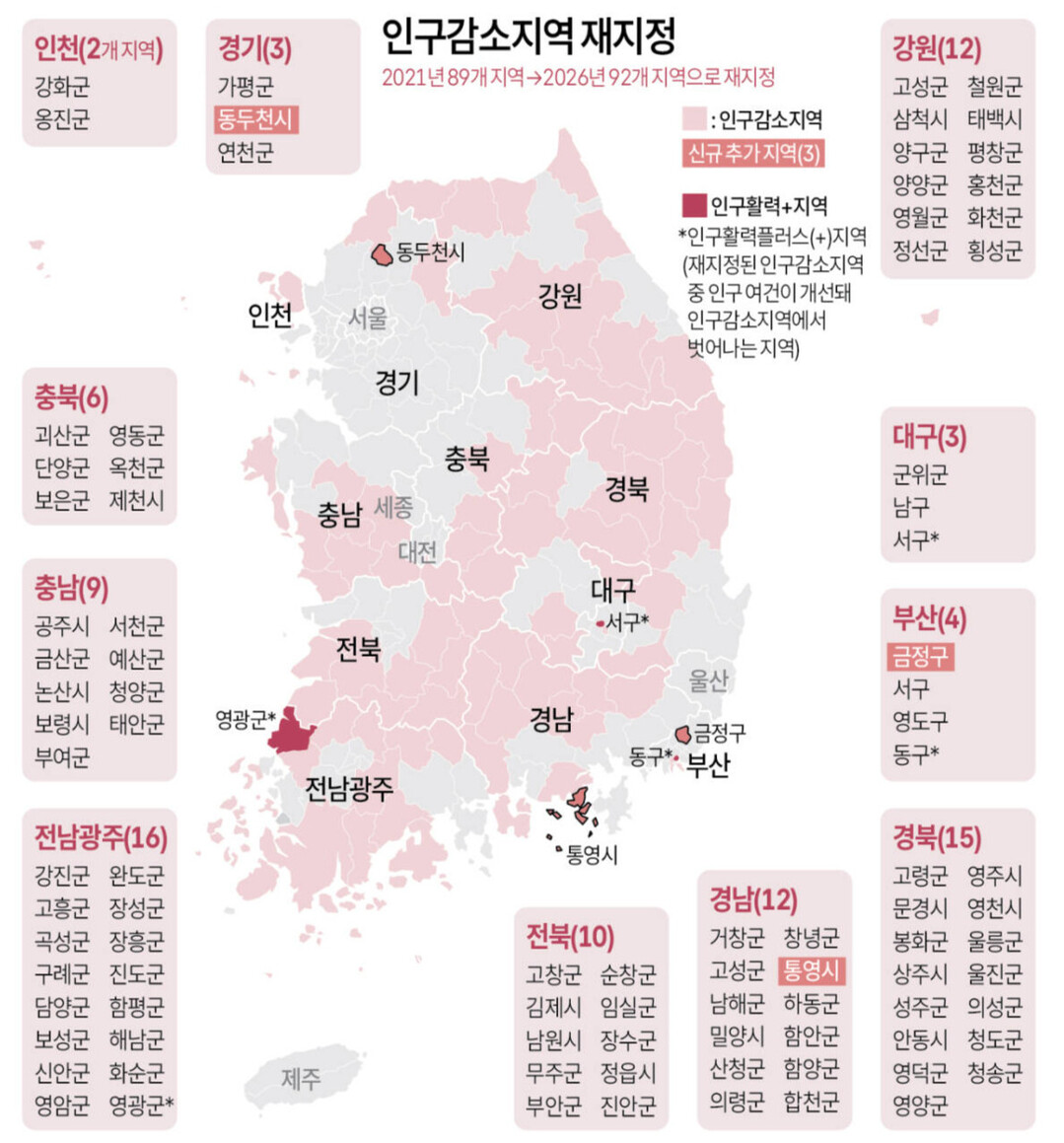
SEOUL — Dongducheon City has been newly designated as a population-declining area, bringing the total number of such designated regions in the Gyeonggi and Incheon areas from four to five.
Minister of the Interior and Safety Yoon Ho-jung held a briefing at the Seoul Government Complex on the 7th to announce the 5-year re-designation of population-declining areas.
The newly announced re-designation heavily reinforced calculation criteria to accurately reflect demographic and regional changes over the past five years. Alongside traditional metrics such as the average annual population growth rate and aging ratio, new economic vitality indicators were factored in, including the urbanization rate (the proportion of land where people gather and buildings are constructed), the number of employed workers, and the regional resident population (living population).
In Gyeonggi Province, Dongducheon City was newly incorporated alongside existing regions Gapyeong County and Yeoncheon County, raising the total number of population-declining areas in the province to three. Incheon maintained its existing two regions, Ganghwa County and Ongjin County. This outcome reflects local realities—facing severe population outflow and a lack of jobs characteristic of border regions—despite being situated close to the capital area.
Based on this re-designation, the government plans to concentrate the annual 1 trillion won local extinction response fund into effective projects to improve settlement conditions. The vision goes beyond simple facility expansion, aiming to organically link infrastructure with content to encourage substantial resident activity. Furthermore, 44 special provisions and tax benefits under the Special Act on Support for Population-Declining Areas will be continuously reinforced.
Additionally, the government intends to discover diverse, high-demand administrative and financial support measures—such as tax special exceptions for local second homes and acquisition tax reductions for young adults purchasing their first home—while re-designating 18 "population-declining interest areas" facing high risks of population decline to induce mid- to long-term, customized regional responses. Consequently, Pocheon City and Incheon Jemulpo District were newly designated as population-declining interest areas.
Reflecting concerns that abruptly cutting off support simply because indicators have slightly improved could weaken regional recovery momentum, regions with improving conditions will be classified as "population vitality areas," ensuring stable continuation of existing support for the next five years.
"Moving forward, we will concentrate pan-governmental support tailored to regional conditions for population-declining areas, while backing population vitality areas so that hard-won recovery momentum is not broken," Minister Yoon stated. "We will empower regions to generate their own vitality and growth."
[Copyright (c) Global Economic Times. All Rights Reserved.]