• 2025.12.05 (Fri)
  • All articles
  • LOGIN
  • JOIN
Global Economic Times
APEC2025KOREA가이드북
  • Synthesis
  • World
  • Business
  • Industry
  • ICT
  • Distribution Economy
  • Well+Being
  • Travel
  • Eco-News
  • Education
  • Korean Wave News
  • Opinion
  • Arts&Culture
  • Sports
  • People & Life
  • Column
    • Cho Kijo Column
    • Lee Yeon-sil Column
    • Ko Yong-chul Column
    • Cherry Garden Story
  • Photo News
  • New Book Guide
MENU
 
Home > People & Life

Jajangmyeon Rises in Popularity in North Korea Amid Push for Flour Consumption

Yim Kwangsoo Correspondent / Updated : 2025-10-20 14:33:44
  • -
  • +
  • Print


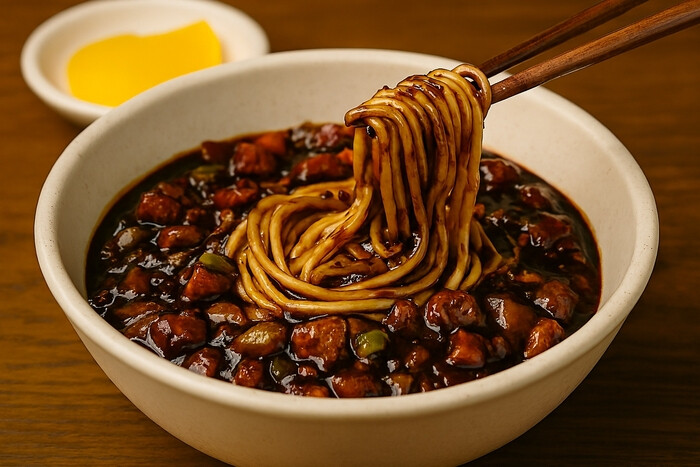
PYONGYANG — Jajangmyeon, the popular noodle dish, is reportedly surging in popularity across North Korea, a trend believed to be linked to the government's recent initiative to encourage consumption of flour-based foods.

A recent report by the pro-Pyongyang newspaper Choson Sinbo, an organ of the General Association of Korean Residents in Japan, highlighted a specialized Jajangmyeon restaurant on Pyongyang's Changwang Food Street. This establishment, a venerable location once visited by leaders Kim Il-sung and Kim Jong-il in 1985, is experiencing a constant stream of customers, with Jajangmyeon cited as the most sought-after item on the menu.

The Jajangmyeon enjoyed in the North, however, is known to differ significantly from its southern counterpart. While South Korean Jajangmyeon features a thick, sweet sauce made from chunjang (sweet soybean paste), the Northern version characteristically uses a salty, savory sauce primarily based on doenjang (fermented soybean paste), giving it a more distinctively simple and nutty flavor.

Furthermore, the noodles themselves often vary. Instead of using only wheat flour, North Korean recipes frequently incorporate a blend of ingredients such as starch, potato, buckwheat, and various flours to achieve a chewier, more resilient texture.

This growing embrace of flour-based meals, including Jajangmyeon, appears to be a strategic move by the North Korean government. Amid persistent food shortages, largely stemming from a continuous rice deficiency, authorities are reportedly working to boost domestic wheat production and promote the consumption of powdered food (bunsik) as a partial solution to the nation's food crisis.

The expansion of wheat-based diets is also supported by closer cooperation with Russia. In a notable instance of bilateral aid, Russia supplied North Korea with significant shipments of flour sourced from its Kuzbass region, providing 1,280 tons in April 2023 and an additional 1,276 tons in May 2023. These shipments underscore the external support helping to facilitate the nation's shift toward increased flour consumption.

The rising popularity of Jajangmyeon thus serves as a visible culinary manifestation of Pyongyang's broader efforts to diversify its food sources and address ongoing domestic food security challenges.

[Copyright (c) Global Economic Times. All Rights Reserved.]
  • #globaleconomictimes
  • #micorea
  • #mykorea
  • #Lifeplaza
  • #nammidonganews
  • #singaporenewsk
  • #Samsung
  • #Daewoo
  • #Hyosung
  • #A
Yim Kwangsoo Correspondent

Popular articles

  • Non-Smokers Also at Risk: 'Complex Causes' Found in 7 Out of 10 COPD Patients

  • Fatal Flutter: Why Atrial Fibrillation is a Critical Heart Warning

  • North Korea Publicly Executes ‘Big-Hand’ Business Couple Over ‘Arrogance’ and Anti-State Charges

I like it
Share
  • Facebook
  • X
  • Kakaotalk
  • LINE
  • BAND
  • NAVER
  • https://globaleconomictimes.kr/article/1065591182936437 Copy URL copied.
Comments >

Comments 0

Weekly Hot Issue

  • China Stages Massive Naval Show of Force Amid Heightened Tensions with Japan
  • EU Launches Antitrust Probe into Meta Over WhatsApp AI Chatbot Restrictions
  • Sports Icons Converge as 2026 FIFA World Cup Draw Approaches
  • Russia Vows 'Strongest Response' as EU Proposes Using Frozen Assets for Ukraine Loan
  • US Layoffs Surge: Over 1.17 Million Job Cuts Announced in First 11 Months of 2025
  • EU Weighs 'Buy European' Rule: Up to 70% Local Content for Key Products

Most Viewed

1
Korean War Ally, Reborn as an 'Economic Alliance' Across 70 Years: Chuncheon's 'Path of Reciprocity,' a Strategic
2
A Garden Where the City's Rhythm Stops: Dongdaemun's 'Cherry Garden', Cooking Consideration and Diversity
3
The Sudden Halt of Ayumi Hamasaki's Shanghai Concert: Unpacking the Rising Sino-Japanese Tensions
4
Farewell to a Legend: South Korea Mourns the Passing of Esteemed Actor Lee Soon-jae
5
China’s Anti-Starlink Strategy: Simulation Suggests 2,000 Drones Needed for Taiwan Disruption
광고문의
임시1
임시3
임시2

Hot Issue

Global Billionaire Count Hits 2,919, Total Wealth Reaches $15.8 Trillion

China Stages Massive Naval Show of Force Amid Heightened Tensions with Japan

Russia Vows 'Strongest Response' as EU Proposes Using Frozen Assets for Ukraine Loan

UK and Norway Form Joint Naval Fleet to Counter Rising Russian Submarine Threat

Let’s recycle the old blankets in Jeju Island’s closet instead of incinerating them.

Global Economic Times
korocamia@naver.com
CEO : LEE YEON-SIL
Publisher : KO YONG-CHUL
Registration number : Seoul, A55681
Registration Date : 2024-10-24
Youth Protection Manager: KO YONG-CHUL
Singapore Headquarters
5A Woodlands Road #11-34 The Tennery. S'677728
Korean Branch
Phone : +82(0)10 4724 5264
#304, 6 Nonhyeon-ro 111-gil, Gangnam-gu, Seoul
Copyright © Global Economic Times All Rights Reserved
  • 에이펙2025
  • APEC2025가이드북TV
  • 세종시
Search
Category
  • All articles
  • Synthesis
  • World
  • Business
  • Industry
  • ICT
  • Distribution Economy
  • Well+Being
  • Travel
  • Eco-News
  • Education
  • Korean Wave News
  • Opinion
  • Arts&Culture
  • Sports
  • People & Life
  • Column 
    • 전체
    • Cho Kijo Column
    • Lee Yeon-sil Column
    • Ko Yong-chul Column
    • Cherry Garden Story
  • Photo News
  • New Book Guide
  • Multicultural News
  • Jobs & Workers