![[등록] 2026-09-01 15:48:31](/support/_updata/banner2/tl181982910_6749.png)


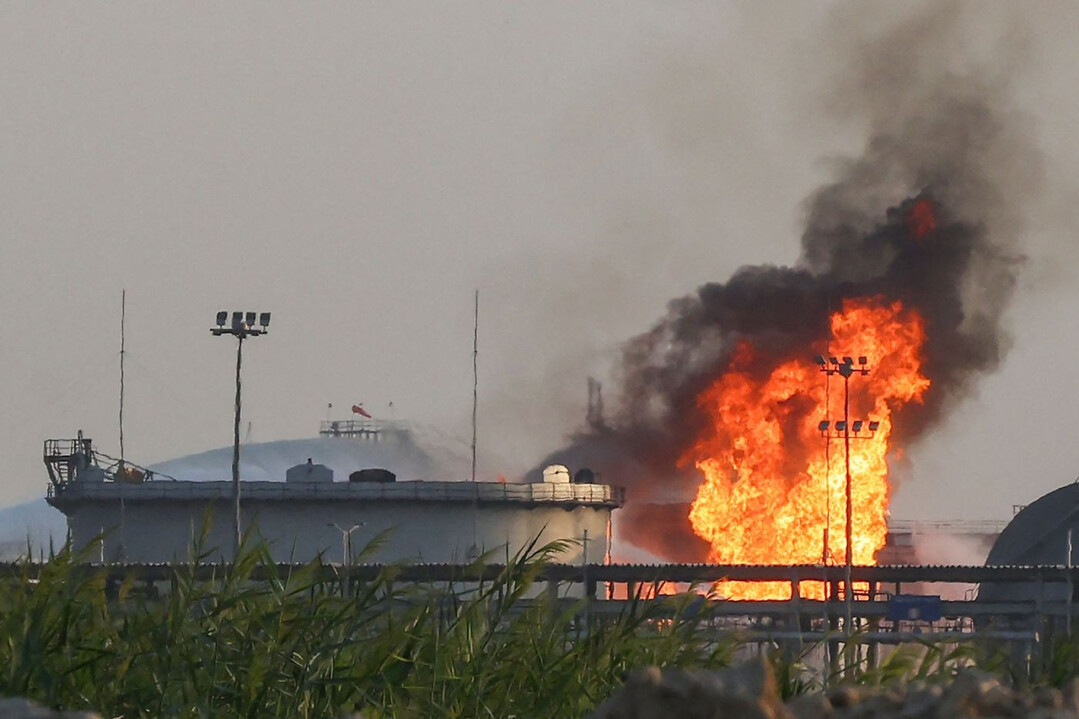
The conflict between Saudi Arabia and Yemen's Iran-backed Houthi rebels has intensified. On the 13th (local time), damages cascaded as a fire broke out at the headquarters of Aramco, the state-owned oil company that underpins the Saudi national economy.
With growing concerns over airport safety driven by the Houthi rebels' successive attacks, nearly half of Saudi Arabia's skies have been effectively closed.
Meanwhile, U.S. President Donald Trump hinted at the possibility of launching retaliatory strikes targeting the Houthi rebels following the November midterm elections.
The Saudi Ministry of Energy announced via X (formerly Twitter) that an Aramco office building in Dhahran, Eastern Province, was attacked, resulting in a small-scale fire with no casualties reported.
The fire broke out shortly after the Saudi military issued an alarm that multiple missiles fired by Houthi rebels were heading toward the eastern region, a major Saudi oil-producing area.
Citing an Aramco official, Reuters reported that a ballistic missile struck the Dhahran complex housing Aramco's headquarters, damaging the top three floors of an office building.
Aramco is Saudi Arabia's state-owned petrochemical and oil corporation and the core axis of the Saudi economy. Interpretations suggest that the fact Houthi forces carried out an airstrike targeting Aramco's headquarters carries immense symbolic weight in this conflict.
Damages also continued to pile up in the Saudi capital of Riyadh.
According to Saudi civil defense authorities, debris from two intercepted Houthi missiles fell on a residential area in Riyadh, injuring four civilians and damaging 15 homes.
The military also disclosed that it intercepted a missile in Al-Kharj, a Saudi Air Force military stronghold city located about 80 kilometers southeast of Riyadh.
The Saudi-led coalition also launched preemptive airstrikes on major fuel and military facilities, including the Houthi-controlled Yemeni capital of Sanaa.
Turki al-Maliki, spokesperson for the coalition, announced, "It was confirmed by the joint command headquarters that Houthi rebels were exploiting civilian facilities and critical infrastructure for military purposes, prompting us to execute precision military operations to neutralize them."
Al-Maliki explained that key targets included the Al-Sabaha central base (refueling and charging facilities) and underground reserve fuel storage in the capital Sanaa, as well as fuel transport and offloading storage tanks and piers in Hodeidah, Sanaa, and Dhamar.
He pointed out, "The Houthi rebels hijacked resources desperately needed by the Yemeni people and directly diverted them to support terrorist activities. These facilities were used to fill arsenals of missiles and unmanned aerial vehicles (drones) that threaten the safety of airports, ports, and merchant vessels in Saudi Arabia and the Red Sea."
The airstrikes were executed immediately after the coalition issued an emergency evacuation order to civilians near the targeted facilities.
The strikes are interpreted as a retaliatory measure against the recent devastating blow inflicted by Houthi rebels on Riyadh International Airport.
Previously, Houthi rebels targeted major airports for a week in defiance of Saudi Arabia's intervention in the Yemeni civil war. On the 10th, a missile attack targeting Riyadh's King Khalid International Airport killed 13 people, marking the worst civilian casualty toll in Saudi Arabia in the past decade.
With the Houthi attacks continuing, it is estimated that more of 3,120 flights scheduled to depart from airports across Saudi Arabia have been canceled or grounded since the 8th.
This accounts for approximately 41% of originally scheduled departures. The 3,120-plus flights include about 300 flights that were scheduled to depart on the 14th (local time).
Some airlines have suspended flights to Saudi Arabia citing Houthi airport attacks, according to the AP.
Battles between the Saudi-backed Yemeni government forces and Houthi rebels are also intensifying.
According to Yemen's Ministry of Interior, attacks by Houthi rebels targeting the southwestern city of Taiz resulted in 6 deaths and 18 injuries over the past 24 hours as of the 13th.
A Yemeni government military commander stated, "The battle surrounding Taiz, which has long been an object of contention, has entered a critical phase."
The reignited Yemeni civil war has taken on a rapidly escalating expansion phase, compounded by the spillover effects of the recently triggered conflict between the United States and Iran.
Following Iran's blockade of the Strait of Hormuz in February, Houthi rebels seized the Bab el-Mandeb Strait at the entrance of the Red Sea—a vital energy shipping detour—cutting off Saudi Arabia's oil export routes.
Saudi Arabia is deploying a large-scale military operation to push back Houthi forces that have advanced near the strait.
Amidst these developments, President Trump and Turkish President Recep Tayyip Erdogan held phone calls with Crown Prince Mohammed on the same day to discuss the situation.
Iran, Saudi Arabia's arch-rival in the region and a supporter of the Houthi rebels, stated the previous day that it would step in to mediate between the two sides.
As the situation spirals into a worsening crisis, attention is focusing on how actively the United States will intervene in the clash between Saudi Arabia and the Houthis.
President Trump wrote on Truth Social, "The Houthi rebels are behaving very badly. Even after the midterm elections are over, I will still be in this seat [the presidency], and I will never forget."
This is interpreted to mean that, regardless of the outcome of the midterm elections, President Trump—remaining in office—could order retaliatory strikes against the Houthis.
Attention is also focused on whether regional nations such as Turkey and Syria will join the campaign to repel the Houthis.
[Copyright (c) Global Economic Times. All Rights Reserved.]