![[등록] 2026-09-01 15:48:31](/support/_updata/banner2/tl181982910_6749.png)


As French student protests entering their near-month-long streak continue, slogans are emerging threatening to recreate the "1968 Revolution" that shook French society 58 years ago. Demands from high school students for improved educational environments have snowballed into nationwide resistance joined by university students, teachers, and teacher unions, drawing renewed attention to history—when even Charles de Gaulle, revered as the founding father of France, was driven to a crisis.
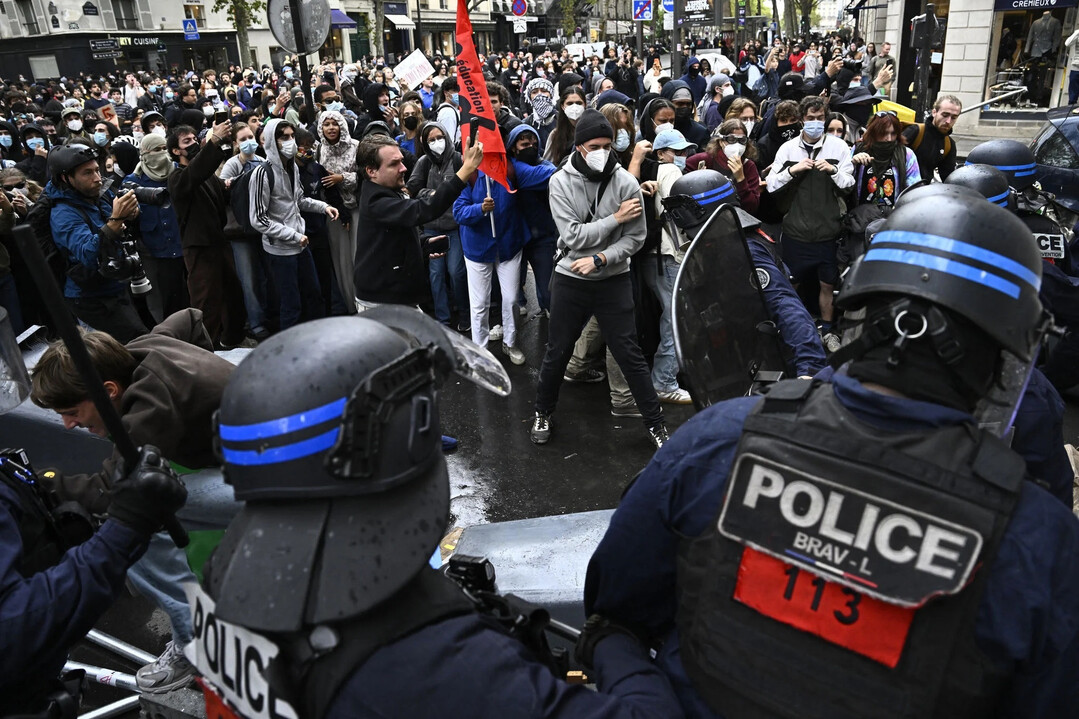
On the 13th (local time), education reform protests held across France drew 161,500 participants according to the Ministry of the Interior, and up to 480,000 according to organizers. Some students marched holding placards reading, "If you mess with us, we’ll show you May 1968 again." It is a warning that if their demands are not met, they will embark on large-scale resistance akin to the 1968 Revolution.
In Paris, clashes broke out, including vehicle arson and police suppression using tear gas and water cannons. The protests began on the 21st of last month when high school students in the Paris suburbs protested against a shortage of teachers, dilapidated school facilities, and overcrowded classrooms. Since then, university students, teachers, parents, and teacher unions have joined in, spreading the movement nationwide.
The number of people arrested has already exceeded 6,800, with 86% being minors. Jean-Luc Mélenchon, leader of the hard-left France Unbowed (LFI), actively encouraged participation, calling it "the most powerful high school and university student movement since May 1968," and personally attended the Paris protest on the 13th.
The 1968 Revolution invoked by the protesters was an event that shook the power of President de Gaulle, a national hero who led the Free French Forces against Nazi Germany during World War II. At the time, France had achieved high economic growth and raised living standards, but as the post-World War II baby boom generation entered universities in droves, dissatisfaction grew over the lack of educational facilities and authoritarian university administration.
The protests, which began in March 1968 at the University of Nanterre in the outskirts of Paris, spread to the Sorbonne in central Paris in May. When police arrested students and forcibly dispersed the protests, students fought back by building barricades. Labor unions, protesting the police crackdown, joined the movement, pushing the resistance beyond the university walls.
Workers went on a general strike demanding improved working conditions, with up to about 10 million participating as factories were occupied across the country, bringing French society to a near standstill. President de Gaulle weathered the immediate crisis by dissolving parliament and calling snap elections, but resigned the following year after losing a national referendum. The slogan chanted by students at the time, "It is forbidden to forbid," embodied the desire to change not only university reforms but also the authority of the older generation and the existing social order.
Like the 1968 Revolution, today's protests evoke memories of the past in that grievances starting in schools have escalated through clashes with police and spread across society. However, while university students took to the streets first and workers followed in 1968, today's protests have been spearheaded by high school students, with university students, teachers, and labor unions joining in afterwards.
Both protests originated from educational issues, but their demands differ. While students in 1968 sought to change the social order itself beyond the authoritarianism of universities amidst economic prosperity, today's students are demanding improvements to basic educational conditions amidst national financial hardship. They are calling for the recruitment of teachers and the expansion of education budgets, complaining of overcrowded classrooms with up to 35 students and classrooms vulnerable to heatwaves.
Meanwhile, student protests are continuing not only in France but in other European countries as well. In Tirana, the capital of Albania, hundreds of university students protested on the 13th demanding better educational environments and the resignation of Prime Minister Edi Rama. In Liège, eastern Belgium, student protests against education reforms and budget cuts have intensified since the 5th of this month, resulting in over 200 arrests. On the 9th in the capital city of Brussels, students opposing educational reforms joined a trade union protest against government austerity policies.
[Copyright (c) Global Economic Times. All Rights Reserved.]