![[등록] 2026-09-01 15:48:31](/support/_updata/banner2/tl181982910_6749.png)


(C) AOL.com
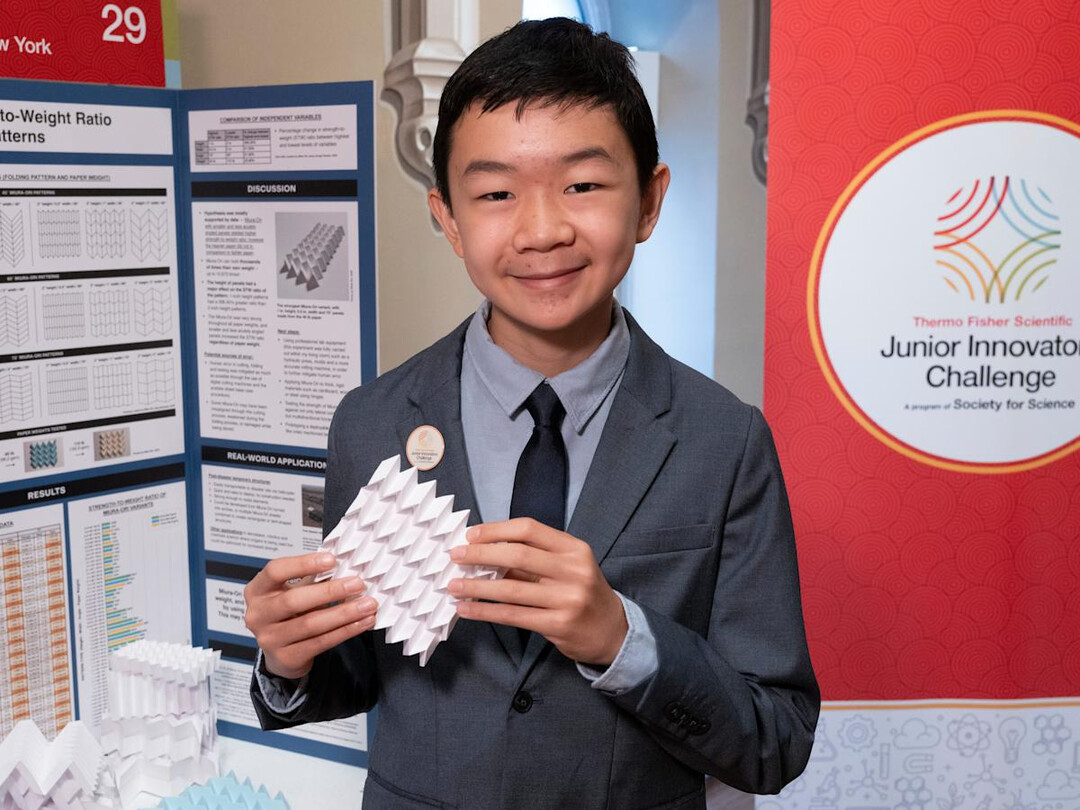
A 14-year-old boy has clinched a $25,000 prize (approximately 37 million KRW) for a groundbreaking research project that integrates the ancient art of origami with the principles of physics. His innovative work is being hailed for its potential to aid in the creation of robust, deployable structures suitable for emergency and disaster relief situations.
Miles Woo, a resident of New York, USA, was awarded the top prize last month at a competition hosted by the global science company Thermo Fisher Scientific to select exceptional young innovators, according to a November 28th (local time) report by Business Insider.
Woo’s award-winning entry showcased an origami pattern designed to mitigate structural damage in the wake of disasters and catastrophes. His research proposes a structural form that, through the strategic application of various paper-folding techniques, can withstand significantly greater loads and stresses.
The inspiration for his remarkable project stemmed from learning about natural disasters, such as the devastating wildfires that erupted in Southern California this January, and the powerful hurricanes that swept through the southeastern United States last year.
"Tents are sometimes strong, sometimes really compressed to be small, and sometimes easily deployed, but rarely are they all three," Woo explained. He expressed confidence that the unique structural forms he developed could resolve this critical trade-off faced by current emergency shelter designs.
Woo's research lies at the intersection of origami and engineering, a rapidly expanding field known as 'origami engineering.' This discipline leverages the mathematical principles underlying paper folding to design functional, scalable structures—from miniature medical devices to massive space telescopes. By demonstrating how specific folds can maximize a structure's rigidity and load-bearing capacity while maintaining a compact, storable form, Woo has contributed a tangible solution to the logistical challenges of disaster relief.
His work suggests that structures utilizing his pattern could be pre-folded and transported to disaster zones with minimal effort and space. Once deployed, the same structure would transform into a surprisingly durable shelter or support unit, capable of protecting inhabitants and essential supplies from adverse conditions.
The $25,000 award not only recognizes Woo's technical acumen and creativity but also underscores the growing recognition of how fundamental scientific curiosity—even applied through an art form like origami—can lead to practical, life-saving innovations. Woo's achievement serves as an inspiring example of how young minds, guided by observation and ingenuity, can address complex real-world problems. His success is expected to motivate his peers to pursue scientific and engineering studies with a similar interdisciplinary approach.
[Copyright (c) Global Economic Times. All Rights Reserved.]