![[등록] 2026-09-01 15:48:31](/support/_updata/banner2/tl181982910_6749.png)


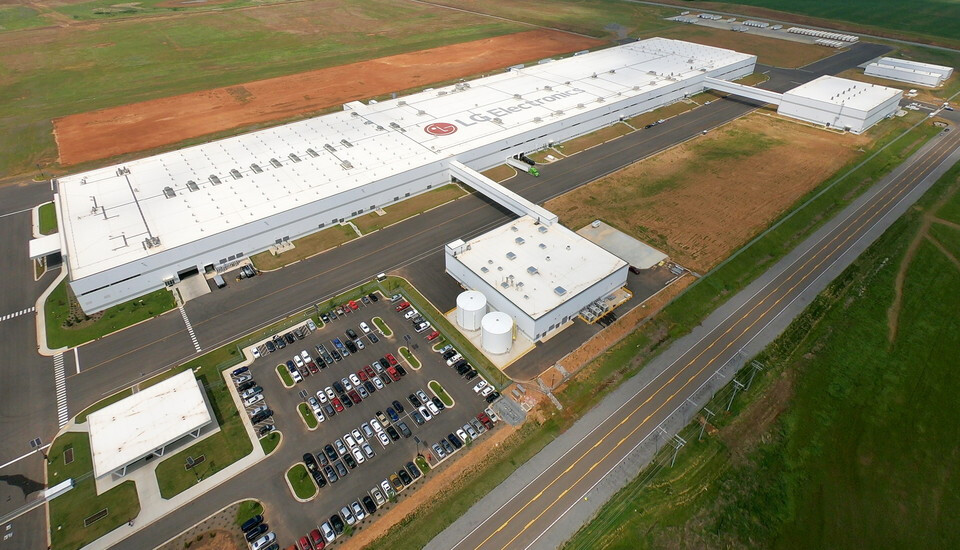
About an hour's drive from Nashville International Airport in Tennessee lies the tranquil town of Clarksville. Upon entering LG Electronics' Tennessee plant, the first sight that captures attention is the fleet of over 170 autonomous mobile robots (AMRs). These robots diligently transport injected plastic components and processed metal sheets. Materials ascend to the second-floor parts assembly line via vertical conveyor belts, and the assembled components then descend back to the first floor for the final product manufacturing process.
This sprawling production facility, covering an area equivalent to 13 soccer fields, earned the prestigious 'Lighthouse Factory' designation from the World Economic Forum (WEF) in 2023 – a first for a Korean company's overseas plant. Adding to this industrial beacon, LG Chem is constructing its largest US-based and first domestic automotive battery cathode material plant in the vicinity, slated to commence operations by the end of the year. Much like a lighthouse guiding ships with its beam, LG's advanced technology factories are rapidly illuminating the manufacturing landscape of Tennessee.
● LG's Lighthouse Factory Transforms a US Small Town
[Image Caption: The production process inside LG Electronics' Tennessee plant. This factory has an annual production capacity of 2.15 million units of washing machines and dryers. Provided by LG Electronics]
Inside LG Electronics' Tennessee plant, on the final product assembly line, production workers were engaged in intricate wiring tasks and product inspections – tasks that require human dexterity beyond the capabilities of robots. The fully assembled washing machines and dryers moved to the end of the line, awaiting shipment. From raw material production to assembly, inspection, and packaging, an 'integrated production' system was operating seamlessly under one roof.
LG Electronics invested $462 million (approximately 670 billion Korean won) to establish this home appliance plant in Tennessee. Starting with washing machine production in 2018 with around 600 employees, they expanded to dryer production in 2022, adding another 200 jobs. Currently, over 800 individuals are employed at the factory. Including employees of partner companies involved in environmental management and landscaping, LG Electronics has created over 1,000 jobs in the area. A factory representative noted that "the majority of our workers are from Clarksville, Tennessee, or the neighboring state of Kentucky."
This unfamiliar Korean company has profoundly transformed the town itself. As LG Electronics established its plant and hired local residents, Clarksville began to revitalize. The creation of jobs led to an influx of new residents, necessitating the construction of new schools for their children. Notably, housing prices in the area have surged nearly threefold since 2018, just before the LG Electronics plant was completed.
LG is establishing the Tennessee region as an 'LG production hub.' LG Chem is investing approximately 2 trillion Korean won to build an electric vehicle battery cathode material plant on a 1.7 million square meter site near the LG Electronics factory. This plant, scheduled for commercial operation by the end of this year, will employ around 400 people and produce 60,000 tons of cathode materials annually – enough for approximately 600,000 electric vehicles. Plans for a second phase expansion are also underway, potentially doubling the hiring scale. About two hours away, another LG affiliate, LG Energy Solution, has also established a battery manufacturing plant. The continuous influx of LG's investment in Tennessee has even prompted Austin Peay State University in the region to establish a Korean language course.
● Forum Held for Investing Companies
Southern US states like Tennessee actively court businesses and job creation by offering incentives such as tax breaks and land provision. They are also known for streamlining bureaucratic processes that could hinder business activities and providing 'one-stop' solutions for infrastructure-related grievances, including electricity and road networks. Chattanooga, another small city in southern Tennessee, serves as a prime example. To revitalize the city, Chattanooga offered tax benefits and free land, successfully attracting a Volkswagen plant in 2011. More recently, it invested in a city-wide high-speed fiber optic network, attracting remote workers and other newcomers. With global companies like LG and Volkswagen establishing roots, Tennessee, traditionally known for its whiskey and country music, is transforming into a burgeoning industrial hub in the Southeast.
LG's bold investment in establishing its plants in Tennessee was also facilitated by significant investment support from both the federal and state governments. Speaking at the 'Tennessee Manufacturing Forum' hosted by the Tennessee Chamber of Commerce and Industry, Koh Yun-joo, Chief Sustainability Strategy Officer (CSSO) and Executive Vice President of LG Chem, stated, "Constructing the same cathode material plant in the US costs three times more than in Korea and five times more than in China. LG Chem's investment in the US was significantly enabled by government subsidies." The forum brought together local stakeholders from businesses, the state government, and academia to discuss the government's role in attracting jobs and revitalizing manufacturing.
[Copyright (c) Global Economic Times. All Rights Reserved.]