![[등록] 2026-09-01 15:48:31](/support/_updata/banner2/tl181982910_6749.png)


(C) Descifrando La Noticia
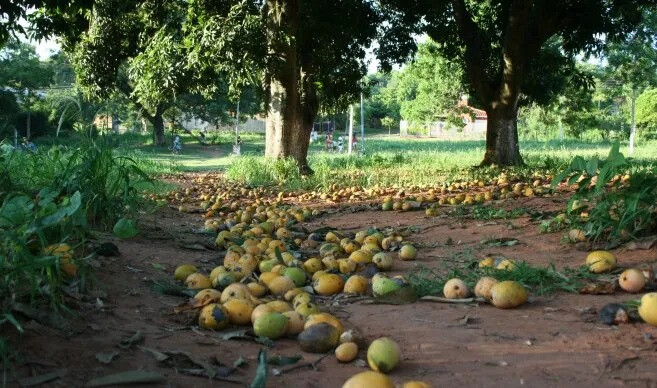
The deep scars left by climate change are increasingly visible in Belém, Brazil, the so-called "Mango City." During the 30th Conference of the Parties to the UNFCCC (COP30) in mid-November, the 'Mango Rain' (chuva de manga)—the season when fully ripened, yellow mangoes drop from the roadside trees—failed to live up to its long-held reputation.
Belém's mango trees are the result of an urban planning project initiated 120 years ago. Planted on a large scale during the rubber export boom of the 1900s with the aim of creating a "Paris of the Tropics," these trees thrived in the hot and humid environment, providing citizens with dense shade and food. Resident Henrique proudly described them as "a gift," stating, "Around this time, we can pick up clean mangoes right off the street. They are so common and appreciated that supermarkets here don’t even sell them."
The Vicious Cycle of Extreme Weather: Wilted Trees and Rotting Fruit
However, the mango trees witnessed on Belém’s streets this year were clear victims of extreme weather. Despite being mid-November, most fruits were green instead of yellow, and many were rotting while still hanging on the branches before they could ripen. Just as apple trees in some regions suffer from extreme weather, Belém’s mango trees are facing a survival crisis.
Henrique noted, "Twenty years ago, we used to harvest the fruit starting in October, but since around 2020, the ripening period has been pushed to November. Lately, many mangoes rot before they ripen." The sight of trees with most of their leaves shriveled brown visibly demonstrated the damage from heat stress caused by soaring temperatures, heavy rainfall, and intensifying storms.
Andrew Leal, a researcher at a local environmental institute in Belém, pointed to the increasingly frequent extreme weather, including record rainfall during last year's wet season (January–May) and torrential rain this year even during the dry season (mid-November), which is the period of the Climate Summit. He warned, "Dozens of mango trees that rotted due to severe drought and heat during the dry season are falling during the wet season storms, turning into weapons that repeat annually." Brazil's National Institute for Meteorology announced that the last summer was the hottest on record, $0.34^{circ}text{C}$ above the 1990s average, with Belém experiencing prolonged heat waves reaching a maximum of $37.3^{circ}text{C}$, leading to reduced tree growth and weakened pest resistance.
Amazon Deforestation and Urban Sprawl Fuel the Catastrophe
Compounding the problem is the fact that unplanned urban development and the destruction of the Amazon rainforest are accelerating Belém’s extreme weather phenomena. Southern Belém, characterized by unplanned settlements with insufficient trees, suffers from severe 'heat island' effects. Research by Belém's environmental institute showed that the surface temperature in the southern Terra Firme district was $10^{circ}text{C}$ higher than forested areas due to heat absorption by concrete and asphalt. Leal explained that the reduction in green spaces exacerbates the heat island effect, subjecting the mango trees to even greater heat stress.
The continuous deterioration of the Amazon rainforest surrounding Belém is pushing the mango trees into an even harsher environment. Data from Brazil’s National Institute for Space Research shows that in 2023 alone, an area of the Amazon roughly 15 times the size of Seoul (9,100 square kilometers) was deforested. Even during the Climate Summit, intentional burning of the primary forest for farm expansion was observed. A Greenpeace Brazil activist emphasized that "intentional arson for development has turned the Amazon into a 'carbon bomb' that emits greenhouse gases." He stressed that if deforestation is not halted, the extreme climate threatening the survival of the mango trees will inevitably worsen.
Staring at the blackening, rotting fruit, Henrique commented forlornly, "The disappearance of the mango trees means the collapse of this city and its people’s way of life." The 100-year-old tradition of Belém's mango rain, now fading amidst the environmental disaster created by humans, has become a silent warning that climate change has deeply infiltrated our lives.
[Copyright (c) Global Economic Times. All Rights Reserved.]