• 2026.08.28 (Fri)
  • All articles
  • LOGIN
  • JOIN
Global Economic Times
fashionrunwayshow2026
  • Synthesis
  • World
  • Business
  • Industry
  • ICT
  • Distribution Economy
  • Well+Being
  • Travel
  • Eco-News
  • Education
  • Korean Wave News
  • Opinion
  • Arts&Culture
  • Sports
  • People & Life
    • International Student Report
    • With Ambassador
  • Column
    • Cho Kijo Column
    • Cherry Garden Story
    • Ko Yong-chul Column
    • Kim Seul-Ong Column
    • Lee Yeon-sil Column
  • Photo News
  • New Book Guide
MENU
 
Home > World

Double Standards in India: The Political Storm Over Female Protesters’ Profanity 

Hwang Sujin Reporter / Updated : 2026-08-28 07:25:21
  • -
  • +
  • Print


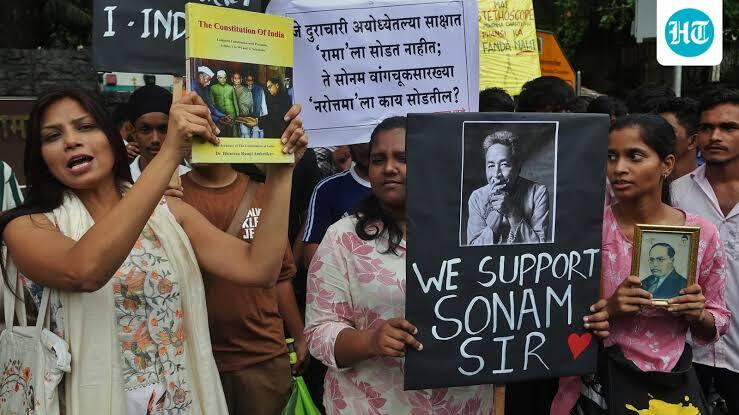
The recent student-led protests in India have triggered a fierce national debate, expanding far beyond the original grievances into a larger controversy over gender equality, patriarchal mindsets, and the political speech of women.

The controversy erupted following weeks of protests organized by the Cockroach Janta Party (CJP) in Delhi and other cities, where demonstrators demanded accountability and the resignation of Education Minister Dharmendra Pradhan over examination paper leaks. During these demonstrations, viral videos emerged showing young participants directing profanity and harsh criticism at Prime Minister Narendra Modi. 

The situation took a severe turn for a 15-year-old girl who became the primary target of the backlash. Although she deleted her video and issued a public apology, she and her family faced relentless online harassment, vicious trolling, and even rape threats, forcing them to move multiple times. While the CJP defended the use of strong language as a traditional form of protest expression that does not constitute a crime, Prime Minister Modi addressed the issue in a social media video. He expressed a "cultural shock" at hearing young girls use such language against him, questioning how "our daughters" could utter such words, though he ultimately stated he was ready to forgive these "mischievous children". However, critics noted that his response failed to address the heavy-handed police crackdowns on student protesters or the alarming torrent of sexual threats directed at the female participants. 

This singular focus on the gender of the protesters drew sharp rebukes from opposition leaders. Rahul Gandhi, addressing a major student gathering in Pune, heavily criticized the Prime Minister's remarks. He questioned the underlying double standard, asking, "Why is there no problem when boys use profanity, but it becomes a 'cultural shock' when girls do it?" Gandhi argued that singling out female protesters exposes a deeply entrenched patriarchal mindset in Indian politics—one that grants absolute freedom and leniency to men while strictly policing and controlling women's behavior. 

Gender experts and journalists have echoed these concerns, pointing out that female political dissent is frequently met with a disproportionate severity of attacks. Societal double standards are evident when considering that while certain traditional cultural practices in northern India even incorporate playful or explicit language among women, a woman stepping into the political sphere and using strong language is instantly demonized and subjected to gender-based violence and online abuse. Furthermore, critics have highlighted Prime Minister Modi's own history of controversial remarks regarding women—ranging from past political jibes to diplomatic missteps like referring to foreign female leaders with diminutive familial titles—as symptoms of a broader hierarchical and patronizing view of women in public life. 

Ultimately, sociologists and political analysts view this uproar as a grim symptom of declining democratic discourse. As aggressive rhetoric, insults, and hyper-polarization increasingly infiltrate Indian politics, the weaponization of misogyny against young female activists reveals that India's political arena still struggles heavily with basic gender equality and mutual respect.

[Copyright (c) Global Economic Times. All Rights Reserved.]

  • #\ormuz Impasse
  • #globaleconomictimes
  • #micorea
  • #mykorea
  • #nammidonganews
  • #singaporenewsk
  • #Samsung
  • #Daewoo
  • #Hyos
Hwang Sujin Reporter

Popular articles

  • Japan Estimated to Have Spent ¥6–7 Trillion in Fresh Yen-Buying Intervention as US Joint Action Hints Emerge

  • Goldman Sachs Maintains KOSPI Target at 12,000, Citing "Excessive Market Fear"

  • South Korea to Revive Pro-Japanese Asset Recovery: New Law Targets "Disposed" Property

I like it
Share
  • Facebook
  • X
  • Kakaotalk
  • LINE
  • BAND
  • NAVER
  • https://globaleconomictimes.kr/article/1065565476969498 Copy URL copied.
Comments >

Comments 0

Weekly Hot Issue

  • South Korean National Team Defender Seol Young-woo Completes Dream Transfer to German Bundesliga Side FC Augsburg on a Four-Year Deal
  • "Kim Sang-sik Magic": Vietnam Defeats Thailand to Claim Second Consecutive ASEAN Hyundai Cup Title
  • The Return of the Bunt Era in Major League Baseball: A Strategic Countermeasure to the Velocity Revolution
  • A "Little Red Dot" Spotted in Deep Space: Is It a Black Hole or a Baby Galaxy?
  • Unlocking a Century-Old Venusian Mystery: New Quantitative Clues Shed Light on Venus's Elusive UV Patterns
  • Kim Jae-joong Unveils His Luxury Tokyo Detached House for the First Time: Featuring a 4-Meter High Ceiling and a Private Elevator 

Most Viewed

1
KOSPI Nears 7,000 Milestone with a 2.4% Surge, Riding a Five-Day Winning Streak Market Overview: A Powerful Weekly Rally
2
Samsung Electronics Enters a Strong Recovery Phase, Eyeing a Potential Rebound Past Recent Lows
3
South Korea to Revive Pro-Japanese Asset Recovery: New Law Targets "Disposed" Property
4
Record-Breaking Deluge Batters Chiba: 8 Dead, Thousands Stranded in Night of Chaos
5
"Why Is Coupang Delivering While My Package Is Stuck?"—The 2026 Delivery Shutdown and What You Need to Know
광고문의
임시1
임시3
임시2

Hot Issue

'K-Hydropower' Concentrated in South Asia Faces Rising Risks: Urgent Need for Comprehensive Disaster Response Systems

Samsung Speeds Up 'AI Transformation': Executive Evaluation Expansion Across All Affiliates

The Autonomous Driving Era Approaches: Automotive Industry Fiercely Competes Over "Running Screens"

Beyond China’s Ambition: Will YMTC’s Push to Overtake Samsung and SK Hynix Become Reality?

Fashion Runway Show 2026

Global Economic Times
korocamia@naver.com
CEO : LEE YEON-SIL
Publisher : KO YONG-CHUL
Registration number : Seoul, A55681
Registration Date : 2024-10-24
Youth Protection Manager: KO YONG-CHUL
Singapore Headquarters
5A Woodlands Road #11-34 The Tennery. S'677728
Korean Branch
Phone : +82(0)10 4724 5264
#304, 6 Nonhyeon-ro 111-gil, Gangnam-gu, Seoul
Copyright © Global Economic Times All Rights Reserved
  • 향기네무료급식
  • BCB부천방송
  • 반달곰 프로젝트
Search
Category
  • All articles
  • Synthesis
  • World
  • Business
  • Industry
  • ICT
  • Distribution Economy
  • Well+Being
  • Travel
  • Eco-News
  • Education
  • Korean Wave News
  • Opinion
  • Arts&Culture
  • Sports
  • People & Life 
    • 전체
    • International Student Report
    • With Ambassador
  • Column 
    • 전체
    • Cho Kijo Column
    • Cherry Garden Story
    • Ko Yong-chul Column
    • Kim Seul-Ong Column
    • Lee Yeon-sil Column
  • Photo News
  • New Book Guide
  • Multicultural News
  • Jobs & Workers