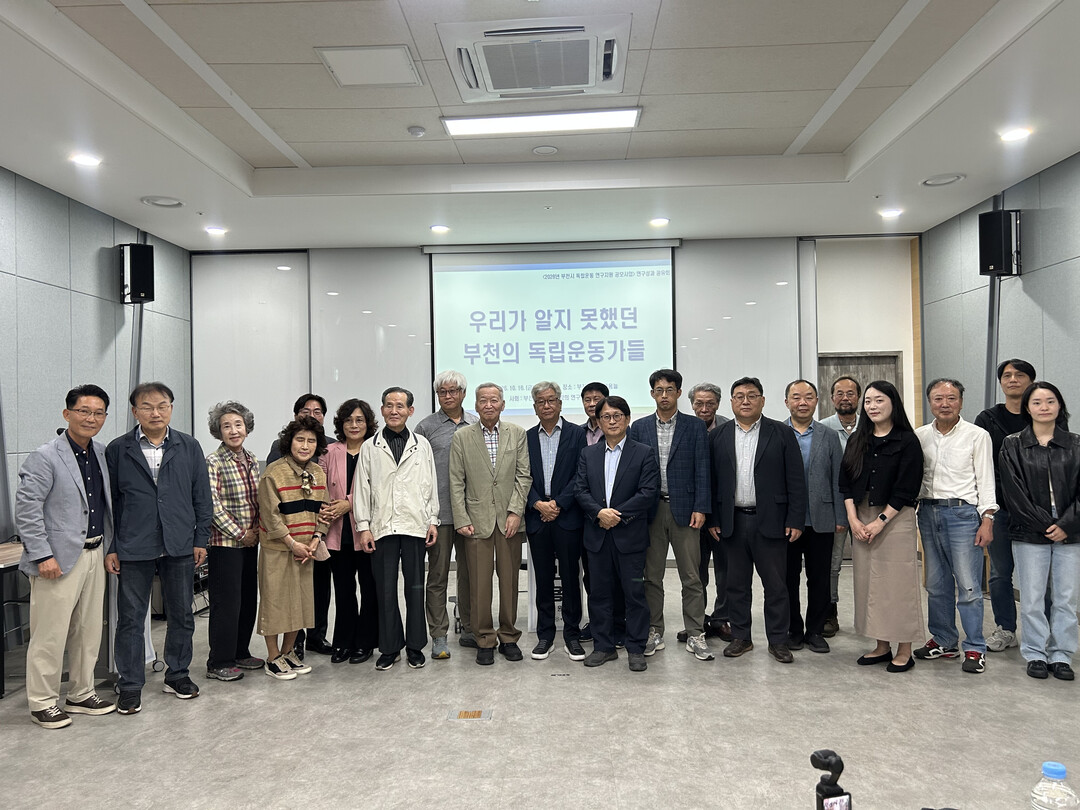
On October 16, 2026, the Bucheon Cultural Center (Director Kwon Soon-ho) hosted an achievement-sharing seminar to unearth and reilluminate the independence activists of Bucheon during the Japanese colonial period, as part of the "Bucheon City Anti-Japanese Independence Movement Research Support Public Project."
Held at the Bucheon Cultural Center, the event served as a meaningful occasion for modern and contemporary Korean history researchers from the Bucheon Cultural Center and external experts to share their research findings with Bucheon citizens. In particular, the seminar featured presentations and discussions shedding light on the family and activities of Nam Gwang-won, the sole righteous army leader originating from Bucheon; the tenant-farming resistance movement by Bucheon farmers in the 1920s; and the anti-Japanese independence movement patterns of employees at Yuhan Corporation, a representative national enterprise in Bucheon during the 1940s.
Co-organized by the Bucheon Welfare Policy Division and the Bucheon Cultural Center, this project was designed to discover and research independence activists originating from or active in Bucheon during the Japanese colonial period. Notably, through this research project, the tombstone, genealogical records, and descendant interviews of Nam Gwang-won, a righteous army leader from Wonjong-ri, Bucheon, were newly discovered.
Furthermore, full-scale research was conducted for the first time on the tenant-farming resistance movement by the Bucheon Farmers' Association, which was discovered during the research process regarding the Bupyeong Irrigation Association. In addition, the activities of patriots Oh Sang-heum and Jeong Moon-gyu—who attempted to assassinate Governor-General Saitō of the Japanese Government-General in the 1940s, a period when domestic independence movements had entered a lull—were analyzed in detail, drawing significant attention.
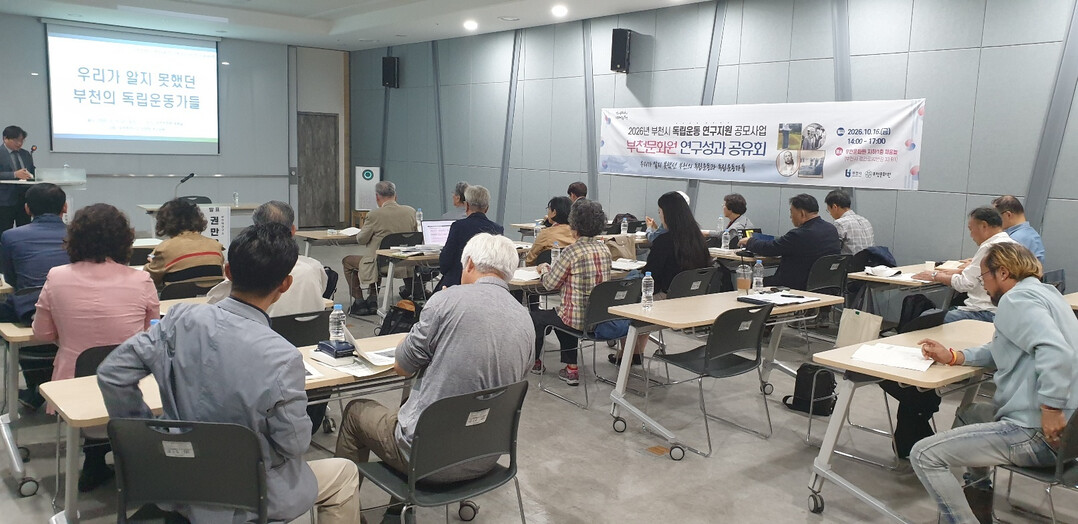
The first presentation was delivered by Kwon Man-yong, a researcher at the Bucheon Institute of Korean Studies, focusing on the lineage of the Uiryeong Nam clan centered in the Wonjong-dong area and Nam Gwang-won, Bucheon's sole righteous army leader. Research results revealed that Righteous Army Leader Nam Gwang-won was a descendant of the Gyowi-gong lineage within the Chunggan-gong branch of the Uiryeong Nam clan, and his family had resided in Wonjong-ri, Ojeong-myeon, Bucheon-gun for five generations or more.
After stepping down as an administrative officer at Gwangjewon before the Eulsa Treaty of 1910, Nam conducted righteous army activities in Sutgol, Impi-myeon, Gunsan, Jeollabuk-do, where he was arrested, and later passed away right after liberation in 1945. Notably, the tombstone of Righteous Army Leader Nam Gwang-won, discovered for the first time through this effort, is included as an appendix.
Next, Jang Jeong-gyu, a researcher at the Bucheon Institute of Korean Studies, presented research findings on the peasant uprisings in the Bucheon area that occurred following the establishment of the Bupyeong Irrigation Association. The presentation held profound significance as it was based on materials concerning the Bupyeong Irrigation Association collected by the Bucheon Cultural Center in 2025.
In particular, the presentation highlighted historical facts: how the numerous harms and side effects caused by the "Bupyeong Irrigation Association," established in 1914, subjected a majority of Korean tenant farmers in Bucheon to unfair treatment, leading them to form a farmers' association and engage in resistance movements rejecting irrigation association fees and tenant farming rates. It also comprehensively illuminated how the Japanese landowner, who served as the association head, colluded with construction contractors for shoddy construction, and how a massive flood in 1925 required enormous recovery costs, leading to an attempt to impose the ballooning debts of the association onto Korean tenant farmers, which ultimately sparked the tenant farming fee resistance. Furthermore, opinions emerged suggesting the need to locate the site of the "Megari" factory, where some 4,000 tenant farmers successfully united against landlord tyranny and triumphed in their tenancy fee struggle, adding great interest.
Thirdly, Kim Myeong-hwan, a lecturer at Konkuk University, delivered a presentation highlighting the national movement of Jeong Moon-gyu and Oh Sang-heum, employees of Yuhan Corporation and forgotten independence activists of Bucheon in the 1940s. Lecturer Kim surprised the audience by revealing that, based on Bucheon's current administrative district boundaries, Nam Gwang-won is the sole independence activist originating from Bucheon during the Japanese colonial period, and only three independence activists (Jeong Moon-gyu, Oh Sang-heum, and Lee Yeon-hyeong) were active within Bucheon.
After explaining the growth of Bucheon in the 1940s centered around Sosa Station and the significance of the relocation of Yuhan Corporation's headquarters, he shed light on the background and meaning behind how Jeong Moon-gyu and Oh Sang-heum—who were top-tier elites at the time—waged independence movements as employees of Yuhan Corporation, boosting the civic pride of the citizens.
Following all presentations, a comprehensive panel discussion was held, led by moderator Kim Hee-tae (Director of the Bucheon Institute of Korean Studies) along with modern and contemporary history experts. They emphasized the importance of full-scale research on Bucheon's independence activists and shared a consensus on the necessity for specific future research and policies to honor these figures.
Through this achievement-sharing seminar filled with experts and citizens, the Bucheon Cultural Center plans to accelerate its research, content discovery, and civic education regarding Bucheon's independence movement and its activists. In addition, the Bucheon Cultural Center, together with the Bucheon Institute of Korean Studies, is scheduled to host the 4th Bucheon Cultural Center Toponymy Academic Conference on Tuesday, November 10. The center invites the enthusiastic interest of Bucheon citizens who love culture and history. For more information regarding Bucheon Cultural Center events and activities, please visit the official Bucheon Cultural Center website (https://bucheonculture.or.kr/).
[Copyright (c) Global Economic Times. All Rights Reserved.]