![[등록] 2026-09-01 15:48:31](/support/_updata/banner2/tl181982910_6749.png)


(C) Ministry of Foreign Affairs
SEOUL – The South Korean government has officially concluded that the recent fire aboard the HMM Namu-ho in the Strait of Hormuz was the result of a targeted strike by unidentified flying objects. The findings, released on May 10 by a joint government task force, paint a harrowing picture of a precision attack that brought 24 crew members to the brink of a maritime catastrophe.
On the morning of May 4, the silence of the Strait of Hormuz was shattered by a series of deafening explosions. What was initially reported as a potential mechanical failure has now been revealed to be a deliberate "aerial ambush." According to the Ministry of Foreign Affairs, the Namu-ho was struck by two unidentified projectiles that hit the vessel’s port-side aft ballast tank in quick succession, with a gap of only about one minute between impacts.
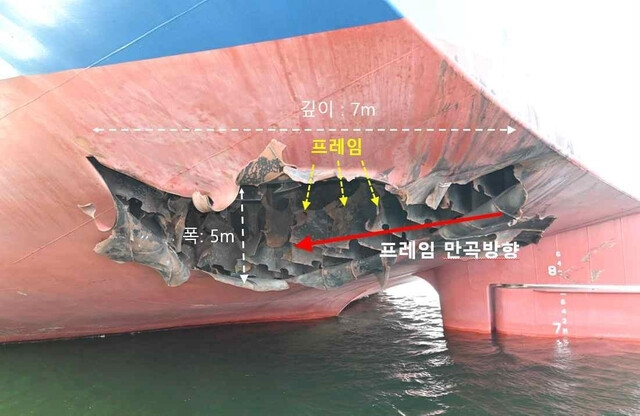
The sheer power of the blasts was staggering. Investigation photos released by the task force show a massive breach in the hull—approximately 5 meters wide and extending 7 meters deep into the ship’s interior. The heavy steel frames of the vessel were crushed inward by the force of the impact, while the outer plating was torn and jaggedly flared outward. "The first strike ignited the fire, and the second strike caused it to spread rapidly," a government official stated. Experts noted that if a third strike had occurred or if the projectiles had hit the engine room directly, the vessel would likely have sunk, leaving the 24 crew members with little hope of survival.
Jun Jeong-geun, chairman of the HMM Seafarers' Union, described the chaos: "The explosion was loud enough to be heard by nearby vessels. It was a massive shockwave that left everyone on board in a state of panic and terror." While early theories suggested an internal gas explosion or a sea mine, the physical evidence tells a different story.
The investigation team pointed out that the damage was located 1 to 1.5 meters above the waterline, effectively ruling out torpedoes or submerged mines. Furthermore, a thorough inspection of the ship’s engine and generators found no mechanical abnormalities. CCTV footage confirmed the presence of flying objects in the vicinity moments before the blasts. However, the exact origin, model, and size of these "unidentified flying objects" remain a mystery, as the forensic evidence at the scene provided no definitive "fingerprints" of the attacker.
This incident has sent shockwaves through the international shipping community, raising urgent questions about the safety of South Korean vessels in the volatile waters of the Middle East. While the fire was extinguished and the crew was saved, the identity of the perpetrator remains hidden in the shadows of the strait.
The South Korean government has vowed to strengthen security protocols for merchant vessels in high-risk zones, but for the 24 sailors of the Namu-ho, the "hellish roar" of that day is a memory that will not easily fade. The mystery of who launched the attack—and why—continues to haunt one of the world's most vital maritime corridors.
[Copyright (c) Global Economic Times. All Rights Reserved.]