• 2026.04.28 (Tue)
  • All articles
  • LOGIN
  • JOIN
Global Economic Times
fashionrunwayshow2026
  • Synthesis
  • World
  • Business
  • Industry
  • ICT
  • Distribution Economy
  • Well+Being
  • Travel
  • Eco-News
  • Education
  • Korean Wave News
  • Opinion
  • Arts&Culture
  • Sports
  • People & Life
    • International Student Report
    • With Ambassador
  • Column
    • Cho Kijo Column
    • Cherry Garden Story
    • Ko Yong-chul Column
    • Kim Seul-Ong Column
    • Lee Yeon-sil Column
  • Photo News
  • New Book Guide
MENU
 
Home > Synthesis

Kurly Abandons 'All-Paper' Packaging Strategy Amid Rising Cost Pressures

KO YONG-CHUL Reporter / Updated : 2026-04-28 08:51:13
  • -
  • +
  • Print


Kurly, the South Korean e-commerce pioneer known for its premium grocery delivery, has officially rolled back its signature "All-Paper" packaging policy, shifting back to plastic and vinyl materials after six years. While the company cites "delivery stability" as the primary reason, industry experts point to the escalating financial burden of eco-friendly materials as the decisive factor.

According to industry sources on April 27, Kurly recently replaced its paper box tapes with standard plastic (OPP) tapes. This marks a significant pivot from the "All-Paper Challenge" launched in 2019, which aimed to minimize plastic waste by replacing vinyl buffers, pouches, and tapes with paper alternatives. Ironically, Kurly was recognized just last July by the Ministry of Environment as an outstanding enterprise for reducing delivery packaging waste.

However, less than a year after that commendation, the company has reintroduced vinyl air bubbles as buffers and is using film-type vinyl for ice packs in refrigerated and frozen shipments. On social media, customers have expressed mixed reactions, with some lamenting the loss of the easy-to-recycle paper tapes.

A Kurly representative explained the shift as a functional necessity, stating, "We switched to vinyl tapes to improve adhesive strength and are mixing vinyl and paper buffers to ensure better delivery stability."

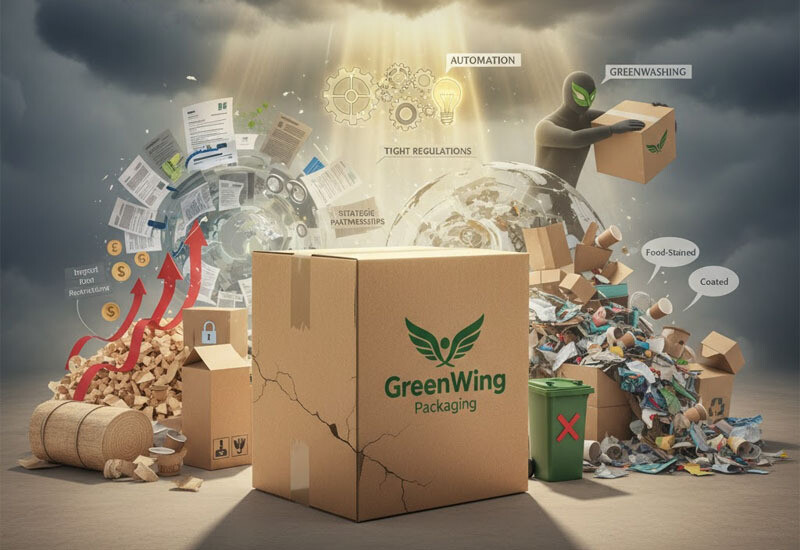
Despite these explanations, the industry consensus is that cost efficiency played a major role. Eco-friendly materials lack the massive production infrastructure of plastic, leading to significantly higher unit prices. "As the e-commerce sector faces intensifying pressure on logistics costs and profitability, packaging materials are becoming a primary target for cost restructuring," an industry insider noted.

This shift highlights a growing dilemma: while consumers and regulators demand sustainability, the lack of subsidies or large-scale production for green materials makes it difficult for corporations to sustain eco-friendly practices in a low-margin environment. Experts argue that for green delivery to expand, more robust institutional support and cost-competitive solutions must be established.

[Copyright (c) Global Economic Times. All Rights Reserved.]

KO YONG-CHUL Reporter
Reporter Page

Popular articles

  • 'Epic Fury' Without an Exit: The Aftermath of Trump’s "Hit-and-Run" Politics

  • Localization of Specialized Semiconductors Complete: 4-Inch Wafer Yield Hits 95%

  • President Lee’s Approval Rating Hits Record High of 67% for Second Consecutive Week: Gallup Korea

I like it
Share
  • Facebook
  • X
  • Kakaotalk
  • LINE
  • BAND
  • NAVER
  • https://globaleconomictimes.kr/article/1065570605942977 Copy URL copied.
Comments >

Comments 0

Weekly Hot Issue

  • The cherry blossoms in South Korea are now falling. We won't be able to see them again until next spring.
  • New Safety Measures for Sports Events
  • A Symphony of Cultures at Arequipa’s Historic Teatro Fénix
  • Tradition Meets the Public: Chungju’s Gugak Busking
  • KOICA Volunteer Enhances Creative Education in Luque, Paraguay
  • The Great River Confluence: A Natural Border at a Crossroads

Most Viewed

1
“Printing Lenses Like Newspapers”: Korean Researchers Unveil Game-Changing Mass Production for Metalenses
2
ASML Sees Surge in South Korean Revenue as Samsung and SK Hynix Accelerate Next-Gen Fab Operations
3
[Interview] Chairman David Cha of ‘Ethiopia Bet’: "Building a House (Bet) of Self-Reliance Beyond Simple Relief"
4
Meta Set to Dethrone Google as Digital Advertising King, Driven by AI-Powered Reels
5
Generative AI Use Triples Among Seoul Citizens, but Digital Divide Persists for Seniors
광고문의
임시1
임시3
임시2

Hot Issue

80% of Enterprises Hit by 'AI Agent Anomalies': SailPoint Calls for Integrated Identity Governance

Korea and Vietnam Forge Strategic Partnership in Science, Technology, and Innovation

University of Utah Asia Campus Hosts ‘2026 Film Festival,’ Showcasing Student Cinematic Excellence

South Korea Fines Paper Cartel $245M for Systematic Price Fixing

Fashion Runway Show 2026

Global Economic Times
korocamia@naver.com
CEO : LEE YEON-SIL
Publisher : KO YONG-CHUL
Registration number : Seoul, A55681
Registration Date : 2024-10-24
Youth Protection Manager: KO YONG-CHUL
Singapore Headquarters
5A Woodlands Road #11-34 The Tennery. S'677728
Korean Branch
Phone : +82(0)10 4724 5264
#304, 6 Nonhyeon-ro 111-gil, Gangnam-gu, Seoul
Copyright © Global Economic Times All Rights Reserved
  • 에이펙2025
  • APEC2025가이드북TV
  • 반달곰 프로젝트
Search
Category
  • All articles
  • Synthesis
  • World
  • Business
  • Industry
  • ICT
  • Distribution Economy
  • Well+Being
  • Travel
  • Eco-News
  • Education
  • Korean Wave News
  • Opinion
  • Arts&Culture
  • Sports
  • People & Life 
    • 전체
    • International Student Report
    • With Ambassador
  • Column 
    • 전체
    • Cho Kijo Column
    • Cherry Garden Story
    • Ko Yong-chul Column
    • Kim Seul-Ong Column
    • Lee Yeon-sil Column
  • Photo News
  • New Book Guide
  • Multicultural News
  • Jobs & Workers