![[등록] 2026-09-01 15:48:31](/support/_updata/banner2/tl181982910_6749.png)


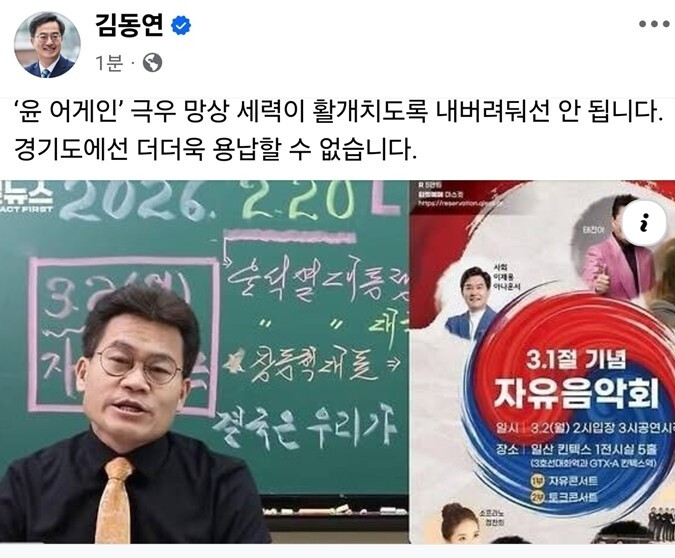
(C) SNS (Facebook)
GOYANG — A major performance venue in Gyeonggi Province has abruptly canceled a scheduled concert following a direct intervention by the provincial governor, sparking a heated debate over political neutrality and public space usage.
KINTEX, South Korea’s largest exhibition center, announced late Monday that it has rescinded its lease agreement for the "March 1st Memorial Freedom Concert," an event headlined by controversial figure Jeon Han-gil. The cancellation comes after Gyeonggi Governor Kim Dong-yeon publicly condemned the event, labeling the organizers as "far-right delusional forces" and urging the venue to block the gathering.
The conflict highlights the tightening grip of administrative oversight on semi-public venues. Gyeonggi Province is a major shareholder in KINTEX, and the venue’s current leadership has deep professional ties to the provincial government. Governor Kim’s vocal opposition left little room for the venue's management to maneuver, leading to a swift termination of the contract just days before the scheduled date.
In a formal statement, KINTEX CEO Lee Min-woo noted that while the event was initially pitched as a patriotic tribute to the 1919 independence movement, its actual trajectory leaned toward a political rally. "We have a responsibility to uphold social norms," Lee stated. "When an event is deemed unacceptable by the public's general standard or is misrepresented during the booking process, we reserve the right to revoke access."
The event’s credibility was further eroded by a "talent exodus." Legendary singer Tae Jin-ah and former broadcaster Lee Jae-yong, who were featured prominently in the concert's marketing, expressed outrage over being associated with the project. Both celebrities claimed the organizers "deceived" them by framing the concert as a non-partisan cultural event.
As the "Jeon Han-gil News" YouTube channel continues to face backlash for its promotional tactics, legal experts suggest the organizers may face potential lawsuits for unauthorized use of celebrity likenesses. Meanwhile, the cancellation serves as a stark reminder of the volatile intersection between South Korean politics and the public arts.
[Copyright (c) Global Economic Times. All Rights Reserved.]