![[등록] 2026-09-01 15:48:31](/support/_updata/banner2/tl181982910_6749.png)


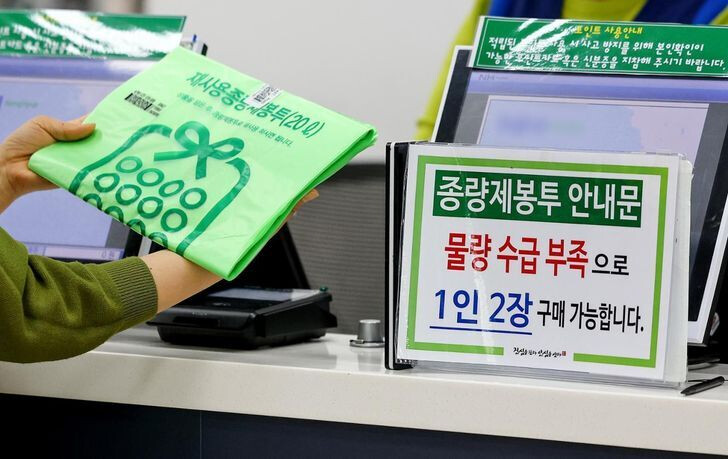
The "Garbage Bag Crisis" Hits the Resale Market
"Selling Seongnam City garbage bags. 30 pieces of 20-liter bags available for bulk purchase."
As the conflict in the Middle East continues to drag on, the shortage of municipal waste bags—a daily necessity—has escalated beyond simple panic buying into a wave of illegal transactions on second-hand trading platforms. According to distribution industry sources on March 30, posts offering garbage bags for sale have been popping up nationwide on major C2C (consumer-to-consumer) platforms. These transactions are strictly illegal, as only businesses authorized by local governments are permitted to sell official waste bags.
The root of this "absurdist drama" lies in the Middle East. The prolonged war has destabilized the supply of naphtha, which is processed into polyethylene—the primary raw material for garbage bags. This has led to significant production bottlenecks, causing a shortage at local convenience stores and supermarkets.
Evading Filters for Illegal Gains
Under Article 14 of the Wastes Control Act, garbage bags can only be sold by entities that have entered into a commission contract with a local government. Violators can face up to five years in prison, a fine of up to 50 million KRW ($37,000), or an administrative fine of 3 million KRW.
Despite these heavy penalties, hoarders who previously stocked up on large quantities are now targeting desperate citizens who cannot find bags for their immediate trash disposal. On the night of March 29, a post appeared on the platform Bungaejangter offering 110 pieces of 75-liter bags for Jungnang-gu at 18,000 KRW.
While the platform lists "Jongnyangje" (volume-based bag) as a restricted search term, sellers bypassed this filter by using terms like "trash bag," the specific district name, and the capacity. The seller offered a 33% discount compared to the official retail price of 26,800 KRW to lure quick buyers. Similar listings have appeared on Joonggonara for food waste bags in Gangseo-gu and general waste bags in Daegu and Seongnam, with some sellers even attaching photos as proof of their massive stockpiles.
Platform Responses and Growing Anxiety
While Danggeun (formerly Karrot Market) reports that search volumes for "garbage bags" are skyrocketing, the platform maintains a strict zero-tolerance policy. "We clearly define garbage bags as a prohibited item for trade," a Danggeun representative stated. "We manage these listings through constant monitoring and user reports, taking immediate action such as hiding posts when violations are confirmed."
However, the anxiety among citizens remains high. Many are turning to these platforms not to profit, but simply to find information on where bags might still be in stock. An official from Seongnam City reiterated, "Garbage bags can only be sold at designated locations that have applied for and received a sales permit."
Government Intervention: "No Need to Hoard"
In response to the growing supply instability, the South Korean government has stepped in to calm the public. Ministry of Environment officials emphasized that there is no plan to raise the price of the bags and that emergency measures are being prepared.
Minister of Climate and Environment Kim Seong-hwan addressed the issue via his social media account on the same day. "We have established comprehensive measures, including the temporary permission to use regular plastic bags if the worst-case scenario occurs," he wrote. "There is absolutely no need to worry about trash piling up at home, and there will be no price hikes for official bags."
As the government moves to stabilize the supply chain, authorities are also expected to increase crackdowns on illegal online reselling to prevent further market distortion and exploitation of the ongoing energy crisis.
[Copyright (c) Global Economic Times. All Rights Reserved.]