• 2026.06.05 (Fri)
  • All articles
  • LOGIN
  • JOIN
Global Economic Times
fashionrunwayshow2026
  • Synthesis
  • World
  • Business
  • Industry
  • ICT
  • Distribution Economy
  • Well+Being
  • Travel
  • Eco-News
  • Education
  • Korean Wave News
  • Opinion
  • Arts&Culture
  • Sports
  • People & Life
    • International Student Report
    • With Ambassador
  • Column
    • Cho Kijo Column
    • Cherry Garden Story
    • Ko Yong-chul Column
    • Kim Seul-Ong Column
    • Lee Yeon-sil Column
  • Photo News
  • New Book Guide
MENU
 
Home > Distribution Economy

Won-Dollar Exchange Rate Surges to 1,515 Range Amid Triple Whammy: War, Oil Prices, and Foreign Capital Outflow

Yim Kwangsoo Correspondent / Updated : 2026-03-30 18:21:57
  • -
  • +
  • Print
Geopolitical Risks in Middle East Fuel Strong Dollar and Risk Aversion Foreign Investors Offload ₩2.1 Trillion in Domestic Equities, Adding Upward Pressure


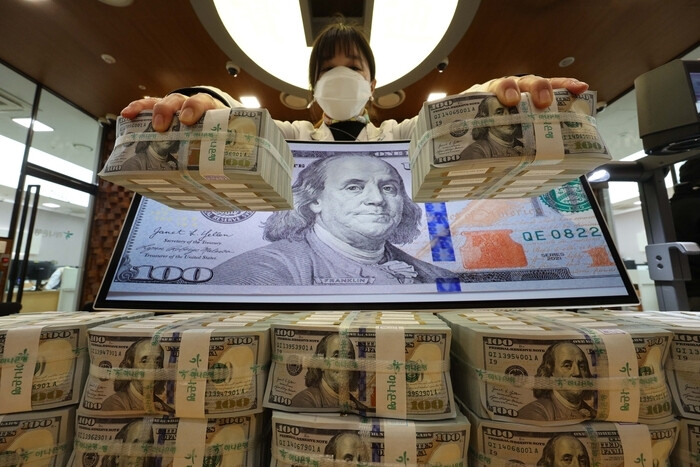
The South Korean won has weakened significantly against the U.S. dollar, climbing to the mid-1,515 range as escalating geopolitical tensions in the Middle East continue to rattle global financial markets. A combination of surging international oil prices, a broad-based strengthening of the greenback, and a massive exodus of foreign capital from the domestic stock market has created a "triple whammy" of downward pressure on the Korean currency.

According to data from the Seoul Foreign Exchange Market, the won-dollar exchange rate closed at 1,515.7 won during the standard trading session (as of 3:30 PM KST) on Monday, up 6.8 won from the previous closing price. This mark sits just 1.6 won shy of the 1,517.3 won recorded on March 23—the highest closing level since the onset of the current conflict involving Iran.

Middle East Escalation and the Flight to Safety
The primary driver behind the currency's depreciation is the heightening friction in the Middle East. Market anxiety spiked following reports of potential preparations for ground operations by the United States, coupled with the official entry of Yemen's Houthi rebels into the conflict. These developments have stoked fears of a wider regional war, triggering a global "flight to safety."

The impact was immediately visible in the energy markets. West Texas Intermediate (WTI) crude surpassed $100 per barrel, while Brent crude soared above $115. As South Korea is heavily dependent on energy imports, rising oil prices typically lead to a trade deficit and increased demand for dollars, further weakening the won.

The U.S. Dollar Index, which measures the greenback against six major global currencies, rose for the fifth consecutive session, briefly touching the 100-point threshold during intraday trading. Although it retreated slightly toward the close, the index remains at a multi-month high, reflecting intense global demand for safe-haven assets.

Foreign Sell-off in Domestic Equities
Adding fuel to the fire, foreign investors are retreating from the Korean capital markets at an alarming rate. On the Korea Exchange (KRX), foreign investors net sold a staggering 2.13 trillion won worth of stocks today. While institutional and individual investors attempted to buffer the fall by purchasing approximately 883.1 billion won and 897.3 billion won respectively, the sheer volume of the foreign exit significantly bolstered the upward trajectory of the exchange rate.

"The market is being weighed down by fears of a prolonged Middle East crisis, as the standoff between the U.S. and Iran shows no signs of resolution," noted Lee Yu-jeong, a senior researcher at Hana Bank. "The combination of surging crude oil prices and strengthening risk aversion will likely leave the exchange rate exposed to further upward pressure in the near term."

Outlook: A Volatile Week Ahead
Financial analysts warn that the environment for the Korean won remains unfavorable for the remainder of the week. The "overlapping" nature of these external shocks—geopolitical instability, energy inflation, and capital flight—suggests that the 1,520 won mark could be tested if diplomatic breakthroughs are not achieved.

As the Korean government and the Bank of Korea monitor the situation closely for potential market stabilization measures, businesses and investors are bracing for continued volatility. With the 1,500 won level now firmly established as the new floor, the focus shifts to whether international diplomatic efforts can de-escalate the Middle Eastern theater before the won suffers further record-breaking losses.

[Copyright (c) Global Economic Times. All Rights Reserved.]

  • #globaleconomictimes
  • #micorea
  • #mykorea
  • #nammidonganews
  • #singaporenewsk
  • #Samsung
  • #Daewoo
  • #Hyosung
  • #Apple
  • #korea
Yim Kwangsoo Correspondent

Popular articles

  • AIDC Emerges as New Growth Engine for Telcos, Filling the Void Left by Stagnant Wireless Revenues

  • U.S. World Cup "Host City Boom" Fizzles: Hotel Bookings Slump One Month Before Kickoff

  • "Countdown to Renewed Strikes on Iran?" At Least 50 U.S. Aerial Refueling Tankers Massed at Israeli Airport

I like it
Share
  • Facebook
  • X
  • Kakaotalk
  • LINE
  • BAND
  • NAVER
  • https://globaleconomictimes.kr/article/1065604811526921 Copy URL copied.
Comments >

Comments 0

Weekly Hot Issue

  • Samsung Electronics Super-Enterprise Union Loses Majority Status Amid Backlash Over Bonus Disparities
  • Samsung to Embed Vital Signs and Heart Health Scores in Upcoming Galaxy Watch9 Lineup
  • Apple Honors Digital Excellence: 12 Exceptional Apps and Games Celebrated at the 2026 Design Awards
  • Nexon Revamps Signature Youth Coding Competition into AI-Driven 'Nexon Young Programmers Cup'
  • Tech University of Korea Gathers 200 Game and AI Researchers to Discuss Industrial Expansion
  • Major Korean Telcos Trim Online-Exclusive Plans by Up to 50% Amid Shift to Unified Mobile Tariffs

Most Viewed

1
From a moment of collective sacrifice to a moment of collective democracy: The Timing of the Election in Ethiopia and Korea
2
U.S. Holds Off on Immediate Comprehensive Semiconductor Tariffs, but Pressure Mounts for Samsung and SK Hynix to Accelerate Domestic Investments
3
[Interview] "Halal is Not a Religious Regulation, but a 'Trust Infrastructure'… Creating a Premium 'K-Halal' Centered on Data and Platforms"
4
‘600 Million Won Bonus’ at Samsung Electronics Triggers Deep Sense of Relative Deprivation Among Korean Workers
5
Bomb Attack Targets Moving Train in Pakistan: At Least 29 Dead, 102 Injured
광고문의
임시1
임시3
임시2

Hot Issue

Murata Unveils Next-Gen Resin Electrode MLCC for Automotive Applications

Samsung to Embed Vital Signs and Heart Health Scores in Upcoming Galaxy Watch9 Lineup

L&F Plus Secures KRW 220 Billion from National Growth Fund to Anchor South Korea’s First Mass LFP Cathode Production

Samsung Electronics Super-Enterprise Union Loses Majority Status Amid Backlash Over Bonus Disparities

Fashion Runway Show 2026

Global Economic Times
korocamia@naver.com
CEO : LEE YEON-SIL
Publisher : KO YONG-CHUL
Registration number : Seoul, A55681
Registration Date : 2024-10-24
Youth Protection Manager: KO YONG-CHUL
Singapore Headquarters
5A Woodlands Road #11-34 The Tennery. S'677728
Korean Branch
Phone : +82(0)10 4724 5264
#304, 6 Nonhyeon-ro 111-gil, Gangnam-gu, Seoul
Copyright © Global Economic Times All Rights Reserved
  • 에이펙2025
  • APEC2025가이드북TV
  • 반달곰 프로젝트
Search
Category
  • All articles
  • Synthesis
  • World
  • Business
  • Industry
  • ICT
  • Distribution Economy
  • Well+Being
  • Travel
  • Eco-News
  • Education
  • Korean Wave News
  • Opinion
  • Arts&Culture
  • Sports
  • People & Life 
    • 전체
    • International Student Report
    • With Ambassador
  • Column 
    • 전체
    • Cho Kijo Column
    • Cherry Garden Story
    • Ko Yong-chul Column
    • Kim Seul-Ong Column
    • Lee Yeon-sil Column
  • Photo News
  • New Book Guide
  • Multicultural News
  • Jobs & Workers