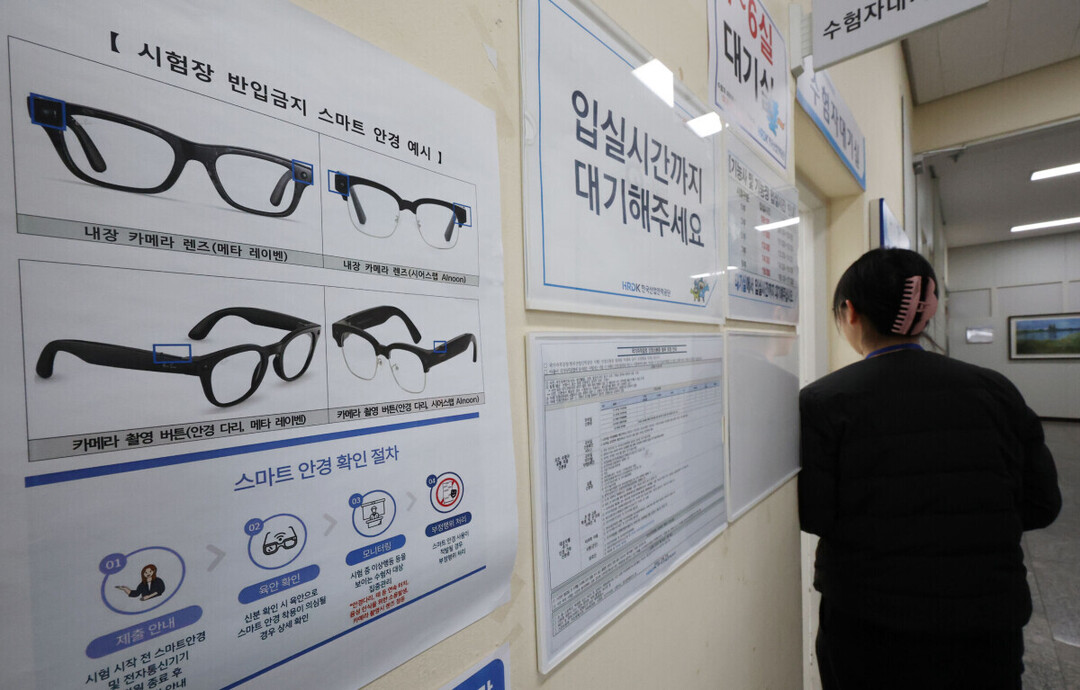
SEOUL, Nov. 25 — South Korean authorities are reconsidering previously shelved signal-jamming technologies and tighter import regulations as part of a sweeping government effort to stamp out artificial intelligence-assisted cheating on national exams.
Following recent concerns over AI misuse during this year’s College Scholastic Ability Test (CSAT), an interagency task force convened its first meeting on Nov. 24 to draft multi-tiered countermeasures. Speaking at a science and AI strategy forum in Seoul on Wednesday, Deputy Prime Minister and Science Minister Bae Kyung-hoon confirmed that officials are exploring a wide spectrum of technical deterrents, including radio frequency detection, digital watermarking, upgraded surveillance systems, and localized Wi-Fi disruption.
The renewed focus on radio wave interference marks a notable policy shift. Just days before the CSAT earlier this month, officials had dismissed network blocking as technically unfeasible. Bae acknowledged that deploying military- or VIP-grade jammers in testing centers remains impractical, but noted that engineers are now evaluating reduced-output jamming methods alongside necessary amendments to the Radio Waves Act and safety protocols.
Beyond technical enforcement, the task force plans to scrutinize certification standards for foreign-manufactured AI hardware entering the country. Bae emphasized that safeguarding test integrity is an ongoing process rather than a one-time fix, adding that the government must also re-evaluate secondary and higher education curricula to adapt to an AI-driven society.
While tightening safeguards against academic misconduct, Seoul remains committed to rapid AI integration across its economy. Bae expressed optimism that South Korea’s sovereign AI foundation models will soon match the capabilities of leading Chinese counterparts, predicting that visible, cross-sector AI adoption—spanning biotechnology, finance, and scientific research—will materialize within two to three years.
Industry and legal experts attending the forum echoed the need for structural readiness. HD Hyundai Chief AI Officer Kim Young-ok urged state backing for sector-specific AI models and industrial data infrastructure, noting that human workers are transitioning into supervisory "conductor" roles. Meanwhile, Hanyang University law professor Yoon Hye-sun called for modernizing regulatory frameworks through initiatives such as AI liability insurance and formal licensing for R&D developers.
[Copyright (c) Global Economic Times. All Rights Reserved.]