![[등록] 2026-09-01 15:48:31](/support/_updata/banner2/tl181982910_6749.png)


(C) Time Magazine
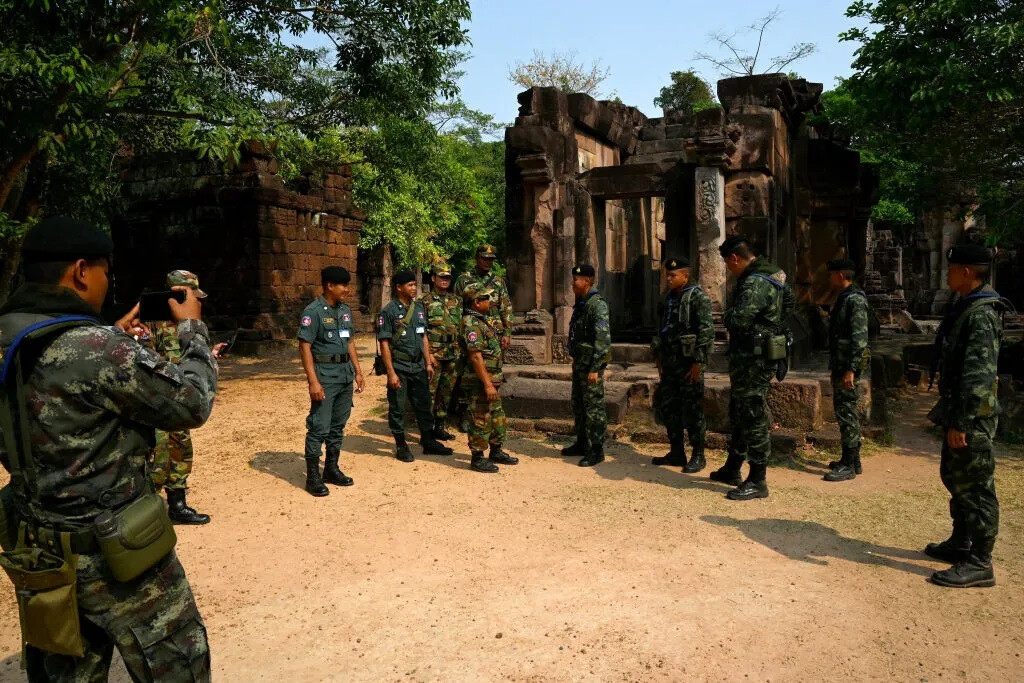
JAKARTA — Thailand and Cambodia have once again engaged in deadly border clashes, resulting in casualties on both sides. This renewed conflict erupts just months after the two nations signed a ceasefire agreement brokered by U.S. President Donald Trump following a major military confrontation in July.
Both sides issued conflicting claims, accusing the other of launching the initial attack and violating the terms of the truce.
Deadly Dawn: The Latest Exchange of Fire
The most recent and severe clash began around 5 a.m. local time on Monday, December 8 (local time), near the border area adjacent to Thailand's Ubon Ratchathani province in the northeast.
The Thai military claimed that Cambodian forces initiated the engagement, utilizing heavy weaponry such as machine guns and mortars to attack multiple points along the border.
"Cambodian troops fired (first) toward the Thai military," the Thai military stated in an official announcement. "One Thai soldier was killed and eight were injured by the Cambodian forces' sustained fire."
The statement further revealed a significant escalation, confirming the use of air power: "The Thai military deployed fighter jets to suppress the supporting attacks of the Cambodian forces," adding that they "struck military targets in several (Cambodian) areas."
The Royal Thai Air Force alleged that Cambodian forces were preparing to expand their military operations, including deploying heavy weapons and repositioning combat units. Furthermore, the Thai Army claimed that Cambodian forces fired BM-21 multi-barrel rocket launchers at civilian areas in Thailand’s eastern Buriram province.
In response to the escalating violence, local media reported that Thai authorities issued evacuation orders across four provinces bordering Cambodia, mobilizing an estimated 385,000 residents, with over 35,000 seeking refuge in temporary shelters. F-16 fighter jets were reportedly scrambled.
In a televised address, Thai Prime Minister Anutin Charnvirakul stressed that Thailand would conduct necessary military operations for national and public safety. "Thailand has never invaded first," he emphasized, "and we will never tolerate any violation of our sovereignty."
The fighting exacted a heavy toll on the Cambodian side as well. Agence France-Presse (AFP) reported that four Cambodian civilians were killed in the crossfire on Monday.
Cambodian Information Minister Net Pheaktra confirmed the casualties: "Four Cambodian civilians died and 10 others were injured due to attacks by the Thai military in the border areas of Preah Vihear (north) and Oddar Meanchey (northwest) provinces." The shelling reportedly caused approximately 1,100 families to evacuate their homes in Cambodia's Oddar Meanchey province.
A Truce Tenuously Held: The Breakdown of Diplomacy
The Monday clash followed smaller skirmishes on the preceding day, Sunday, where two Thai soldiers were injured by gunfire. The exchange of accusations had begun even earlier.
On Sunday, the Cambodian Ministry of National Defense issued a statement claiming that Thai forces had carried out "provocative actions" in recent days before attacking Cambodian troops in two locations. Cambodia asserted that its forces did not retaliate and instead requested a cessation of fire.
The Thai military, however, countered this claim immediately. They stated that Cambodian forces initiated an attack at the border in Thailand’s eastern Sisaket province, forcing the Thai side to respond in accordance with the rules of engagement, with the skirmish concluding after 34 minutes.
The former Cambodian Prime Minister and current Senate President, Hun Sen, who ruled for 38 years and is the father of current Prime Minister Hun Manet, urged Cambodian forces to exercise restraint, accusing the Thai military of seeking to provoke retaliation.
Writing on his social media platform (Facebook), Hun Sen stated: "The 'red line' for response has already been set. I urge all commanders to educate officers and soldiers accordingly."
The escalation prompted immediate regional concern. Malaysian Prime Minister Anwar Ibrahim posted a statement on social media calling for restraint from both nations, emphasizing: "Our region cannot afford a situation where long-standing disputes spiral into a cycle of confrontation."
Root Cause: A Century of Undefined Borders
The underlying issue fueling these recurring deadly conflicts is a 100-year-old territorial dispute over several undefined segments of the 817-kilometer border, originally surveyed in 1907 when France administered Cambodia as a colony.
The latest series of confrontations began with smaller clashes in May, followed by two landmine explosions in July near the border that injured eight Thai soldiers. This culminated in a fierce five-day conflict that month, leaving 48 people dead and displacing over 300,000 people on both sides.
The bloodshed finally led to a significant diplomatic effort. In October, during the ASEAN Summit in Malaysia, U.S. President Donald Trump successfully mediated a ceasefire agreement. The deal included commitments to withdraw heavy weapons and clear landmines from the border region.
However, the fragile peace quickly unraveled. On November 10, a landmine explosion in the Sisaket province border area injured a Thai soldier, leading the Thai government to declare that it would not adhere to the truce. Two days later, a shooting exchange in the border area of northwestern Cambodia killed one Cambodian civilian, marking the continuous chain of clashes that culminated in Monday's major engagement.
The involvement of sophisticated weaponry, fighter jets, and the immediate evacuation of hundreds of thousands of civilians highlight the extreme volatility of this long-dormant dispute. The effectiveness of the Trump-brokered truce has now been severely undermined, raising serious concerns within ASEAN and the broader international community about the potential for this conflict to further destabilize the Indo-Pacific region. Both governments face intense domestic pressure to defend their sovereignty, making de-escalation a complex and challenging diplomatic tightrope walk.
[Copyright (c) Global Economic Times. All Rights Reserved.]