• 2026.03.06 (Fri)
  • All articles
  • LOGIN
  • JOIN
Global Economic Times
fashionrunwayshow2026
  • Synthesis
  • World
  • Business
  • Industry
  • ICT
  • Distribution Economy
  • Well+Being
  • Travel
  • Eco-News
  • Education
  • Korean Wave News
  • Opinion
  • Arts&Culture
  • Sports
  • People & Life
    • International Student Report
    • With Ambassador
  • Column
    • Cho Kijo Column
    • Cherry Garden Story
    • Ko Yong-chul Column
    • Kim Seul-Ong Column
    • Lee Yeon-sil Column
  • Photo News
  • New Book Guide
MENU
 
Home > Arts&Culture

Historic Korean Pagoda Restored After Century of Trials

Desk / Updated : 2024-11-15 16:24:43
  • -
  • +
  • Print


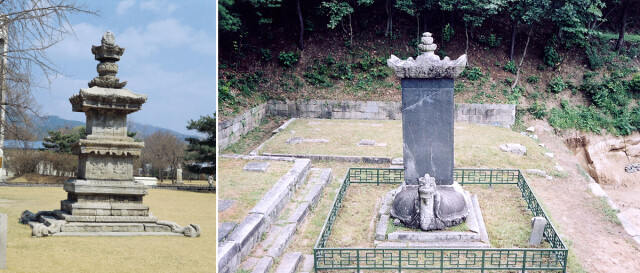
Wonju, South Korea – The Gwangguksa Pagoda, a national treasure and one of Korea's most significant Buddhist pagodas, has been fully restored and returned to its original home at the Beopcheonsa Temple site in Wonju. The pagoda, which suffered extensive damage during Japan's colonial rule and the Korean War, has undergone a meticulous restoration process over the past few years.

Built in 1070 to honor the eminent Buddhist monk Gwangguksa Haerin, the pagoda is renowned for its exquisite carvings and intricate design. However, its turbulent history began during Japan's colonial rule when it was dismantled and transported to Japan. It was later returned to Korea but suffered further damage during the Korean War.

"After completing the conservation and restoration work on the Gwangguksa Pagoda in collaboration with Wonju City, we will be holding an unveiling ceremony and other commemorative events at the Beopcheonsa Temple site on November 12th," said the National Cultural Heritage Research Institute.

The pagoda's journey has been marked by numerous trials. It was repeatedly moved and damaged, eventually ending up at the National Palace Museum in Seoul. In 2016, due to severe damage and structural instability, the pagoda was transferred to the National Cultural Heritage Research Institute in Daejeon for a comprehensive restoration project.

The restoration process involved a meticulous examination of the pagoda's original design and materials. Experts from various fields worked together to recreate the pagoda's intricate carvings and ensure its structural integrity. The restored pagoda now stands on a special foundation designed to withstand earthquakes up to a magnitude of 7.

"The restoration of the Gwangguksa Pagoda is a model case of returning a cultural heritage to its original place," said the National Cultural Heritage Research Institute. "It was achieved through collaborative research in various fields, including the study of the pagoda's imagery, patterns, and the origin of the stones used for restoration."

The institute plans to publish a detailed final report on the conservation and restoration process next year.

The restoration of the Gwangguksa Pagoda is a significant achievement in Korea's cultural heritage preservation efforts. It marks the return of a national treasure to its rightful place and serves as a testament to the resilience of Korea's cultural heritage.

[Copyright (c) Global Economic Times. All Rights Reserved.]

Desk
Desk

Popular articles

  • Samsung TV Plus Surpasses 100 Million Monthly Active Users, Solidifying Leadership in Global FAST Market

  • South Korean Conglomerates Pledge 270 Trillion Won for Regional Investment to Boost Jobs and Growth

  • Mixed U.S. Employment Data Sparks Wall Street Retreat; Fed Shifts Focus to Inflation

I like it
Share
  • Facebook
  • X
  • Kakaotalk
  • LINE
  • BAND
  • NAVER
  • https://globaleconomictimes.kr/article/1065597780681272 Copy URL copied.
Comments >

Comments 0

Weekly Hot Issue

  • The Illusion of a "Stress-Relieving" Smoke: Study Finds Smokers More Prone to Depression
  • From Table to Space: Japan Unveils Edible Spoons Made of Cookies
  • Luckin Coffee Shakes Up Global Market with Blue Bottle Acquisition
  • U.S. Private Sector Hiring Hits 7-Month High in February, ADP Reports
  • Self-Employed Loan Delinquency Rates Double in a Decade Amid Economic Headwinds
  • Multi-Homeowner Loan Balance Hits 103 Trillion Won; Half Concentrated in Seoul and Gyeonggi

Most Viewed

1
Adwa’s Echo in Korea: A Shared Story of Dignity and Freedom
2
2026, The Grand Year of Hangeul Celebration — The River of History Where Five Streams Converge
3
A New Milestone for Ukraine’s Post-War Reconstruction: The Birth of ISVP
4
Mexican currency and the powerful history behind its designs
5
Revised and Expanded Edition of ‘Failure of Negotiations with North Korea: Truth and Solutions’ Published
광고문의
임시1
임시3
임시2

Hot Issue

South Korean Markets Shaken by "Iran Shock": KOSPI Suffers Historic Rout Amid Soaring Oil and FX Rates

Self-Employed Loan Delinquency Rates Double in a Decade Amid Economic Headwinds

U.S. Private Sector Hiring Hits 7-Month High in February, ADP Reports

Industrial Output Dips in January Amid Semiconductor Adjustments; Middle East Tensions Loom as Wild Card

Let’s recycle the old blankets in Jeju Island’s closet instead of incinerating them.

Global Economic Times
korocamia@naver.com
CEO : LEE YEON-SIL
Publisher : KO YONG-CHUL
Registration number : Seoul, A55681
Registration Date : 2024-10-24
Youth Protection Manager: KO YONG-CHUL
Singapore Headquarters
5A Woodlands Road #11-34 The Tennery. S'677728
Korean Branch
Phone : +82(0)10 4724 5264
#304, 6 Nonhyeon-ro 111-gil, Gangnam-gu, Seoul
Copyright © Global Economic Times All Rights Reserved
  • 에이펙2025
  • APEC2025가이드북TV
  • 독도는우리땅
Search
Category
  • All articles
  • Synthesis
  • World
  • Business
  • Industry
  • ICT
  • Distribution Economy
  • Well+Being
  • Travel
  • Eco-News
  • Education
  • Korean Wave News
  • Opinion
  • Arts&Culture
  • Sports
  • People & Life 
    • 전체
    • International Student Report
    • With Ambassador
  • Column 
    • 전체
    • Cho Kijo Column
    • Cherry Garden Story
    • Ko Yong-chul Column
    • Kim Seul-Ong Column
    • Lee Yeon-sil Column
  • Photo News
  • New Book Guide
  • Multicultural News
  • Jobs & Workers