• 2025.12.07 (Sun)
  • All articles
  • LOGIN
  • JOIN
Global Economic Times
APEC2025KOREA가이드북
  • Synthesis
  • World
  • Business
  • Industry
  • ICT
  • Distribution Economy
  • Well+Being
  • Travel
  • Eco-News
  • Education
  • Korean Wave News
  • Opinion
  • Arts&Culture
  • Sports
  • People & Life
  • Column
    • Cho Kijo Column
    • Lee Yeon-sil Column
    • Ko Yong-chul Column
    • Cherry Garden Story
  • Photo News
  • New Book Guide
MENU
 
Home > Synthesis

South Korea Unveils Ambitious Plan to Revitalize Rural Areas and Boost Agriculture

Desk / Updated : 2025-01-14 16:08:53
  • -
  • +
  • Print


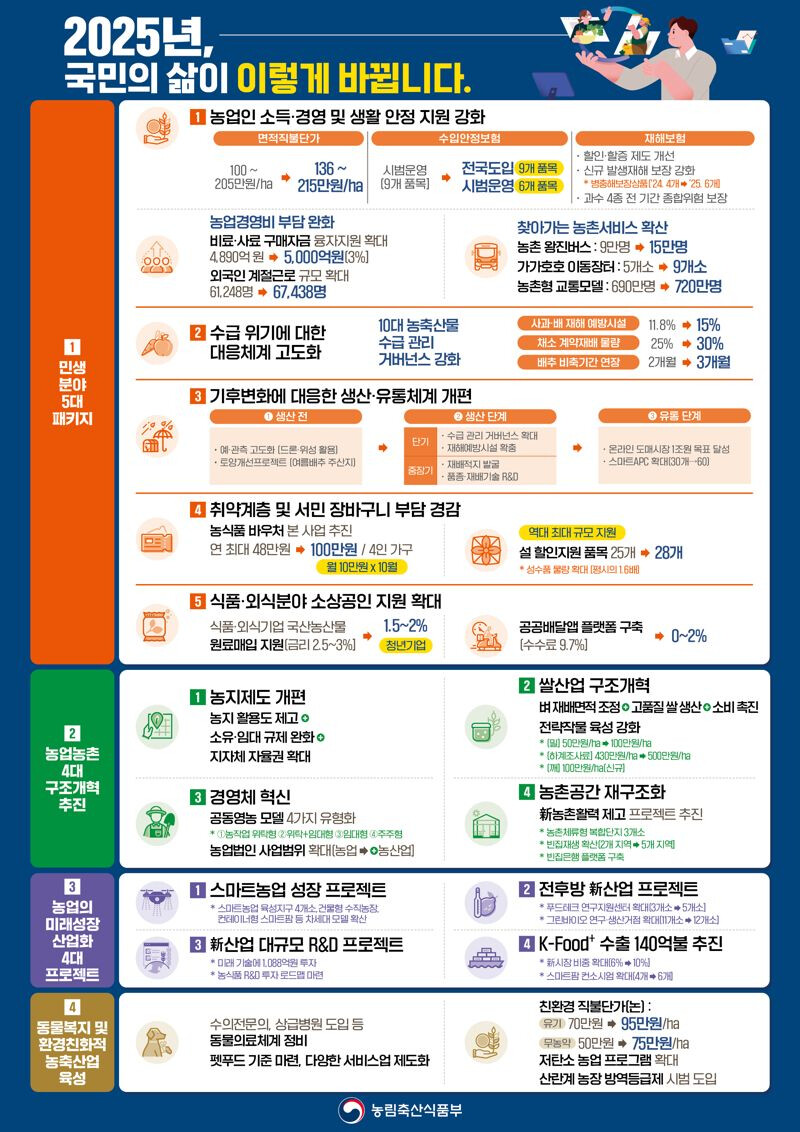
Seoul, South Korea – The Ministry of Agriculture, Food, and Rural Affairs (MAFRA) has announced a comprehensive plan to revitalize rural areas and stimulate agricultural growth. The 2025 work plan, unveiled on Wednesday, outlines a series of reforms aimed at modernizing agriculture, attracting investment, and improving the quality of life in rural communities.

Key components of the plan include:

Farmland Reform: The government intends to amend the Farmland Act to allow for more flexible use of agricultural land. This includes permitting the use of farmland for weekend farming experiences and agricultural businesses, as well as easing restrictions on land ownership and acquisition.
Regulatory Innovation: The introduction of self-regulatory innovation zones in rural areas will foster a more dynamic and entrepreneurial environment. By streamlining regulations, the government aims to attract investment in technology-driven agriculture, such as smart farming and agritech.
Infrastructure Investment: Significant investments will be made in research and production infrastructure to support the growth of the agricultural sector. Additionally, the government plans to establish a tiered system for animal hospitals, similar to human healthcare, to improve animal welfare and health.

Rural Revitalization

A central focus of the plan is to transform rural areas into vibrant, multi-functional communities. The government will designate five pilot zones where land use regulations will be relaxed to facilitate the development of mixed-use spaces that combine agriculture, residential, and commercial activities.

To further stimulate economic activity in rural areas, the government will launch the "New Rural Vitality Project," which aims to create new opportunities for employment and entrepreneurship. This initiative includes the development of rural co-living spaces, the establishment of a vacant house bank, and investments in rural infrastructure.

Addressing Regulatory Hurdles

While the government's ambitious plan has been well-received, its implementation will require significant legislative changes. MAFRA officials have acknowledged that amending the Farmland Act and introducing new legislation for self-regulatory innovation zones will be challenging. However, they expressed optimism that these reforms can be achieved through close collaboration with lawmakers and stakeholders.

Future of Agriculture

The government's commitment to modernizing agriculture is evident in its plans to expand the adoption of smart farming technologies. By investing in research and development and creating specialized zones for smart agriculture, the government aims to increase the productivity and sustainability of the agricultural sector.

Conclusion

South Korea's 2025 work plan represents a significant shift in the country's approach to rural development and agriculture. By focusing on regulatory reform, infrastructure investment, and innovation, the government aims to create a more vibrant and sustainable rural sector. The success of these initiatives will depend on the government's ability to work collaboratively with stakeholders and overcome the challenges posed by existing regulations.

[Copyright (c) Global Economic Times. All Rights Reserved.]

  • #globaleconomictimes
  • #seoulkorea
  • #periodicoeconomico
  • #글로벌이코노믹타임즈
  • #GET
  • #GETtv
  • #대한민국
  • #중기청
  • #재외동포청
  • #외교부
  • #micorea
  • #my
Desk
Desk

Popular articles

  • Retirement Age Debate Rages: Youth Employment at Risk as Older Workers' Tenure Lengthens

  • Alliance in a Dilemma: The Fallout of Trump's Advice to Takaichi Not to 'Provoke Taiwan' 

  • Korean Fashion Brands Set Sights on China: Dunst Opens Pop-up in Shanghai

I like it
Share
  • Facebook
  • X
  • Kakaotalk
  • LINE
  • BAND
  • NAVER
  • https://globaleconomictimes.kr/article/1065596891222869 Copy URL copied.
Comments >

Comments 0

Weekly Hot Issue

  • JAPAN’S RISING PREDICAMENT: RECORD BEAR ATTACKS STRIKE FEAR ACROSS NATION
  • Trump NSS Declares Europe Faces 'Civilizational Erasure,' Vows to Aid Anti-Immigration Right-Wing Parties
  • Meta's Strategic U-Turn: The AI Race Re-Elevates Real-Time News
  • Gapyeong's Petit France and Italian Village Illuminate Winter with 'Starlight Festival'
  • Grand Opening: Gwangju Museum's Ceramics Culture Center Offers Comprehensive Look at Ceramic History
  • Choi Bun-do, Chairman of PTV Group, Assumes Presidency of the Korean Chamber of Commerce and Industry in South Central Vietnam

Most Viewed

1
Korean War Ally, Reborn as an 'Economic Alliance' Across 70 Years: Chuncheon's 'Path of Reciprocity,' a Strategic
2
A Garden Where the City's Rhythm Stops: Dongdaemun's 'Cherry Garden', Cooking Consideration and Diversity
3
The Sudden Halt of Ayumi Hamasaki's Shanghai Concert: Unpacking the Rising Sino-Japanese Tensions
4
Farewell to a Legend: South Korea Mourns the Passing of Esteemed Actor Lee Soon-jae
5
China’s Anti-Starlink Strategy: Simulation Suggests 2,000 Drones Needed for Taiwan Disruption
광고문의
임시1
임시3
임시2

Hot Issue

EU Unveils €90 Billion Ukraine Aid Plan Backed by Frozen Russian Assets

Seoul's 'Insane Rent' Warning: Why $30,000 Monthly Rent is a Looming Threat Residential Crisis Deepens as Tourist Housing Conversion Hits Supply

Seo Min-kyu Wins Gold at Junior Grand Prix Final... First Korean Since Kim Yuna 20 Years Ago

2026 Overseas Koreans Agency Budget Confirmed at 112.7 Billion Won... 5.3% Increase Year-on-Year

Let’s recycle the old blankets in Jeju Island’s closet instead of incinerating them.

Global Economic Times
korocamia@naver.com
CEO : LEE YEON-SIL
Publisher : KO YONG-CHUL
Registration number : Seoul, A55681
Registration Date : 2024-10-24
Youth Protection Manager: KO YONG-CHUL
Singapore Headquarters
5A Woodlands Road #11-34 The Tennery. S'677728
Korean Branch
Phone : +82(0)10 4724 5264
#304, 6 Nonhyeon-ro 111-gil, Gangnam-gu, Seoul
Copyright © Global Economic Times All Rights Reserved
  • 에이펙2025
  • APEC2025가이드북TV
  • 세종시
Search
Category
  • All articles
  • Synthesis
  • World
  • Business
  • Industry
  • ICT
  • Distribution Economy
  • Well+Being
  • Travel
  • Eco-News
  • Education
  • Korean Wave News
  • Opinion
  • Arts&Culture
  • Sports
  • People & Life
  • Column 
    • 전체
    • Cho Kijo Column
    • Lee Yeon-sil Column
    • Ko Yong-chul Column
    • Cherry Garden Story
  • Photo News
  • New Book Guide
  • Multicultural News
  • Jobs & Workers