![[등록] 2026-09-01 15:48:31](/support/_updata/banner2/tl181982910_6749.png)


(C) KBS
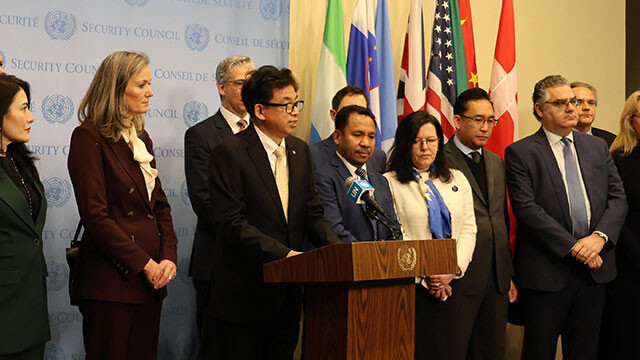
UNITED NATIONS, New York—The insidious intersection of high-tech fraud and human trafficking has propelled a global crisis to the forefront of the international agenda, culminating in a powerful joint statement issued by 44 United Nations member states. The coalition, spearheaded by South Korea, utilized the platform of the UN General Assembly's High-Level Meeting on Trafficking in Persons to demand "urgent and coordinated action" against the burgeoning threat of technology-facilitated human trafficking, particularly that linked to vast, transnational online scam operations.
The joint declaration, read out by South Korean Ambassador to the UN Cha Ji-hoon on November 24, 2025, underscored a grim reality: the digital world, far from being solely a tool for connection, has become a formidable weapon in the hands of organized crime.
The New Digital Frontier of Exploitation
The collective statement expressed profound concern over the escalating trend of human trafficking linked to online scams and other forms of transnational organized crime. This emerging crisis centers on individuals who are deceptively recruited through fake job offers—often promising high salaries in digital marketing or customer service—only to be trapped in notorious "scam compounds" or "scam farms" across Southeast Asia, particularly in regions of Cambodia and Myanmar.
Once confined, victims are subjected to forced labor, sexual exploitation, torture, and severe abuse, compelled under threat of violence to execute sophisticated online frauds, including romance scams, cryptocurrency fraud, and illegal gambling. Recent UN reports estimate that hundreds of thousands of people, from various nationalities, have been trapped in these conditions, transforming the situation into a full-scale humanitarian and human rights crisis.
"Traffickers exploit conflict, economic hardship and digital platforms to expand their networks, while victims suffer forced labor, sexual exploitation and other forms of abuse," the joint statement read, adding that "No country is immune from these practices."
A Call for Global Mobilization Led by South Korea
The impetus for this unprecedented show of international unity came largely from South Korea, which has seen its citizens increasingly targeted by these schemes. The situation gained widespread attention following the horrific report of a Korean university student who was allegedly lured into a Cambodian scam compound, only to be detained, tortured, and murdered by the criminal network.
The coalition of 44 nations—including key partners from Asia (Japan, Australia, Thailand, Vietnam, Indonesia, Cambodia), Europe, and other continents—stressed that the comprehensive response to human trafficking must focus on four key pillars: Prevention, Punishment, Protection, and Cooperation.
Key demands outlined in the statement include:
Strengthening public awareness to prevent deceptive recruitment.
Improving victim identification processes.
Enhancing law enforcement capabilities across borders.
Empowering survivors and ensuring their access to justice and remedy.
Fostering regional and global cooperation among governments, the private sector, and civil society.
Technology is a Double-Edged Sword
The timing of the joint statement coincided with the UN General Assembly's review of the Global Plan of Action to Combat Trafficking in Persons, a check-up held every four years since its adoption in 2010. The meeting's discussions underscored how digital technology is dramatically reshaping the landscape of trafficking.
Annalena Baerbok, President of the UN General Assembly, emphasized this shift in her opening remarks. She warned that traffickers are now weaponizing Artificial Intelligence (AI) tools and deepfake technology to create fake identities and conceal their vast criminal networks. This sophisticated use of technology demands an equally advanced response.
"Our justice systems must evolve with technological advances," Baerbok stated, calling for modernized laws, updated regulations, and strengthened international cooperation to effectively detect, disrupt, and dismantle these digital trafficking networks.
The UN Secretary-General echoed this sentiment, noting that the number of children among detected victims has increased by one-third since 2019, further underscoring the urgency. The consensus across the UN meeting was clear: the response to this evolving crime must keep pace with the speed of technology.
Moving Forward: From Statement to Action
The joint declaration by 44 member states, while a significant diplomatic victory, marks just the beginning of a complex fight. Experts from the UN Office on Drugs and Crime (UNODC) and the Office of the High Commissioner for Human Rights (OHCHR) have previously highlighted that victims of these forced criminality scams are too often erroneously identified as criminals rather than receiving the protection and rehabilitation they desperately need.
The path forward requires not only robust cross-border intelligence sharing and mutual legal assistance to dismantle the transnational criminal groups but also a human-rights-based approach. This includes:
Prioritizing a victim-centered approach that ensures non-punishment for crimes victims were forced to commit.
Addressing the root drivers of forced cyber-criminality, such as poverty and lack of legitimate job opportunities.
Holding digital platforms accountable for content, including fraudulent advertisements that lure victims.
The unified voice of 44 nations has signaled that the global community will no longer tolerate the exploitation of digital platforms for human misery. The focus now shifts to translating this strong collective resolve into concrete, effective policies that can rescue the trapped, punish the perpetrators, and finally sever the devastating link between online fraud and human trafficking.
[Copyright (c) Global Economic Times. All Rights Reserved.]