![[등록] 2026-09-01 15:48:31](/support/_updata/banner2/tl181982910_6749.png)


2026 Gwangmyeong City International Forum on Community Wealth Building Held Vision Declared for Policies Where Local Capital Circulates Locally “Restrictions on Private Contracts Must Be Re-examined” to Support Local Businesses
While the attraction of large-scale commercial zones like high-speed railways and department stores, along with station area developments, brings tourists and consumers to local areas, it is not easy for that money to return to local investments and employment. To solve the problem of “cities that grow but leave no wealth behind,” a growing number of cities are looking for solutions in community wealth building. Community wealth building refers to policies where, instead of relying on external investments, local anchor institutions, social solidarity economy enterprises, community assets, and local finance are woven together so that the wealth generated locally circulates within the region.
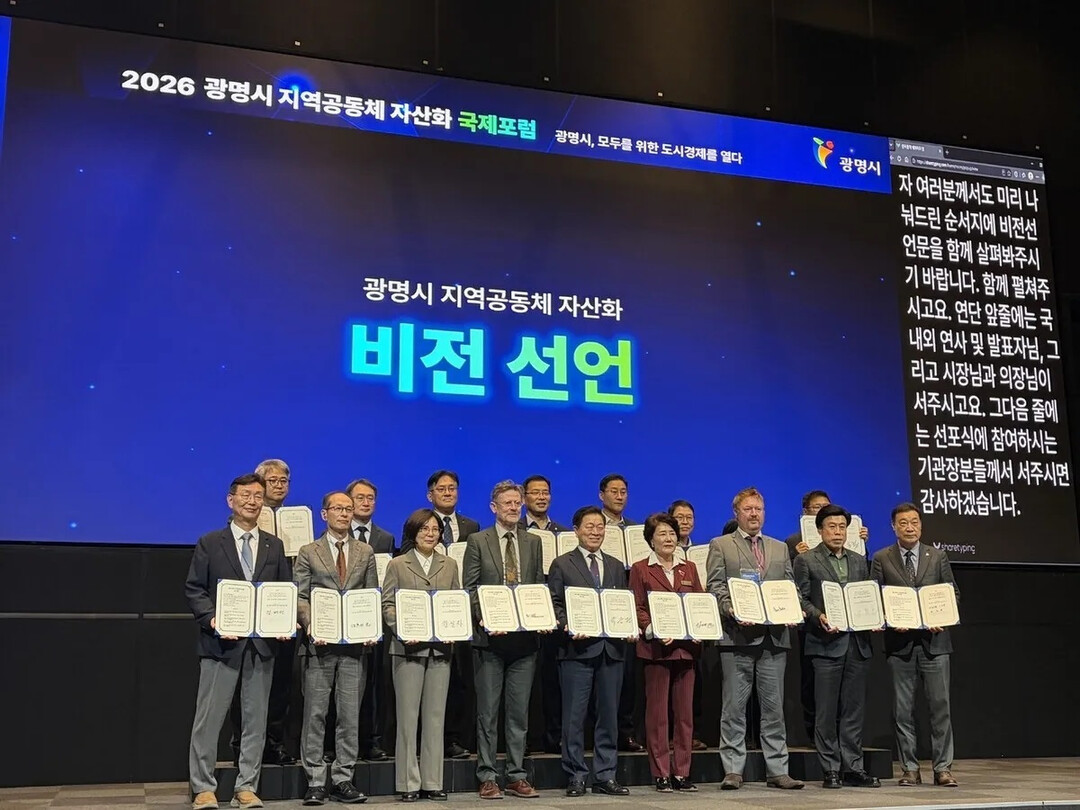
The “2026 Gwangmyeong City International Forum on Community Wealth Building,” which explored ways to ensure local capital circulates within the region, was held on the 13th at the L7 Gwangmyeong by Lotte Hotel in Gwangmyeong, Gyeonggi Province. Hosted by Gwangmyeong City, the event declared a policy vision for “community wealth building,” where public procurement drives local growth, urban growth leads to citizens' assets, and local capital circulates within the region. Gwangmyeong Mayor Park Seung-won expressed his determination, stating, “Gwangmyeong is facing a turning point in growth alongside large-scale development projects. Through asset-building policies, we will strive to ensure that the fruits of this growth lead to the everyday economy of local businesses and citizens.”
Taking the stage for the first presentation, Neil McInroy, Global Lead for The Democracy Collaborative, explained that community wealth building is a core policy for strengthening local economic capacity. He stated, “In an environment where inequality deepens and markets become uncertain, we must secure economic sovereignty that local communities own and control.” Community wealth building can lock assets into the region and reduce dependence on volatile external factors, thereby equipping the local economy with resilience, he noted.
Pointing out South Korea's problems such as regional polarization, aging, and population decline, he suggested that community wealth building policies could serve as a solution to these complex challenges. He added, “Asset-building policies can connect policies such as regionally-rooted social solidarity economy enterprises and local currency into a single strategy.”
Arguments were also raised that community wealth building policy models should be developed to fit local environments. Chris Martin, Chief Executive of Social Enterprise Scotland, introduced asset-building policies of local governments in his home country, emphasizing, “There is no single policy model for Scotland. It is important to utilize public procurement policies that allow social solidarity economy enterprises to grow, and to create a model tailored to local circumstances together with local anchor institutions such as universities and hospitals, supported by local finance.” In Scotland, the Community Wealth Building Bill passed Parliament last February, requiring local governments and affiliated public institutions to jointly formulate implementation plans and promote policies within the next three years.
Unlike Europe, where local government autonomy is well-developed, the case of Japan’s local governments—which feature a central government-centered administrative system similar to South Korea’s—was also introduced. Hikaru Samuta, a professor at Kanazawa University in Japan, presented specific measures to revitalize the local economy, citing the long-term stagnation of the Keihin region.
Located south of Tokyo, the Keihin region was equipped with research and development personnel and incubation facilities for startups, but experienced a prolonged economic recession in the early 2000s. This was because, due to the Tokyo-centric concentration structure, it failed to secure its own city “central functions” and remained a periphery of Tokyo.
As knowledge workers commuted to Tokyo and growing startups left for Tokyo, the local economy entered a path of decline. Professor Samuta argued, “Mid-sized cities must develop specialized areas and build industrial communities equipped with various business functions. If there are limits to resources, they must be able to build intra-regional networks to secure information and assets, and promote strategies for the long term.”
As the final presenter, Mayor Park Seung-won explained the background behind promoting asset-building policies, stating, “Even growing metropolitan cities cannot avoid polarization if they do not monitor where wealth flows.” Mayor Park added that the goal of asset-building policies is to support citizens in stably sustaining their everyday economies, such as food, distribution, care, and energy.
In April of this year, Gwangmyeong City enacted the metropolitan area's first ordinance on community wealth building and newly established the Social Solidarity Economy Division and the Regional Economic Strategy Research Center. Driven by these policies, the number of social solidarity economy enterprises within its jurisdiction increased from 77 in 2018 to 213 as of September 2026.
As of 2025, Gwangmyeong's new local currency subscriber count and average payment amount per capita were recorded as the highest among the 31 cities and counties in Gyeonggi Province. Mayor Park stated, “We will foster the local economic scale by creating a social solidarity economy fund and systematically promote corporate support strategies by establishing the Gwangmyeong Industry Promotion Agency.”
In Session 2’s panel discussion, local government heads from Anseong City in Gyeonggi Province, Jung-gu in Daejeon, and Yeongam-gun in South Jeolla Province participated to share their local government policy achievements. Mayor Kim Bo-ra of Anseong City introduced the “Nighttime Consumption Promotion Project” implemented to revitalize consumption among local small business owners, noting that local currency usage in July and August doubled compared to the previous year.
Kim Je-sun, Mayor of Jung-gu, Daejeon, shared a vision for participating together in solving local problems—such as providing care services and operating public parking lots—through the establishment and activation of resident autonomy association corporations. Woo Seung-hee, Governor of Yeongam-gun, introduced the Yeongam-type local circular economy model, including the local currency “Wolchul Pay” linked to the taxi and tourism industries, and the resident-led photovoltaic power generation project “Sunshine Income Village.”
The local government heads also pointed out institutional limitations in community wealth building policies. They expressed concern that the recent government guidelines restricting the frequency and amount of private contracts by local governments could become stumbling blocks to promoting asset-building policies.
Last August, the Ministry of the Interior and Safety announced guidelines restricting the frequency and amount of private contracts that can be concluded with the same company to prevent private contracts from being repeatedly concentrated on specific companies. Basic local governments can no longer exceed 5 times or 200 million won per year, and metropolitan local governments cannot exceed 7 times or 300 million won per year in private contracts with the same company.
Mayor Kim Bo-ra stated, “Public procurement is one of the important policies for nurturing companies within our jurisdiction. When public procurement policies are restricted in this way, local governments face the difficulty of having to devise new support measures to enhance the competitiveness of companies within their jurisdictions.” Professor Hikaru Samuta, who previously presented on the Japanese regional case, also argued, “To promote region-tailored policies, economic policy authority and financial resources must be decentralized to empower local autonomy.”
[Copyright (c) Global Economic Times. All Rights Reserved.]