![[등록] 2026-09-01 15:48:31](/support/_updata/banner2/tl181982910_6749.png)


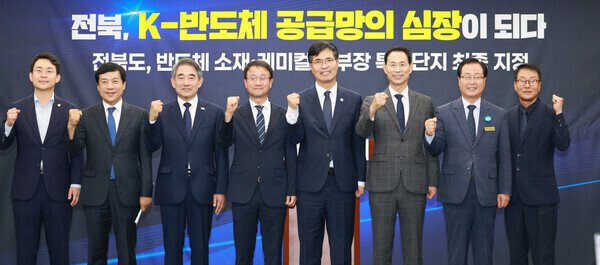
Jeonbuk State is emerging as a central axis of South Korea’s semiconductor industry, spearheaded by core semiconductor materials and chemicals. This holds great significance as Jeonbuk will serve as a connecting link in the supply chain, bridging semiconductor production bases scattered across the metropolitan area and the southern region.
Jeonbuk State Governor Lee Won-taek announced during a press conference at the provincial office on the 18th that the province has been finally selected for the "Semiconductor Materials and Chemicals, Parts & Equipment (M&C) Specialized Complex" project—encompassing Saemangeum National Industrial Complex, Iksan Industrial Complex 3 & National Industrial Complex, and Wanju General Industrial Complex—in a competition hosted by the Ministry of Trade, Industry and Energy (MOTIE) for the 3rd phase of M&C specialized complexes.
Semiconductors go through hundreds of processes before becoming a single finished product. Because a breakdown in even one essential material can halt the entire production line, the industry refers to it as a "bottleneck industry." Although South Korea's semiconductor industry has grown centered around memory fabs, the underlying materials and chemicals sector has been relatively weak, making the structure vulnerable to external variables such as export regulations. The background behind Jeonbuk being selected as an optimal location for semiconductors lies not just in "potential," but in sites already up and running. In Iksan, Dongwoo Fine-Chem produces ultra-high-purity ammonia water and IPA (cleaning chemical products), possessing top-tier domestic purification technology. In Saemangeum, PKC mass-produces special gases such as high-purity hydrochloric acid and nitrous oxide, while OCI is mass-producing ultra-high-purity polysilicon, a raw material used to make semiconductor wafers.
In Wanju, Hansol Chemical maintains the nation's highest export share for cleaning hydrogen peroxide and produces core precursors. Combined with infrastructure such as Jeonbuk National University’s Joint Research Institute for Semiconductors and Jeonbuk TechnoPark, as well as 26,256,716 square meters of industrial land, conditions have been established where investment, R&D, and talent training work hand in hand.
Jeonbuk’s roadmap for fostering the semiconductor M&C specialized complex has been established across four major fields—infrastructure, R&D, corporate support, and talent training—over a five-year period (2027–2031), with detailed annual plans to be materialized through future consultations with the Ministry of Trade, Industry and Energy.
For "infrastructure," the plan is to sequentially build an impurity analysis testbed, a precursor synthesis and purification pilot line, and evaluation equipment centered around the Jeonbuk National University Joint Research Institute for Semiconductors, thereby easing companies' testing and evaluation burdens and enhancing delivery competitiveness. "R&D" will focus on the localization of next-generation deposition material precursors, the design of etching gases for extreme device structures, and the development of precursors for next-generation logic and memory ALD processes, thereby laying the foundation for self-reliance in core materials that previously relied heavily on overseas sources.
"Corporate support" will back up the enhancement of companies' technological capabilities centered around the Semiconductor M&C Specialized Complex Promotion Team. Based on industry-academia-research cooperation, a cooperative model between supply and demand companies will be established, and technological innovation will be aided through demand discovery, technical consulting, grievance resolution, R&D linkage, and commercialization support. "Talent training" will foster on-site practical talents through cooperation between the industrial sector and educational institutions. By operating industry-linked curricula at the Jeonbuk National University Joint Research Institute for Semiconductors and fully operating Jeongeup Jeil High School as a semiconductor specialized high school, a talent supply system extending from high school to undergraduate, graduate, and practical levels will be established.
Through this, the province plans to achieve a leap in the semiconductor M&C industry through three stages. Phase 1 (2027) focuses on designing and launching R&D tasks, establishing a promotion system, and introducing and stabilizing testbed equipment. Phase 2 (2028–2029) begins verification support in earnest, including the official operation of the promotion team, formation of a Jeonbuk semiconductor dedicated team, pilot operation of regulatory sandboxes, and discovery of regulatory innovation tasks. Phase 3 (2030–2031) concludes the establishment of the testbed, prepares a cooperation network with other regional specialized complexes, and continues value chain advancement, investment stabilization, and the activation of a channel for resolving corporate grievances.
The province also presented a blueprint for 2031, when the construction of the specialized complex will be completed. The plan is to double the regional concentration of semiconductor materials and chemical companies from 15% in 2026 to 30% in 2031, reorganizing the Iksan-Saemangeum-Wanju area into a materials and chemicals industrial belt densely packed with anchor company-centered partner firms and research institutions. Through this, the goal is to raise the domestic self-sufficiency rate for semiconductor materials and chemicals from the current 20–40% level up to 40–60%.
This selection draws attention because Jeonbuk’s importance as a core hub for the semiconductor M&C supply chain has been officially recognized in a national-level support project promoted by the Ministry of Trade, Industry and Energy to stabilize supply chains and strengthen global competitiveness. At the same time, coinciding with the timing when support bases for local anchor companies are being established and the demand for materials and chemicals is expanding due to rising semiconductor chip demand, it has secured a growth foothold for fostering the semiconductor industry. Furthermore, it is expected to lead to the agglomeration of companies in related industries such as parts and equipment, raising prospects for the advancement of the overall industrial ecosystem.
Jeonbuk's "Semiconductor Materials and Chemicals, Parts & Equipment Specialized Complex" does not remain confined to the region. As a national rear supply base for semiconductor materials and chemicals supplying photoresists, high-purity phosphoric acid, special gases, and hydrogen peroxide, it is expected to act as a bridge connecting the Seoul metropolitan area's K-Semiconductor Mega Cluster (Yongin, Pyeongtaek, Icheon, Hwaseong), the southwestern semiconductor fab, and the southern semiconductor innovation belt connecting Gumi, Gwangju, and Busan.
Once this super-regional cooperation model connecting Jeonbuk, the metropolitan area, and the southern region is completed, South Korea will establish a system that fully completes the semiconductor value chain from materials to finished products within its own borders. This is expected to act as a safety valve to lower external risks for South Korea's semiconductor industry amid the global supply chain reorganization phase.
Jeonbuk State Governor Lee Won-taek stated, "Jeonbuk has long been home to operating companies possessing world-class technology and capabilities in the ultra-high-purity semiconductor materials and chemicals sector," adding, "We will do our utmost to ensure that Jeonbuk plays a leading role as a material and chemical supply hub in response to the growing demand from fabs in the metropolitan and southwestern regions."
[Copyright (c) Global Economic Times. All Rights Reserved.]