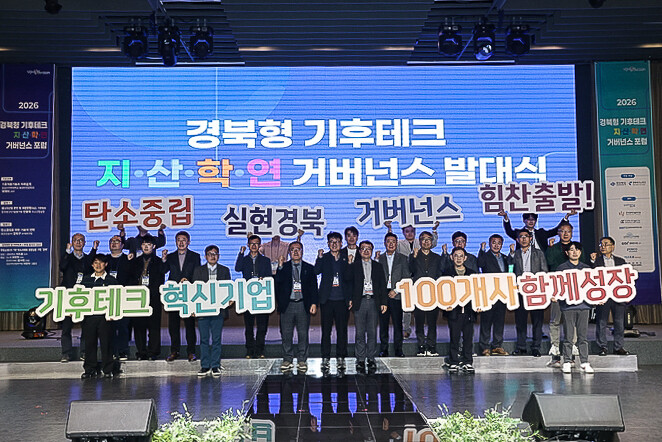
To prepare for the carbon-free era and intensely cultivate the climate tech industry, Gyeongsangbuk-do Province and Gyeongbuk Technopark (GTP) have officially launched the "Climate Tech Governance," a collaborative network uniting local government, industry, academia, and research institutions. Moving beyond simple climate crisis awareness, the initiative aims to build a full-cycle cooperation framework—ranging from policy consultation and technology validation to commercialization—establishing Gyeongbuk as South Korea’s premier climate tech testing ground.
Gyeongbuk Technopark recently held the "Gyeongsangbuk-do Climate Tech Forum," featuring keynote lectures and a panel discussion in Part 1, followed by the official governance launch ceremony in Part 2. While last year’s inaugural forum at Yeungnam University focused on mapping the direction of industrial development, this year's event represents a significant step forward by launching a practical, execution-ready partnership.
2030 Carbon Neutrality Vision and Technological Strategies
During the opening ceremony, Kang Byung-jung, Director-General of the Climate Environment Bureau of Gyeongsangbuk-do, presented the province’s carbon neutrality vision to reduce greenhouse gas emissions by 43% compared to 2018 levels by 2030.
"In January of this year, we enacted an ordinance supporting the cultivation of the climate tech industry and initiated efforts to foster 100 promising companies by 2029, making climate tech a core pillar of our industrial restructuring," Director-General Kang stated, requesting that the governance serve as a robust think tank.
Subsequent keynote speeches and presentations offered technology-driven, concrete carbon neutrality strategies:
Professor Kwak Jae-shik of Soongsil Cyber University defined climate change not as a vague fear, but as a challenge to be solved through science and technology, emphasizing that climate adaptation technologies to prepare for disasters such as heatwaves and droughts must form the starting point for future industrial design.
Ahn Jong-deuk, Head of the Hydrogen Industry Division at the Korea Institute of Energy Technology Evaluation and Planning (KETEP), highlighted the role of local governments as "regional testing grounds" where national energy technology R&D tasks are validated in the field.
Jung Hee-gu, Senior Researcher at Ecopro HN, introduced commercialization cases of greenhouse gas reduction technologies in industrial sites, suggesting that carbon neutrality should transcend mere regulatory compliance and become a growth strategy that unlocks new markets.
Mega-Projects and Integration Plans for Carbon Capture and Utilization (CCU)
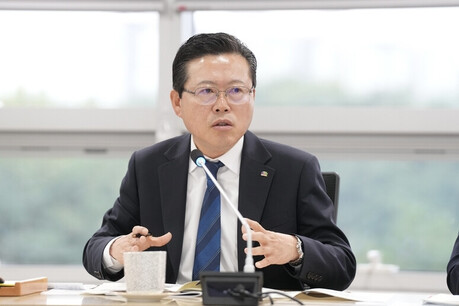
In the comprehensive panel discussion chaired by Professor Lee Soo-chul of Kyungpook National University, intensive discussions took place under the theme of "Realizing Carbon-Recycling Integrated Validation Based on Carbon-Free Energy."
Panelists agreed that the KRW 191.9 billion Carbon Capture and Utilization (CCU) mega-project and the KRW 30.8 billion carbon-negative Direct Air Capture (DAC) technology advancement project, both centered around Pohang, must be combined with carbon-free energy sources such as nuclear and renewable energy. Their blueprint centers on building an integrated validation model in Gyeongbuk where "capture, conversion, and utilization" are verified in a single location. Policy tasks such as joint utilization of testing infrastructure, regulatory exemptions like regulatory-free special zones, and supply chain development were proposed to achieve this.
Full-Cycle Support through the Governance Platform
The newly launched "Gyeongsangbuk-do Climate Tech Industry-Academia-Research Governance" will operate as a regular consultation platform focusing on:
*Climate tech policy consulting
*Joint discovery of national R&D and validation projects
*Linkage of verification infrastructure
*Corporate fostering and investment attraction
In June, the provincial government signed a memorandum of understanding (MOU) for core technology development with Pohang City and the Korea Institute of Energy Research (KIER), accelerating the establishment of the East Coast Climate Tech Belt. Moving forward, the province plans to regularize sector-specific consultations and on-site corporate visits centered around the governance.
Ha In-sung, President of Gyeongbuk Technopark, stated, "Pohang and Gyeongbuk are optimal climate tech testing grounds, endowed with carbon reduction demands from the steel and energy industries, world-class research institutes, and future energy clusters. As the governance secretariat and a companion to businesses, Gyeongbuk Technopark will strengthen full-cycle support from technology development to validation and commercialization."
[Copyright (c) Global Economic Times. All Rights Reserved.]