![[등록] 2026-09-01 15:48:31](/support/_updata/banner2/tl181982910_6749.png)


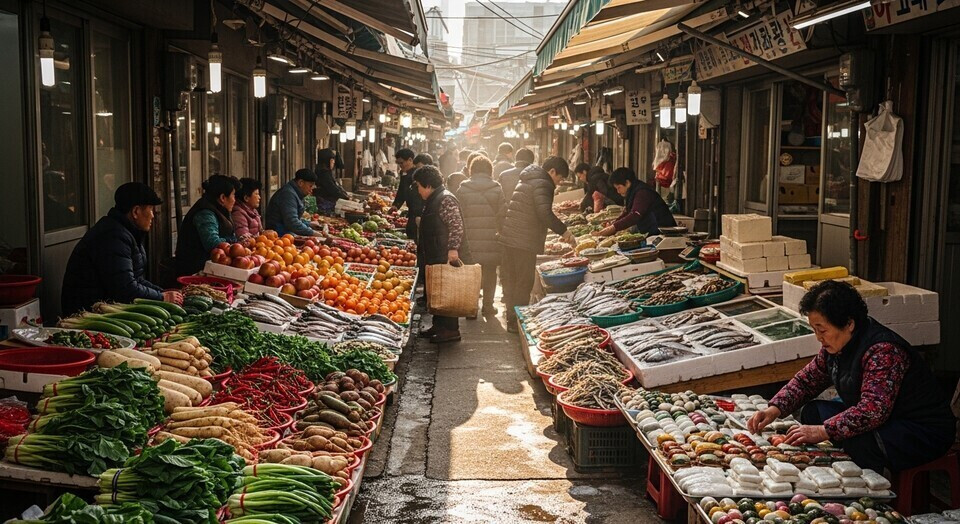
The traditional market is a place where you can see people moving like busy honeybees or worker ants. Having such a market nearby, walking through it every day, is my personal joy. I watch the way people live. About fifty shops and street stalls line both sides of a narrow path. There are sundries, wild greens, side dishes, vegetables, fruits, fish, dried seafood, tofu, rice cakes, bread, and meat. In particular, there are shops that fry chopped chicken and others that boil and slice pig’s trotters. The beef butcher boils bones to sell ox-bone soup (gomguk). It looks so rich and milky that I always feel like buying some.
A small shop at the end of the market sells wild greens cheaply. I used to go there often for a walk, but it has been closed for nearly a month now. I frequently bought bracken, spinach, and green onion kimchi there. The owner once said she had to raise the price of seasoned dried squid because the cost of ingredients had gone up. When I asked the neighboring shop, they said the grandmother was too ill to come out. What a pity. She looked to be in her 90s, having worked in that single spot for her entire life.
Most vendors in this market are elderly. They likely didn't have much formal education. Some sit in tiny stalls, less than a pyeong (3.3㎡) wide, eating cold lunch boxes while trimming greens or kimchi. There is a lady roasting sesame seeds to press oil, and an old woman grilling seaweed over a tiny brazier. There are shops that grind chili powder and rice cake mills that make custom cakes. Sometimes I want to buy just a few sweet potatoes or potatoes, but I can't. Just one would be enough for a taste, but I feel too apologetic to ask for so little. When I was growing up, I ate potatoes and sweet potatoes until I was sick of them, but they don't seem to taste the same anymore. Perhaps it’s the difference between being hungry and being full.
At one stall, a grandmother who shucks clams sells seasoned gamtae (green sea felt). The fresh gamtae is sent by relatives from her coastal hometown, and it requires almost no seasoning. She doesn’t even add minced garlic, which usually goes into everything. She just seasons it with soy sauce and adds a bit of chopped green onion to preserve the bitter, refreshing taste of the gamtae.
Seasoned gamtae is a winter delicacy that whets the appetite; if not here, you’d have to travel to Yeosu or Mokpo to taste it. Now, it’s the end of the season. It looked so delicious that I bought some clams. They told me to let them spit out the sand in water, then boil them in cold water from the start, and stop as soon as the shells open. I tried them without adding anything, and they were salty and delicious. However, the shells are a bothersome waste. Personally, I find the fist-sized blood clams (pijogae) tastier than cockles. I also love tofu with kimchi. Do you know the taste of eating stir-fried aged kimchi with a little pork alongside tofu, accompanied by a bowl of makgeolli? Yet, when I buy tofu and fry it myself, it doesn’t taste the same. Should I start living with my grandchildren now?
In early March, I saw ripe persimmons (hongsi) at a fruit stall and bought them impulsively, thinking what a treat they were. How precious they are! But I was greedy and bought too many, and they all ended up rotting. If I had rinsed them, dried them, and frozen them, I could have eaten them as sorbet in the summer. Instead, I left them on the veranda and completely forgot about them. What a waste, and I feel sorry for the persimmon tree. The fruit grows under the stinging sun from spring through midsummer and only becomes hongsi after the autumn frost. How hard the tree must have struggled to hold onto them through the wind and rain.
There are a few places I occasionally visit to buy seafood. Cuttlefish, covered in ink, have a "bone" inside that isn't really a bone. They taste great blanched in boiling water and dipped in vinegar-gochujang sauce. Octopus is appetizing when stir-fried with onions, gochujang, and plenty of sesame oil for a spicy kick. I eyed a fresh hairtail at the fish market, as wide as five fingers, but gave up immediately when they said it was 80,000 won. Nothing in this world is easy. Catching fish in the middle of the ocean, shivering in the cold and fighting waves, is a life-threatening job. And with the high cost of boat fuel, it must be hard to make a profit.
My joy is buying fresh vegetables or fruits in small amounts. At the fruit stall, I pick through a basket of fruit sold at 8 for 10,000 won, wondering which ones will taste better. If I blanch "bomdong" (early spring cabbage) and dip it in fish sauce, it’s a feast in itself. I want to taste the sweet, pinkish roots of spinach again. Perhaps because they were grown in a greenhouse, mugwort has already appeared. If you missed the winter cod soup, you must taste the doddari-mugwort soup (flounder mugwort soup).
At any rate, the traditional market is a place where I rediscover vitality. Seeing how hard people work makes me reflect on whether I am just idling my life away. Today, I am once again a neighborhood old man who, unable to resist, wanders through the vibrant market and returns home carrying black plastic bags.
[Copyright (c) Global Economic Times. All Rights Reserved.]