![[등록] 2026-09-01 15:48:31](/support/_updata/banner2/tl181982910_6749.png)


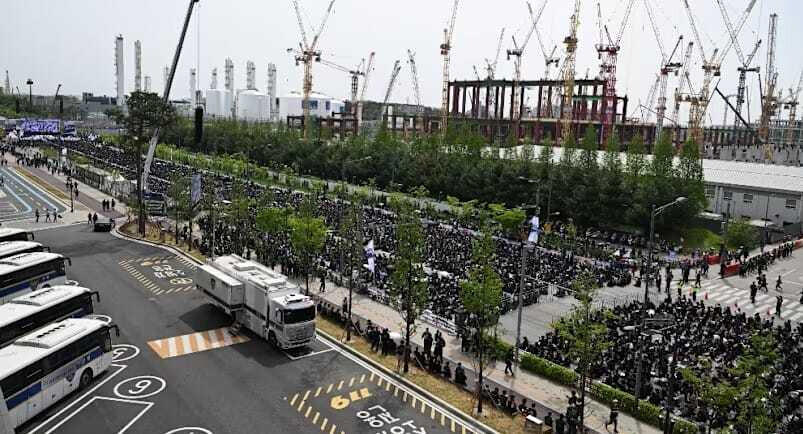
(C) Business Today Malaysia
SEOUL — The ripples of aggressive labor demands in South Korea are now crossing borders, creating a geopolitical headache for the world’s leading semiconductor manufacturers. Samsung Electronics and SK Hynix, both currently embroiled in intense wage negotiations at home, are facing a new and unexpected front: their massive workforce in China.
Reports emerged on Thursday that local employees at Samsung’s Xi’an NAND flash facility and SK Hynix’s Wuxi DRAM plant have begun organized demands for performance-based bonuses (PS) that align with the high standards set by their South Korean counterparts. This "compensation contagion" threatens to disrupt the delicate balance of global operational costs just as the industry enters a critical recovery phase.
The Digital Spark: How Domestic Demands Traveled West
The catalyst for the unrest appears to be the hyper-connectivity of the modern workforce. News of the Samsung Electronics labor union’s demand for 15% of the company’s annual operating profit as bonuses spread rapidly across Chinese social media platforms like Baidu and Weibo.
According to industry insiders, local hires in China are no longer satisfied with regional pay scales. "The local staff are fully aware of the astronomical figures being discussed at the headquarters in Seoul," a source told local media. "They are now asking why their contribution to the company’s bottom line is being valued differently based on geography."
Strategic Strongholds Under Pressure
The timing could not be worse for the South Korean tech giants. The facilities in question are not mere satellite offices; they are the heart of global memory production:
Samsung Electronics (Xi’an): This facility is Samsung’s only overseas NAND flash production base, accounting for roughly 40% of the company’s total NAND output. It employs over 3,000 local workers.
SK Hynix (Wuxi): Responsible for nearly half of the company’s global DRAM production, the Wuxi plant is a vital artery in the global electronics supply chain, employing at least 4,000 local staff.
While SK Hynix officially stated that they "operate performance-based pay systems tailored to the specific characteristics of each country," the pressure on the ground suggests that "local standards" may no longer be enough to appease a workforce that views itself as part of a singular, global elite.
The "America Factor": A Mounting Financial Risk
The true concern for investors and analysts isn't just China—it’s what comes next. As Samsung and SK Hynix aggressively expand their footprints in the United States, the precedent set in China could lead to a financial "snowball effect."
Samsung is currently finalizing its massive foundry in Taylor, Texas, while SK Hynix is moving forward with an advanced packaging facility in Indiana.
"If performance bonuses are hiked for Chinese staff to match Seoul, other global sites will inevitably follow suit," warned a senior analyst at a major securities firm. "In the U.S., where base wages are significantly higher than in Asia, the cost of performance-based bonuses could skyrocket beyond manageable levels, eating into the very R&D budgets needed to maintain a competitive edge over rivals like TSMC and Intel."
A Summer of Discontent
The domestic situation in South Korea provides no relief. The Samsung Electronics labor union has already signaled its intent to launch an 18-day general strike starting May 21, demanding a transparent and significantly higher share of profits.
As the "equal pay for equal work" sentiment goes global, the management of Samsung and SK Hynix find themselves at a crossroads. They must choose between risking a localized labor exodus in China—which could paralyze global memory supply—or setting a global compensation precedent that could permanently alter the cost structure of the semiconductor industry.
For now, the world watches the "Ping-Pong" effect of labor rights: what started as a protest in Pyeongtaek has officially become a boardroom crisis in Xi'an and Wuxi.
[Copyright (c) Global Economic Times. All Rights Reserved.]