![[등록] 2026-09-01 15:48:31](/support/_updata/banner2/tl181982910_6749.png)


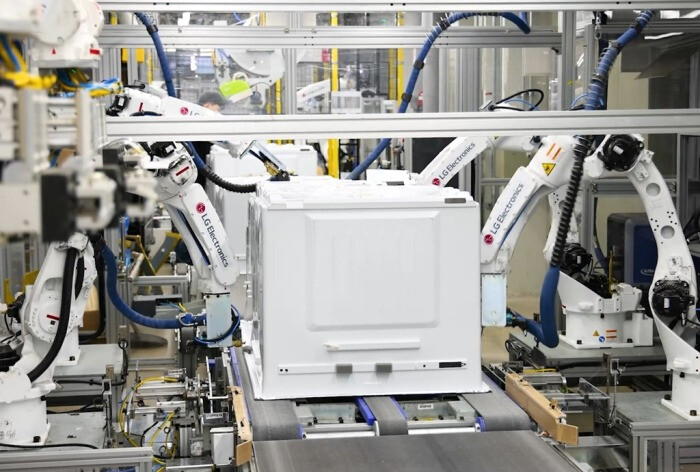
SEOUL — LG Electronics is aggressively pivoting its Smart Factory business model, moving beyond traditional manufacturing to conquer the logistics sector. By integrating "Physical AI"—the union of sophisticated software with robotic hardware—the South Korean tech giant aims to redefine global supply chain automation.
Strategic Talent Acquisition and Organizational Growth
According to industry sources on March 30, 2026, LG Electronics has launched a massive recruitment drive for its Smart Factory Solution Center. The hiring spree spans across sales, hardware (HW), and software (SW) R&D. Notably, the company is prioritizing experts with deep backgrounds in logistics, signaling a strategic shift to internalize specialized logistics technologies rather than merely diversifying its portfolio.
The Smart Factory Solution Center, established late last year under the Production Engineering Research Institute, serves as a unified hub for R&D and global sales. "We are reinforcing our workforce to expand vertical sales and R&D capabilities," an LG spokesperson stated. "This includes bringing in veterans from the logistics industry to capitalize on our growing list of contract wins."
The Power of Physical AI: From Production to Packing
LG’s competitive edge lies in its ability to port "Full-Stack" solutions—proven on its own manufacturing floors—directly into the logistics environment. Key technologies include:
Autonomous Mobile Robots (AMRs): Utilizing LG’s diverse robot lineup to automate high-labor tasks such as box picking and palletizing.
Vision AI: Minimizing errors in sorting and packaging through high-precision optical recognition.
Digital Twin Integration: Using Nvidia’s Omniverse platform, LG creates virtual replicas of logistics centers. This allows operators to simulate "what-if" scenarios, identifying bottlenecks and optimizing workflows before a single physical shelf is moved.
Surpassing Targets: Financial Momentum
The financial markets are responding positively to this expansion. Since the official launch of the Smart Factory business in 2024, LG has secured an order backlog exceeding 500 billion KRW ($370M USD) as of late 2025, shattering its initial target of 400 billion KRW.
The synergy is also boosting LG’s subsidiaries. Robostar, an industrial robot manufacturer under LG, saw its sales to the parent company triple last year, jumping from 8.1 billion KRW to 23.7 billion KRW. This internal demand reflects LG’s heavy investment in articulated and orthogonal robots required for complex automated systems.
Real-World Application: The Shinsegae Duty Free Project
A landmark project currently underway is the AI-based intelligent logistics system for Shinsegae Duty Free. LG is developing a comprehensive optimization system that links real-time data across the entire lifecycle of an order—from warehousing and inspection to picking and shipping.
Future Outlook: Semiconductors and Bio-Tech
The logistics push is only the beginning. Industry analysts suggest that LG is positioning itself as a universal solution provider for "mission-critical" industries.
"LG is transplanting the DNA of precision manufacturing into the logistics market," noted one industry expert. "Their ability to manage hardware and software in unison makes them a formidable competitor against traditional logistics firms."
Looking ahead, LG Electronics plans to expand its Smart Factory solutions into high-growth sectors including semiconductors, biotechnology, and pharmaceuticals, where precision and automation are non-negotiable.
[Copyright (c) Global Economic Times. All Rights Reserved.]