![[등록] 2026-09-01 15:48:31](/support/_updata/banner2/tl181982910_6749.png)


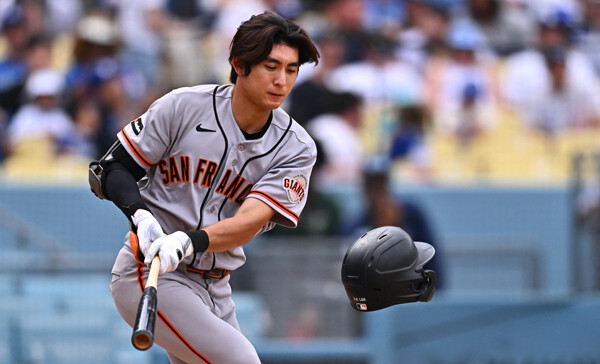
San Francisco Giants outfielder Lee Jung-hoo's 2026 season has come to an end earlier than expected.
On the 22nd (Korean time), the San Francisco club placed Lee on the 10-day injured list due to a groin contusion. Lee was substituted during an away game against the Los Angeles Dodgers at Dodger Stadium the previous day after being hit in the groin by his own batted ball. Medical examinations diagnosed him with a contusion requiring rest. With San Francisco's postseason hopes already dashed and only six regular-season games remaining, Lee's season has officially concluded.
In the 2026 season, Lee appeared in 143 games, recording a batting average of .276 with 10 home runs, 57 RBIs, 65 runs scored, 12 stolen bases, and an OPS of .724. His batting average, home runs, RBIs, and stolen bases are all personal bests since his debut in Major League Baseball in 2024. Looking strictly at cumulative stats, there are clear signs of improvement. In particular, by recording 10 home runs and 12 stolen bases simultaneously, he showed a more aggressive approach in power and baserunning than before.
However, a closer look at the entire season tells a different story, as Lee's 2026 campaign resembled a roller coaster.
The period that generated the highest expectations was June. Around mid-season, his hitting rhythm improved, sending his OPS soaring into the mid-.800s and his weighted runs created plus (wRC+) up to the 130 range. Displaying league-leading offensive production, he even found himself contending for the batting title.
Yet, his upward momentum did not last. As the second half of the season unfolded, his offensive productivity dropped, and the batting average he had built up in the early and middle parts of the season gradually chipped away. He ultimately finished the season with a .276 batting average. While current records place him 17th in the National League in batting average, it is certainly a disappointing outcome compared to what was once expected.
Detailed metrics also reveal ongoing concerns. Lee's wRC+ for the 2026 season sits at 101, with an fWAR of 0.9 and a bWAR of 1.1. Although he recorded offensive production close to the league average, his overall value—combining offense, defense, and baserunning—fell short of expectations. In particular, the fact that both his wRC+ and WAR dropped from the previous year is difficult to evaluate solely in a positive light.
The most glaring weakness lies in walks. Lee drew 29 walks across 579 plate appearances this season, resulting in a BB% of 5.0%. While he was never regarded as a hitter whose primary strength is drawing walks, the fact that this figure dropped further from last year's 7.6% is a clear area for improvement. Due to a decrease in walks relative to his hit-production ability, his on-base percentage remained limited at .320.
Power was also far from expectations. Although he set a new personal best with 10 home runs, his slugging percentage hovered at .404. Consequently, his OPS—the sum of his on-base and slugging percentages—stood at .724, which is actually lower than the .735 he recorded last year. This is why his overall offensive productivity cannot be seen as improved, despite surface-level improvements in numbers like home runs and RBIs.
In baserunning, despite setting a personal best with 12 stolen bases, his BsR (Baserunning Runs) metric dropped to 0.7 from last year's 3.5. Furthermore, analyses indicate that his pure sprint speed has declined compared to his first two seasons, bringing him closer to the MLB average.
The biggest issue remains defense. Lee primarily played right field this season while also seeing some time in center field, but he failed to receive favorable marks for his defensive contribution. His Outs Above Average (OAA) stood at -6, Defensive Runs Saved (DRS) at -6, and Field-Value (FRV) at -7.
Analysts note that with his offense failing to provide a definitive edge, combined with below-average defensive evaluations, his overall player value ultimately took a hit.
Above all, considering that this is his third year in Major League Baseball and the significant role San Francisco expects him to play within the team, the outcome is undeniably disappointing.
Lee is a high-salaried player earning an increased salary of approximately $22.83 million (approx. 34.5 billion won) compared to last year. He still has three years remaining on his contract. Without a rebound in advanced hitting metrics and defensive performance, he will inevitably have to spend the remainder of his contract carrying the heavy burden of his price tag.
[Copyright (c) Global Economic Times. All Rights Reserved.]