![[등록] 2026-09-01 15:48:31](/support/_updata/banner2/tl181982910_6749.png)


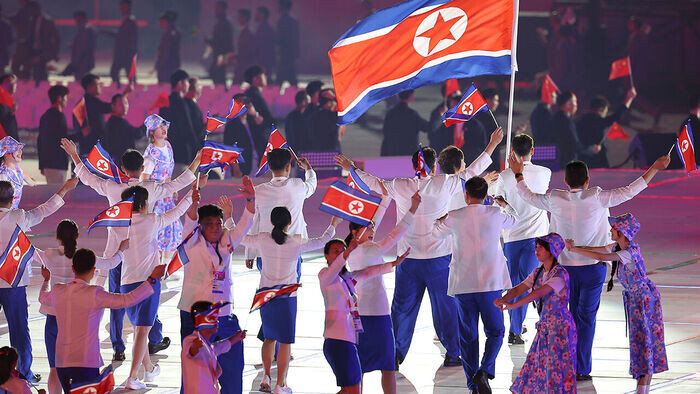
North Korea, which finished 10th overall at the 2022 Hangzhou Asian Games, is struggling to make its presence felt at the 2026 Aichi-Nagoya Asian Games. Amid a sluggish performance in the early stages of the competition, reports have now emerged that two members of the North Korean delegation are exploring ways to stay in Japan rather than return home.
North Korea dispatched a delegation of about 180 people, including athletes and officials, to the 20th Aichi-Nagoya Asian Games, which opened on the 19th. Among them are 107 athletes competing in 14 sports, including men's and women's football, weightlifting, and wrestling.
Judging by its scale alone, North Korea’s commitment to this tournament was not small. However, the early scoreboard falls short of expectations.
Three years ago at the Hangzhou Games, North Korea won 11 gold, 18 silver, and 10 bronze medals, placing 10th overall. In contrast, the team had no medal news until the first medal came from weightlifting on the 22nd.
However, it is still too early to conclude that this represents a general decline in North Korea's athletic performance. This is because the schedules for events in which North Korea traditionally shows strength have not yet fully begun.
In fact, the early medal race in this tournament has centered around swimming and other sports, which are not areas where North Korea's primary athletes are concentrated. North Korea's true competitive edge in medals will only become apparent once weightlifting, wrestling, and other sports it pins its hopes on enter their full schedules.
Even so, the disruption in shooting was a painful blow. North Korea did not compete in the women's 10m air rifle individual and team events held at the Aichi Prefectural Shooting Range in Japan on the 20th. Park Hyun-kyung, Ri Su-rim, and Kim Hyun-sook were originally scheduled to compete in the individual event, but no North Korean athletes appeared at the venue.
The reason was a prior approval issue from the Japanese government regarding the use of firearms and ammunition. An official from the competition's organizing committee explained that North Korea's participation was uncertain because it had failed to obtain the necessary prior approval to use ammunition. It has not been specifically confirmed whether North Korea actually failed to follow the approval process or if the Japanese side rejected the application.
For North Korea, shooting is not just another sport; it is a traditional powerhouse event that has yielded 41 gold medals in Asian Games history alone. Although six male and female athletes were dispatched to this event, they missed the opportunity to secure medals by failing to compete from their very first match.
The fact that weightlifting remains is a relief for North Korea. Weightlifting, which starts on the 23rd, features athletes with whom North Korea has consistently shown strength in the Asian Games. In fact, Ri Song-gum became the protagonist of North Korea's first medal by setting a world record in the 49kg division.
Trouble is also brewing outside the stadium.
According to Monthly Chosun, two members of the North Korean delegation have expressed their intention not to return to North Korea and are reportedly exploring asylum in Japan. However, the identities or ranks of the two individuals within the delegation have not been disclosed.
If this report is confirmed to be true, it could become a highly sensitive issue for North Korea. Especially given that international sports competitions are rare opportunities for North Korean athletes and officials to directly experience the outside world, the very possibility of delegation members refusing to return could create considerable repercussions.
North Korea is also facing the possibility of contact with Japan through this tournament. The Japanese government maintains independent sanctions against North Korea due to its nuclear and missile development, restricting the entry of North Korean nationals as a principle, but exceptionally permitted entry to participants of this tournament. Reports have also emerged that the Japanese side attempted contact for North-Japan exchanges.
The fact that the North Korean delegation visited Japan is significant in itself. Such a large-scale visit to Japan by North Korea is its first in 41 years since the 1985 Kobe Summer Universiade, giving this tournament no small symbolic meaning.
Nevertheless, amidst poor early results and news of some delegation members exploring asylum, the atmosphere remains unsettled.
[Copyright (c) Global Economic Times. All Rights Reserved.]