![[등록] 2026-09-01 15:48:31](/support/_updata/banner2/tl181982910_6749.png)


(C) Carlist
In a year marked by economic uncertainty, the world’s leading food delivery platforms have defied market expectations by reporting stellar financial results for the 2025 fiscal year. Industry analysts point to the aggressive expansion of subscription-based memberships and the diversification into "Quick-Commerce" (Q-commerce) as the primary catalysts driving this unprecedented growth.
Record-Breaking Performance Across the Globe
According to industry data released on March 15, 2026, DoorDash, the top player in the U.S. market, saw its Gross Order Value (GOV) surge to $102.02 billion, a 27% increase year-on-year. The company’s revenue rose by approximately 28% to $13.72 billion, while its adjusted EBITDA (Earnings Before Interest, Taxes, Depreciation, and Amortization) skyrocketed by 55.4% to reach $1.25 billion.
This metric is particularly significant as adjusted EBITDA filters out one-time costs and stock-based compensation, thereby validating the core operational efficiency and cash-generating prowess of DoorDash. The company's Monthly Active Users (MAU) reached a milestone of 56 million, up from 42 million just a year prior.
Similarly, Uber reported robust figures in its delivery segment. Uber Eats recorded a GOV of $90.86 billion, up 21.8%, with its delivery revenue growing by 25.4% to $17.25 billion. The segment's adjusted EBITDA saw a staggering 44.6% increase, reaching $3.57 billion.
The Synergy of Subscriptions and Q-Commerce
The "Holy Grail" of last year's success appears to be the high "stickiness" of subscription models. DoorDash’s combined subscription base—including DashPass and Wolt+—swelled from 22 million to 35 million members. Uber’s "Uber One" membership also saw a 55% jump, reaching 46 million subscribers.
These memberships do more than just ensure recurring revenue; they serve as a bridge to the Q-commerce sector, which includes groceries and retail items. For DoorDash, more than 30% of its MAUs are now utilizing the grocery and retail categories. Uber has mirrored this strategy by strengthening strategic partnerships with retailers like Shopify and OpenTable to bolster its grocery delivery division.
Expansion in Southeast Asia and Europe
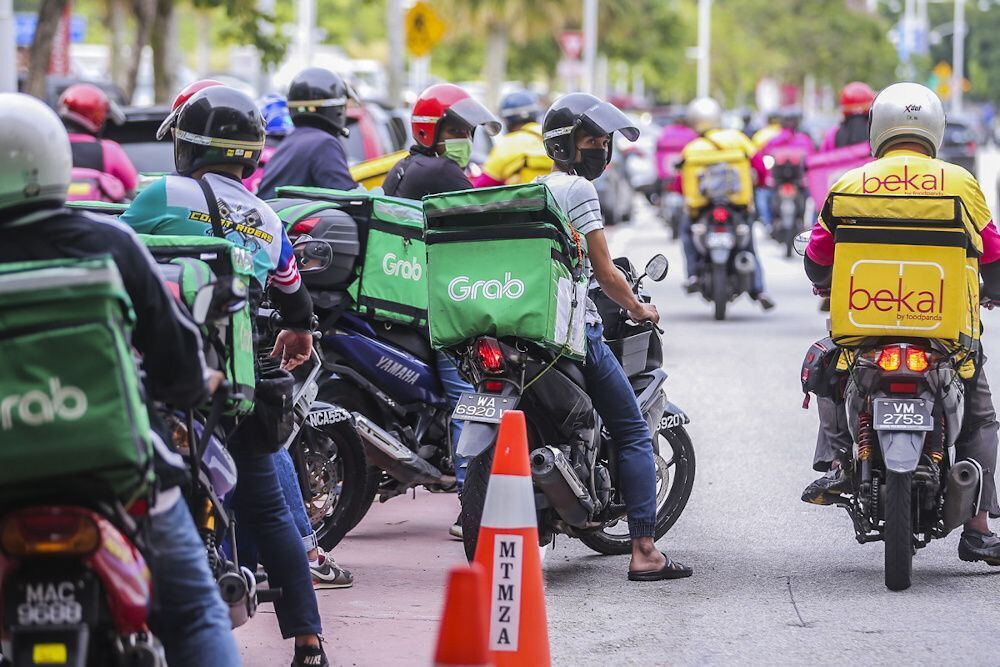
The trend is not confined to the West. Grab, the dominant force in Southeast Asia, reported a 21% increase in its delivery GOV to $14.24 billion. Its Q-commerce arm, "GrabMart," outpaced traditional food delivery in growth by 1.7 times, with higher average order values. Notably, users of its "GrabUnlimited" subscription accounted for 35% of the total delivery GOV, underscoring the vital role of loyal members.
Delivery Hero (DH), the parent company of South Korea’s Baedal Minjok, also maintained upward momentum. The group’s revenue rose nearly 20% to $18.05 billion. DH’s growth was particularly pronounced in the health and beauty category (up 54%) and groceries (up 43%). Its subsidiary, Talabat, noted that "Talabat Pro" subscribers ordered 28% more frequently than non-subscribers, proving that loyalty programs are the bedrock of high-frequency consumption.
Implications for the Korean Market
As global giants transition from mere food delivery apps to "everything delivery" platforms, the competition in the South Korean market is intensifying. Leaders such as Baedal Minjok and Coupang Eats are rapidly expanding their Q-commerce footprints to secure dominance.
Industry experts suggest that the next frontier for these platforms will be further 외연 (outward expansion) into diverse retail sectors. "The data clearly shows that once a user is locked into a subscription, their willingness to purchase non-food items through the same app increases significantly," said one industry consultant. "We are witnessing the evolution of delivery apps into comprehensive commerce ecosystems."
As delivery platforms continue to diversify their portfolios and refine their subscription benefits, the boundary between traditional e-commerce and instant delivery is expected to blur even further in 2026.
[Copyright (c) Global Economic Times. All Rights Reserved.]