• 2026.11.23 (Mon)
  • All articles
  • LOGIN
  • JOIN
Global Economic Times
한인동포뉴스(상단)
  • Synthesis
  • World
  • Business
  • Industry
  • ICT
  • Distribution Economy
  • Well+Being
    • Pet Life
    • Halal Horizon
  • Travel
  • Eco-News
  • Education
  • Korean Wave News
  • Opinion
  • Arts&Culture
  • Sports
  • People & Life
    • International Student Report
    • With Ambassador
  • Column
    • Cho Kijo Column
    • Cherry Garden Story
    • Ko Yong-chul Column
    • Kim Bong-seon's Photo Column
    • Kim Seul-Ong Column
    • Lee Yeon-sil Column
    • Professor Lee Soo-young’s Life Essays
  • Photo News
  • New Book Guide
MENU
 
Home > Business

South Korea Leads OECD in Gender Pay Disparity Despite Gradual Progress

Hee Chan Kim Reporter / Updated : 2026-11-23 07:30:17
  • -
  • +
  • Print

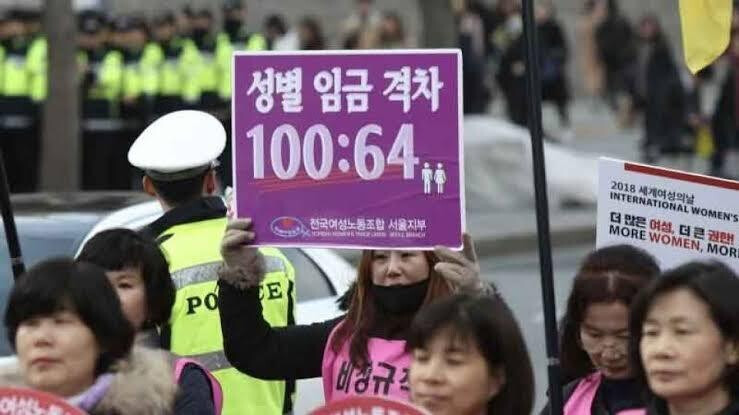
SEOUL — South Korea continues to record the widest gender pay gap among developed nations, underscoring deep-seated structural inequalities in its labor market alongside persistent income polarization, recent international data shows.

According to figures released by the Organisation for Economic Co-operation and Development (OECD) on the 23rd, South Korean women earned 27.8% less than their male counterparts last year—translating to roughly 72 cents for every dollar made by a man. Among the 13 member economies with available data for the period, South Korea topped the list, outpacing runner-up Japan (20.1%) by 7.7 percentage points and sitting well above the United States (17.9%). Colombia posted the narrowest disparity at 2.6%.

While the country has held the top spot in the OECD for gender wage inequality since 2000, long-term metrics indicate slow improvement. The gap has compressed by nearly 10 percentage points over the past decade, falling from 37.2% in 2015 to 31.5% in 2020, and dipping from 29.0% to 27.8% over the past year alone.

Labor analysts point out that rising female labor participation—particularly among married women—has not translated into equitable pay due to disparities in job quality. Women who step away from the workforce for childbirth and child-rearing frequently face steep barriers when attempting to return to high-paying, stable positions, leaving many concentrated in lower-wage roles.

A Dual-Track Labor Market

Inequality in South Korea’s workforce extends beyond gender lines to overall income distribution. OECD data indicates that the earnings threshold for the top 10% of South Korean workers was 3.62 times higher than that of the bottom 10% last year. That placed South Korea third among the 13 surveyed nations, trailing only the United States and Colombia (both at 4.69), and far wider than Sweden’s ratio of 2.20.

Although this overall wage gap narrowed between 2015 (4.59) and 2019 (3.63), progress has largely stalled over the past several years. Economists attribute this stagnation to a rigid, two-tiered corporate ecosystem characterized by a stark divide in compensation and benefits between major conglomerates and smaller firms. Furthermore, limited labor mobility means workers who miss out on top-tier positions early in their careers rarely gain entry later on.

Outlook and Policy Calls

Looking ahead, experts warn that the pay divide could expand again in the near term.

Kim Kwang-seok, director of economic research at the Institute for Korean Economy and Industry, noted that hefty performance bonuses handed out by major semiconductor conglomerates in 2026 will likely skew the numbers further once reflected in upcoming statistics. To reverse the trend, Kim emphasized the need for targeted government policies aimed at improving working conditions at small and medium-sized enterprises and bridging the structural divide in job quality.

[Copyright (c) Global Economic Times. All Rights Reserved.]

  • #Cherry Garden
  • #HalalFood
  • #Halal
  • #Petlife
  • #Halalhorizone
  • #Hormuz Impasse
  • #Joseon
  • #globaleconomictimes
  • #micore
Hee Chan Kim Reporter

Popular articles

  • Andong Launches Inaugural Heritage Film Festival to Blend Local Culture with CinemaA nine-day celebration kicks off on November 7, featuring independent films, cultural exhibitions, and policy forums.

  • Trade Commission to Impose Up to 33.67% Anti-Dumping Duties on Chinese Galvanized Cold-Rolled Steel

  • How about a World Heritage Kimchi-making trip this weekend? The Pyeongchang Alpine Kimchi Festival runs until November 16.

I like it
Share
  • Facebook
  • X
  • Kakaotalk
  • LINE
  • BAND
  • NAVER
  • https://globaleconomictimes.kr/article/1065565760300523 Copy URL copied.
Comments >

Comments 0

Weekly Hot Issue

  • South Korean Small Businesses Brace for Winter Crunch as Rate Hikes Meet Weak Consumption
  • Offline AI Raises New Cheating Alarms Ahead of Next Year’s College Entrance Exam
  • Seongbuk District Accelerates Urban Renewal and Transit Projects Following Presidential Visit
  • Massive Cyberattack on South Korea’s State Utility Exposes Data of 1.52 Million People
  • South Korea’s Small Businesses Face a Double Squeeze as Borrowing Costs Climb and Spending Stalls
  • South Korea Readies Market Stabilization Fund to Ward Off ‘Black Monday’ Panic

Most Viewed

1
South Korea and Ethiopia Sign Trilateral MOU to Introduce Liquid-Based Cytology (LBC) Technology for Cervical Cancer Diagnosis
2
South Korean Burger Chain Lotteria Expands Singapore Footprint with Halal Certification and New Teriyaki Lineup
3
AI Semiconductor Stocks Plummet: Philadelphia Index Drops 5.28% and Micron Plunges 7.59% Amid Executive Shakeup and Export Restrictions
4
"Stay Out, Get Paid, or Have Police Stay With You": Shenzhen Imposes Strict Security Ahead of APEC Summit
5
AI Music Tops Melon Chart: Is the K-Pop Production Formula Changing?
체리가든 스토리
nutri huevos
로타리
동포저널

Hot Issue

Delta Air Lines Experiences Nationwide Flight Delays Following Automated System Glitch

Mexican Forces Capture Wanted Cartel Boss ‘El Chapo Isidro’ in Deadly Sinaloa Raid

UN Talks on Binding ‘Killer Robot’ Treaty Collapse Amid Pushback from Major Military Powers

Fashion Runway Show 2026

Let’s recycle the old blankets in Jeju Island’s closet instead of incinerating them.

Global Economic Times
korocamia@naver.com
CEO : LEE YEON-SIL
Publisher & Editor : KO YONG-CHUL
Registration number : Seoul, A55681
Registration Date : 2024-10-24
Youth Protection Manager: KO YONG-CHUL
Singapore Headquarters
5A Woodlands Road #11-34 The Tennery. S'677728
Korean Branch
Phone : +82(0)10 4724 5264
#304, 6 Nonhyeon-ro 111-gil, Gangnam-gu, Seoul
Copyright © Global Economic Times All Rights Reserved
  • News K
  • 반달곰 프로젝트
  • 광고문의
Search
Category
  • All articles
  • Synthesis
  • World
  • Business
  • Industry
  • ICT
  • Distribution Economy
  • Well+Being 
    • 전체
    • Pet Life
    • Halal Horizon
  • Travel
  • Eco-News
  • Education
  • Korean Wave News
  • Opinion
  • Arts&Culture
  • Sports
  • People & Life 
    • 전체
    • International Student Report
    • With Ambassador
  • Column 
    • 전체
    • Cho Kijo Column
    • Cherry Garden Story
    • Ko Yong-chul Column
    • Kim Bong-seon's Photo Column
    • Kim Seul-Ong Column
    • Lee Yeon-sil Column
    • Professor Lee Soo-young’s Life Essays
  • Photo News
  • New Book Guide
  • Overseas Koreans
  • Multicultural News