• 2026.11.23 (Mon)
  • All articles
  • LOGIN
  • JOIN
Global Economic Times
한인동포뉴스(상단)
  • Synthesis
  • World
  • Business
  • Industry
  • ICT
  • Distribution Economy
  • Well+Being
    • Pet Life
    • Halal Horizon
  • Travel
  • Eco-News
  • Education
  • Korean Wave News
  • Opinion
  • Arts&Culture
  • Sports
  • People & Life
    • International Student Report
    • With Ambassador
  • Column
    • Cho Kijo Column
    • Cherry Garden Story
    • Ko Yong-chul Column
    • Kim Bong-seon's Photo Column
    • Kim Seul-Ong Column
    • Lee Yeon-sil Column
    • Professor Lee Soo-young’s Life Essays
  • Photo News
  • New Book Guide
MENU
 
Home > ICT

Offline AI Raises New Cheating Alarms Ahead of Next Year’s College Entrance Exam

Global Economic Times Reporter / Updated : 2026-11-23 07:32:42
  • -
  • +
  • Print


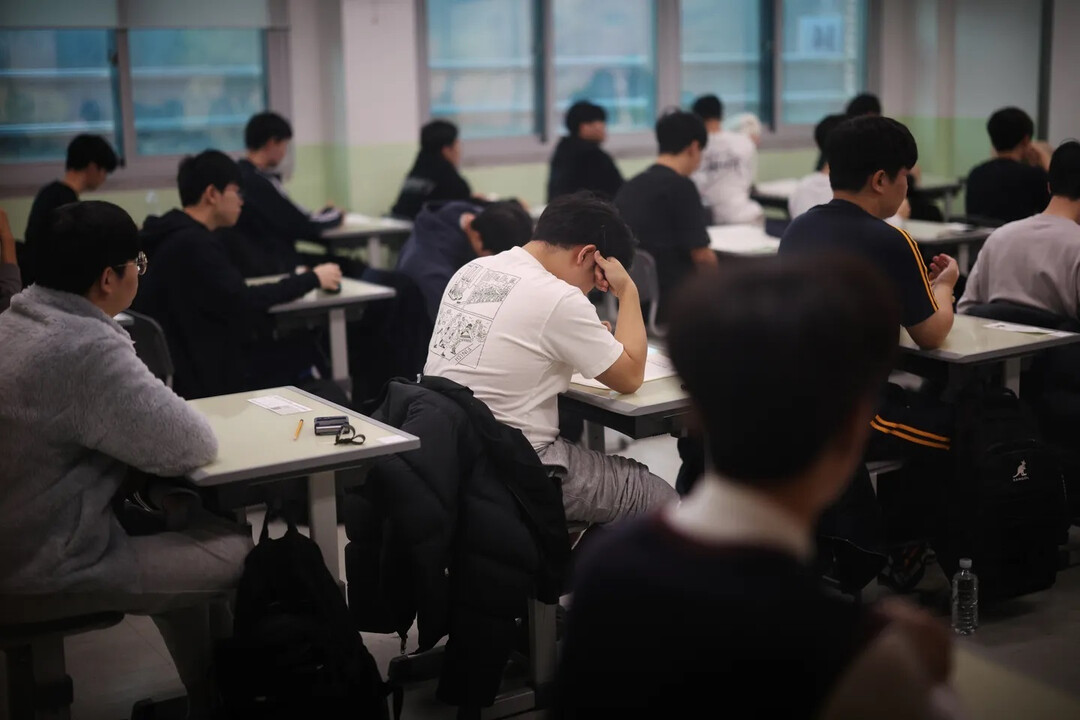
As on-device artificial intelligence rapidly advances, South Korean education authorities face a growing threat: high-tech exam cheating that requires no internet connection and leaves no digital footprint.

Following the recent 2027 College Scholastic Ability Test (CSAT), experts warn that future attempts at academic dishonesty using smart devices could become significantly harder to detect. Unlike cloud-based AI, which relies on external servers and wireless signals, on-device AI processes data locally within the hardware itself—rendering traditional radio-frequency detectors and server-log investigations largely ineffective.

The urgency of the issue was underscored on November 22 by results from the private evaluation project "KSAT AI Benchmark." Five leading models—including GPT-6.2 Sol and Astra, Claude Fable 5.2, and Gemini 4 Neon and Carbon—achieved perfect scores across the Korean, English, and Mathematics sections of this year's exam, completing each test in just 7 to 19 minutes. Even freely accessible models showed formidable capabilities, with Moonshot AI’s Kimi scoring 100% in English and Alibaba’s Qwen acing both Math and English.

While these top-tier models currently run on massive cloud infrastructure, the gap between cloud AI and local hardware is closing fast. According to research institute Epoch AI, models capable of running on a single high-end gaming PC now match the performance of frontier AI systems from just six to twelve months ago. This trajectory suggests that today's test-acing intelligence could run offline on personal devices within a year.

Compact models optimized for mobile devices are already showing sharp gains. Google’s lightweight "Gemma 4 E4B" recently scored 59.5% on image-based math problems, outperforming its much larger predecessor, "Gemma 3 27B" (46.0%). For test-takers, this means a disconnected smartphone could potentially photograph an exam sheet and solve problems locally.

The miniaturization of AI hardware further complicates enforcement. Last year, Qualcomm unveiled a specialized chip for smart glasses that shrinks the component size by 26%, allowing AI models to run directly inside the eyewear without tethering to a smartphone. Combined with more capable compact models, a single pair of glasses could soon capture, process, and answer exam questions entirely offline.

"General-purpose on-device AI still has limitations, but fine-tuning it for specific subjects or test formats changes the equation entirely," said Kim Myung-joo, head of the AI Safety Institute. "Even if an AI doesn't get a perfect score, the ability to solve just a few extra questions provides a strong incentive to cheat."

This technological shift exposes critical blind spots in the government's proposed countermeasures. Authorities have considered deploying radio-frequency scanners to catch Bluetooth or Wi-Fi signals emitted by smart glasses. However, offline devices emit no wireless signals to intercept. While thermal imaging to detect device heat has been floated as an alternative, spotting small gadgets concealed beneath clothing remains a major hurdle.

Post-exam audits face similar roadblocks. Plans to collaborate with global AI developers to track usage logs during exam hours rely on queries passing through company servers. When processing occurs locally, no server logs are generated. Furthermore, downloadable open-weight models—such as certain versions of Qwen—cannot be remotely monitored or disabled during test hours, even by their creators.

"Right now, there is no clear countermeasure against on-device AI other than physically locating the device," Kim warned, noting the risk of organized cheating rings exploiting the technology. "Authorities must look beyond technical crackdowns and fundamentally redesign how exams are administered."

[Copyright (c) Global Economic Times. All Rights Reserved.]

  • #Cherry Garden
  • #HalalFood
  • #Halal
  • #Petlife
  • #Halalhorizone
  • #Hormuz Impasse
  • #Joseon
  • #globaleconomictimes
  • #micore
Global Economic Times Reporter
Reporter Page

Popular articles

  • World Citizens are Flying Directly to Busan... The Era of 4 Million Foreigners is Just Around the Corner

  • Restoring Hearing with Genes, Cochlear Implants with Robots: Where Does Hearing Loss Treatment Stand Today?

  • Cold Wave and Autumn Chill Hit Korea on "Ipdong": Gangwon -6°C, Seoul Real-Feel -4°C… Rain and Snow Expected in Central Regions on Sunday

I like it
Share
  • Facebook
  • X
  • Kakaotalk
  • LINE
  • BAND
  • NAVER
  • https://globaleconomictimes.kr/article/1065565876851765 Copy URL copied.
Comments >

Comments 0

Weekly Hot Issue

  • South Korean Small Businesses Brace for Winter Crunch as Rate Hikes Meet Weak Consumption
  • South Korea Leads OECD in Gender Pay Disparity Despite Gradual Progress
  • Seongbuk District Accelerates Urban Renewal and Transit Projects Following Presidential Visit
  • Massive Cyberattack on South Korea’s State Utility Exposes Data of 1.52 Million People
  • South Korea’s Small Businesses Face a Double Squeeze as Borrowing Costs Climb and Spending Stalls
  • South Korea Readies Market Stabilization Fund to Ward Off ‘Black Monday’ Panic

Most Viewed

1
South Korea and Ethiopia Sign Trilateral MOU to Introduce Liquid-Based Cytology (LBC) Technology for Cervical Cancer Diagnosis
2
South Korean Burger Chain Lotteria Expands Singapore Footprint with Halal Certification and New Teriyaki Lineup
3
AI Semiconductor Stocks Plummet: Philadelphia Index Drops 5.28% and Micron Plunges 7.59% Amid Executive Shakeup and Export Restrictions
4
"Stay Out, Get Paid, or Have Police Stay With You": Shenzhen Imposes Strict Security Ahead of APEC Summit
5
AI Music Tops Melon Chart: Is the K-Pop Production Formula Changing?
체리가든 스토리
nutri huevos
로타리
동포저널

Hot Issue

Delta Air Lines Experiences Nationwide Flight Delays Following Automated System Glitch

Mexican Forces Capture Wanted Cartel Boss ‘El Chapo Isidro’ in Deadly Sinaloa Raid

UN Talks on Binding ‘Killer Robot’ Treaty Collapse Amid Pushback from Major Military Powers

Fashion Runway Show 2026

Let’s recycle the old blankets in Jeju Island’s closet instead of incinerating them.

Global Economic Times
korocamia@naver.com
CEO : LEE YEON-SIL
Publisher & Editor : KO YONG-CHUL
Registration number : Seoul, A55681
Registration Date : 2024-10-24
Youth Protection Manager: KO YONG-CHUL
Singapore Headquarters
5A Woodlands Road #11-34 The Tennery. S'677728
Korean Branch
Phone : +82(0)10 4724 5264
#304, 6 Nonhyeon-ro 111-gil, Gangnam-gu, Seoul
Copyright © Global Economic Times All Rights Reserved
  • News K
  • 반달곰 프로젝트
  • 광고문의
Search
Category
  • All articles
  • Synthesis
  • World
  • Business
  • Industry
  • ICT
  • Distribution Economy
  • Well+Being 
    • 전체
    • Pet Life
    • Halal Horizon
  • Travel
  • Eco-News
  • Education
  • Korean Wave News
  • Opinion
  • Arts&Culture
  • Sports
  • People & Life 
    • 전체
    • International Student Report
    • With Ambassador
  • Column 
    • 전체
    • Cho Kijo Column
    • Cherry Garden Story
    • Ko Yong-chul Column
    • Kim Bong-seon's Photo Column
    • Kim Seul-Ong Column
    • Lee Yeon-sil Column
    • Professor Lee Soo-young’s Life Essays
  • Photo News
  • New Book Guide
  • Overseas Koreans
  • Multicultural News