• 2026.06.06 (Sat)
  • All articles
  • LOGIN
  • JOIN
Global Economic Times
fashionrunwayshow2026
  • Synthesis
  • World
  • Business
  • Industry
  • ICT
  • Distribution Economy
  • Well+Being
  • Travel
  • Eco-News
  • Education
  • Korean Wave News
  • Opinion
  • Arts&Culture
  • Sports
  • People & Life
    • International Student Report
    • With Ambassador
  • Column
    • Cho Kijo Column
    • Cherry Garden Story
    • Ko Yong-chul Column
    • Kim Seul-Ong Column
    • Lee Yeon-sil Column
  • Photo News
  • New Book Guide
MENU
 
Home > Synthesis

South Korea Faces Seaweed Glut, Considers Contract Farming

Desk / Updated : 2025-02-13 07:21:37
  • -
  • +
  • Print

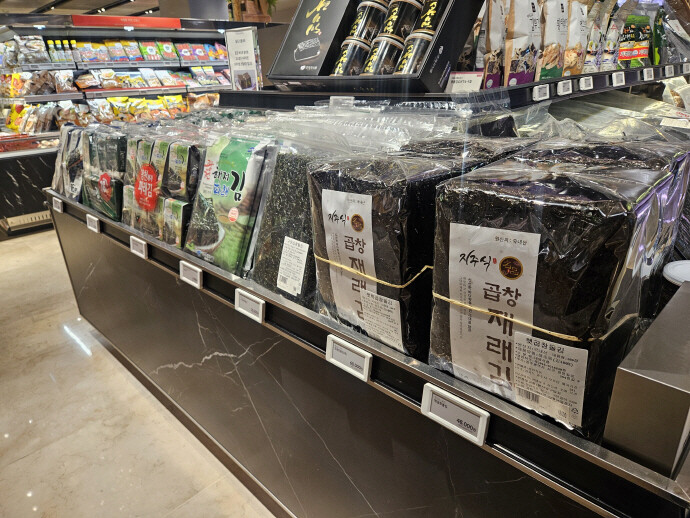
Seoul – South Korea is grappling with a significant overproduction of mulgim, the raw material for seaweed (gim), leading to thousands of tons being discarded. Last month alone, nearly 6,000 tons of mulgim were thrown away due to a supply glut, according to the National Federation of Fisheries Cooperatives.

The overproduction is attributed to several factors, including favorable weather conditions for seaweed growth, new aquaculture farm permits issued by the Ministry of Oceans and Fisheries, and illegal mulgim farming practices. This has resulted in a surplus of mulgim that far exceeds the demand from seaweed processing companies.

"As the supply of mulgim exceeds the demand of seaweed processing companies, it is being discarded without being sold at auction markets," the Ministry of Oceans and Fisheries explained.

The Korea Institute of Ocean Science and Technology reported a 17.6% increase in mulgim production in Jeonnam province last month compared to the same period last year, with even higher increases in Busan (76.9%) and Chungnam (64.9%).

The discarding of mulgim is expected to continue in the coming months, as the Korea Institute of Ocean Science and Technology forecasts further production increases in February (26.8%) and March (13.9%) compared to the previous year.

The excess supply has driven down the price of mulgim at production sites. In January, the average price of mulgim sold was 762 won per kg, a significant drop of 54.0% from the same period last year (1,655 won) and 36.0% lower than in 2023 (1,191 won). In contrast, the price of dried seaweed (gim) remains high, at 1.5 times the average level.

To address the issue, the Ministry of Oceans and Fisheries is considering a pilot program of contract farming for some mulgim aquaculture farmers in Jeonnam province. This initiative aims to reduce mulgim waste and ensure a stable supply and demand for seaweed. The ministry is currently discussing the plan with the local fisheries cooperative.

[Copyright (c) Global Economic Times. All Rights Reserved.]

  • #마른김
  • #물김
  • #globaleconomictimes
  • #글로벌이코노믹타임즈
  • #한국
  • #중기청
  • #재외동포청
  • #외교부
  • #micorea
  • #mykorea
  • #newsk
  • #nammidonganews
  • #singapor
Desk
Desk

Popular articles

  • Banking War 2.0: South Korean Banks Race to Transition into 'AI-First' Institutions

  • Celltrion’s Zymfentra Sees Explosive 300% Growth, Hits Record Quarterly Prescriptions in the U.S.

  • China’s Foundry Offensive: Chasing Samsung’s No. 2 Spot via ‘Mature Node’ Dominance

I like it
Share
  • Facebook
  • X
  • Kakaotalk
  • LINE
  • BAND
  • NAVER
  • https://globaleconomictimes.kr/article/1065565217952748 Copy URL copied.
Comments >

Comments 0

Weekly Hot Issue

  • Nvidia CEO Jensen Huang to Arrive in South Korea for "Sam-So" Meeting with Tech Tycoons
  • Samsung Electronics Super-Enterprise Union Loses Majority Status Amid Backlash Over Bonus Disparities
  • Samsung to Embed Vital Signs and Heart Health Scores in Upcoming Galaxy Watch9 Lineup
  • Apple Honors Digital Excellence: 12 Exceptional Apps and Games Celebrated at the 2026 Design Awards
  • Nexon Revamps Signature Youth Coding Competition into AI-Driven 'Nexon Young Programmers Cup'
  • Tech University of Korea Gathers 200 Game and AI Researchers to Discuss Industrial Expansion

Most Viewed

1
From a moment of collective sacrifice to a moment of collective democracy: The Timing of the Election in Ethiopia and Korea
2
U.S. Holds Off on Immediate Comprehensive Semiconductor Tariffs, but Pressure Mounts for Samsung and SK Hynix to Accelerate Domestic Investments
3
[Interview] "Halal is Not a Religious Regulation, but a 'Trust Infrastructure'… Creating a Premium 'K-Halal' Centered on Data and Platforms"
4
‘600 Million Won Bonus’ at Samsung Electronics Triggers Deep Sense of Relative Deprivation Among Korean Workers
5
Musk’s SpaceX Secures Space Hegemony with Flawless Starship V3 Recovery Ahead of Historic IPO
광고문의
임시1
임시3
임시2

Hot Issue

Murata Unveils Next-Gen Resin Electrode MLCC for Automotive Applications

Samsung to Embed Vital Signs and Heart Health Scores in Upcoming Galaxy Watch9 Lineup

L&F Plus Secures KRW 220 Billion from National Growth Fund to Anchor South Korea’s First Mass LFP Cathode Production

Samsung Electronics Super-Enterprise Union Loses Majority Status Amid Backlash Over Bonus Disparities

Fashion Runway Show 2026

Global Economic Times
korocamia@naver.com
CEO : LEE YEON-SIL
Publisher : KO YONG-CHUL
Registration number : Seoul, A55681
Registration Date : 2024-10-24
Youth Protection Manager: KO YONG-CHUL
Singapore Headquarters
5A Woodlands Road #11-34 The Tennery. S'677728
Korean Branch
Phone : +82(0)10 4724 5264
#304, 6 Nonhyeon-ro 111-gil, Gangnam-gu, Seoul
Copyright © Global Economic Times All Rights Reserved
  • 에이펙2025
  • APEC2025가이드북TV
  • 반달곰 프로젝트
Search
Category
  • All articles
  • Synthesis
  • World
  • Business
  • Industry
  • ICT
  • Distribution Economy
  • Well+Being
  • Travel
  • Eco-News
  • Education
  • Korean Wave News
  • Opinion
  • Arts&Culture
  • Sports
  • People & Life 
    • 전체
    • International Student Report
    • With Ambassador
  • Column 
    • 전체
    • Cho Kijo Column
    • Cherry Garden Story
    • Ko Yong-chul Column
    • Kim Seul-Ong Column
    • Lee Yeon-sil Column
  • Photo News
  • New Book Guide
  • Multicultural News
  • Jobs & Workers